
After teaching AI to 1.5M people, founding a Silicon Valley-based marketing superagent (Juma), and helping 75K+ users across 500+ companies adopt AI for their work, here's how I think people, organizations, and corporations should and will adopt AI.
Note: Throughout this article AI refers mainly to GenAI, e.g. ChatGPT, Claude and agents like Juma, Manus, Lovable.
Key Takeaways
- 90-95% of the global population will be left behind in the AI revolution. Only 200-300 million AI-enabled workers will do most digital work within 10-15 years.
- AI agents that write code are the game-changer. The combination of conversational interfaces and code-based execution means everything automatable will be automated.
- The AI Adoption Framework has three layers: Fundament (basic literacy), Context (domain-specific knowledge), and Mastery (seamless integration).
- Domain expertise beats prompt engineering. The best "prompt engineers" are simply experts who understand what context matters for their field.
- Every successful AI adoption has an AI Champion: a dedicated owner who treats adoption as a project with clear accountability.
I've been thinking a lot about the best path to AI adoption.
How do you learn it? How do you teach it? What does it mean to adopt ChatGPT well? What is stopping teams from adopting GPT? Where is the resistance coming from? Why are people achieving such wildly different results? Why does MIT state that 95% of all AI adoption projects fail?
Most humans will be left behind
Since ChatGPT came out the world really changed. This technological leap is historically unmatched. The world economy is majorly, irreversably, and inevitably changing and technologically advanced nations and individuals will have much better outcomes in life on average.
The problem is that many people who I respect are denying or soft-denying (not using) AI. Maybe 1 in 5 of my friends use it passably well. At the same time, people at our company (Juma) have mastered AI to a point at which, they've become 10x to 100x more productive than non-AI enabled humans.
The divide is becoming bigger and bigger by the day and I don't want my friends left behind. In fact, I don't want anyone to be left behind.
But the reality is that 90-95% of human population will be left behind in some form . My approximation is that 2-5 billion people will have to adopt AI in the next 10-15 years but only 200-300 million of them + AI will be doing most of the digital work.
It should be anyone's goal to be one of those who have a job, once the AI industry matures.
People don't understand why this AI is so different and powerful
Quick Answer: AI agents represent a fundamental shift from assistive AI to autonomous execution. Unlike chatbots that answer questions, AI agents write code to execute tasks, analyze data, and complete multi-step workflows without human intervention. This combination of conversational interfaces and code-based execution means everything automatable will be automated.
'Smart people' are saying AI is the future. But even they don't know why…
So, why?
Partly it's because the whole Internet is condensed into a single model that can run on your iPhone without Internet connection.
But the more prominent and more urgent reason is: AI agents.
Not any agents but coding agents in particular.
It's becoming more and more clear that:
- conversation (chat) is the universal user experience to communicate with AI
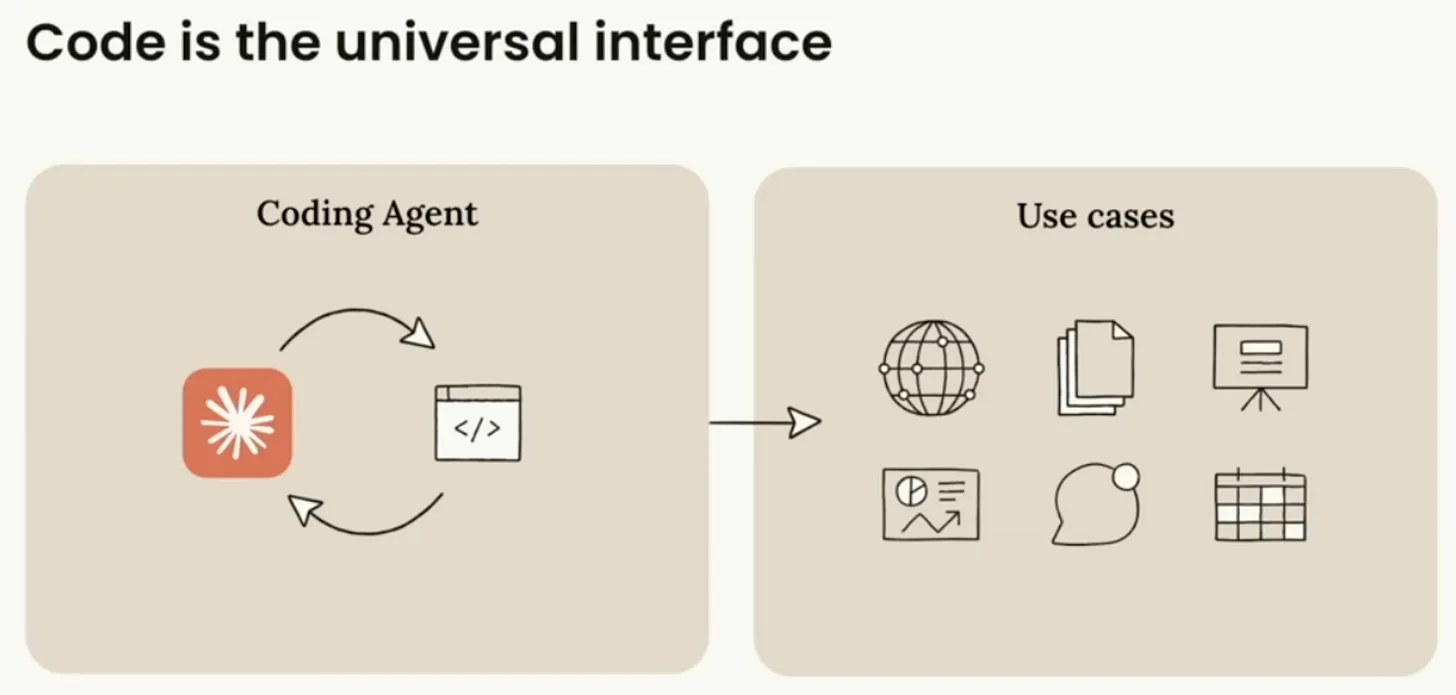
- code is the universal interface to get work done well (watch this by Anthropic)
You can dictate to an app and it can write code to create any software… on the fly. We've already seen the massive success of coding agents like Lovable and Cursor.
Since most of the work use cases can be solved by code, this is just the beginning of AI agents for business and their dominance.
Everything automatable will be automated.
But humans will still be the ones giving tasks and objectives to the AI… Right?
How to adopt AI for work?
Obviously, creating a ChatGPT account is not enough. People need to actually use it and explore its bounderies every day.
Many people create an account, stay on the free tier, and ask basic questions which Google is perfectly capable of answering.
AI can search the internet but also create images, presentations, strategize, work with documents (Word, Excel, PDF) and analyze data.
But we haven't seen anything yet. At the time of writing, we are only 3 years into 'post-ChatGPT' era and I believe that any decent developer can build 99+% of the software ever built… by prompting an AI agent. Everything is possible and as easy as explaining the problem you want solved.
The capabilities of AI are growing daily. Knowing how to use AI for business is a moving target.
- Any webinar discusses past findings
- Any workshop teaches the best practices of yesterday
- Any how-to video is old the moment it's published
Adopting AI at your organization is a mindset. Not a one-off activity.
Start by lighting the spark
We, teachers, have a saying:
Often our job is to simply light the spark in a student. It's up to them to put fuel in the fire.
As much as we want our friends, students, colleagues, compatriots to jump into adopting AI, we must begin by lighting a spark.
They need to get excited!
WOW them somehow.
e.g. get 4h of work done with a single prompt
Ensure you've WOWed each person you'll be helping adopt AI.
The AI Adoption Framework: Three Layers to Success
Quick Answer: The AI Adoption Framework consists of three hierarchical layers that build on each other. The Fundament layer establishes basic AI literacy and the "aha moment." The Context Layer involves curating domain-specific knowledge and connecting relevant data sources. The Mastery layer represents seamless integration where AI becomes an extension of human capability, enabling 10x-100x productivity gains.
Building knowledge and skills is hierarchical*.
Effective learning is about building a fundament and then stacking layers of knowledge on top of it. All else equal, the stronger the fundament, the better the outcomes.
For example, school is the fundament of everything (for people who were schooled). If you have never been to school, everything else is very hard. You build on top of school with university, then professional experience, etc. The more you stack, the higher you go up the pyramid, the more masterful you become. To adopt AI and to learn to utilize GPT-like models, we need to build a strong AI fundament.
The Pyramid of Human+AI Knowledge is a useful helper to explain The AI Adoption Methodology.
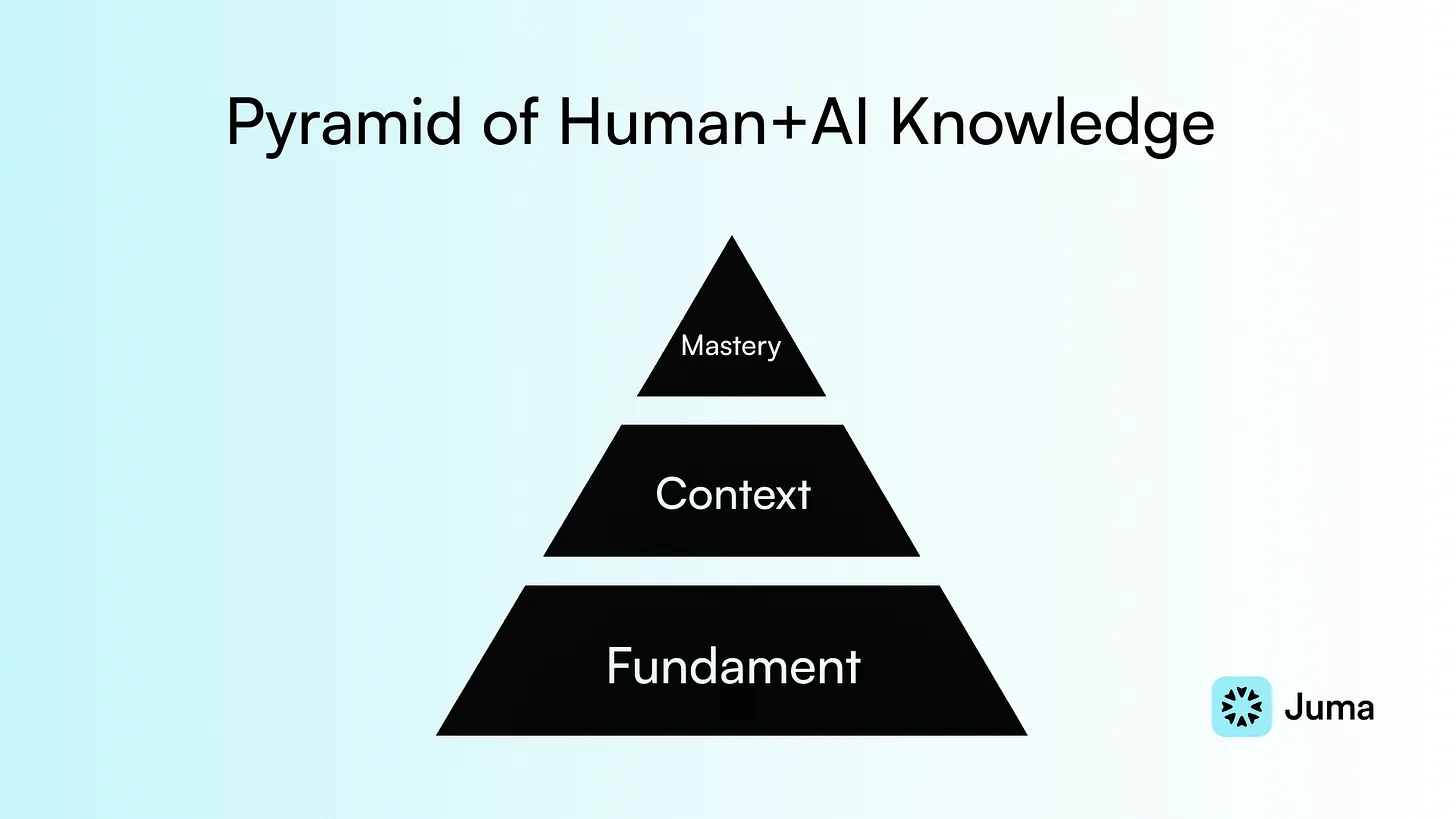
There are 3 layers:
- Fundament - Build a strong fundament and it will hold the pyramid.
- Context - Provide the relevant context to the AI: your coding repository, your Google Drive, your Sharepoint, meeting recordings, or anything else. Make it specific and relevant to your organization.
- Mastery - This is when AI is seamlessly integrated everything you do
Full AI Adoption must be = Mastery.
The Fundament
The foundational layer requires understanding AI's current capabilities and learning core prompting principles. Focus on evergreen concepts: AI works on probability (not understanding), rich context beats clever prompts, and iteration produces better results than perfect first drafts. Interactive learning where AI guides users through its own capabilities creates the most effective training.
You want your people to know how to use AI. Not how to train AI models.
Too late to train AI models
If you have not been in AI for the past many years, forget about building a career creating AI. You will be harnessing other people's AI at best. And that's alright.
It's too late to train AI models. I have been teaching people how to train these models. That was almost 10 years ago…
The people who are required to train AI models worldwide are probably < 10,000 overall. We can argue that 10-100 people are really pushing the technology forward.
It's highly probable that a single person (using AI) will drive the next big leap towards AGI (artificial general intelligence).
Forget about training AI, optimize for using it well.
The 'Aha' moment + knowing what AI can do and then prompting it well
Initially, our hypothesis was that there is a critical number of chats before you reach the 'aha' moment. The moment when you simply know that GPT is something else entirely. My guesstimate (based on the people I've helped learn) is that to 'get AI' you need 3-5-8 conversations on average, depending on the person and their own AI inclination. I'm convinced that at the 10th fruitful conversation, even the biggest sceptic shall be converted to an AI fan. This became the premise of the 'ChatGPT for Work: The Interactive Course', where we had cherry-picked 10 convos that are worth having + 100s of exercises.
Today, I think that 1 chat is enough to reach the 'aha' moment. Probably 500+ million people worldwide have had a chat like this. Yet 99%+ of them have barely scratched the surface of what's possible with AI.

ChatGPT approaching 1B weekly active users
We made an attempt to teach people how to use ChatGPT.
Althought somewhat successful, 2 years after 'ChatGPT for Work: The Interactive Course', I think we should rethink education fundamentally.
The AI industry will evolve in the folowing way.
AI Agents will:
- Have wide variety of expertise
- Be mostly a chat interface, where you prompt or dictate
- Behave like an agent (instead of assistant/chatbot), not only answering questions but also executing series of tasks. Sometimes for hours or days on end.
- Have access to many tools (in our case that's marketing specific tools, e.g. keyword research tool, post analysis tool, Google/Meta ad analysis tool, etc.)
- Access to many hidden assistants (pre-made prompts that are tried and tested: best practices), so that the user doesn't need to know them
- Have a single model, which uses different models under the hood, depending on the task
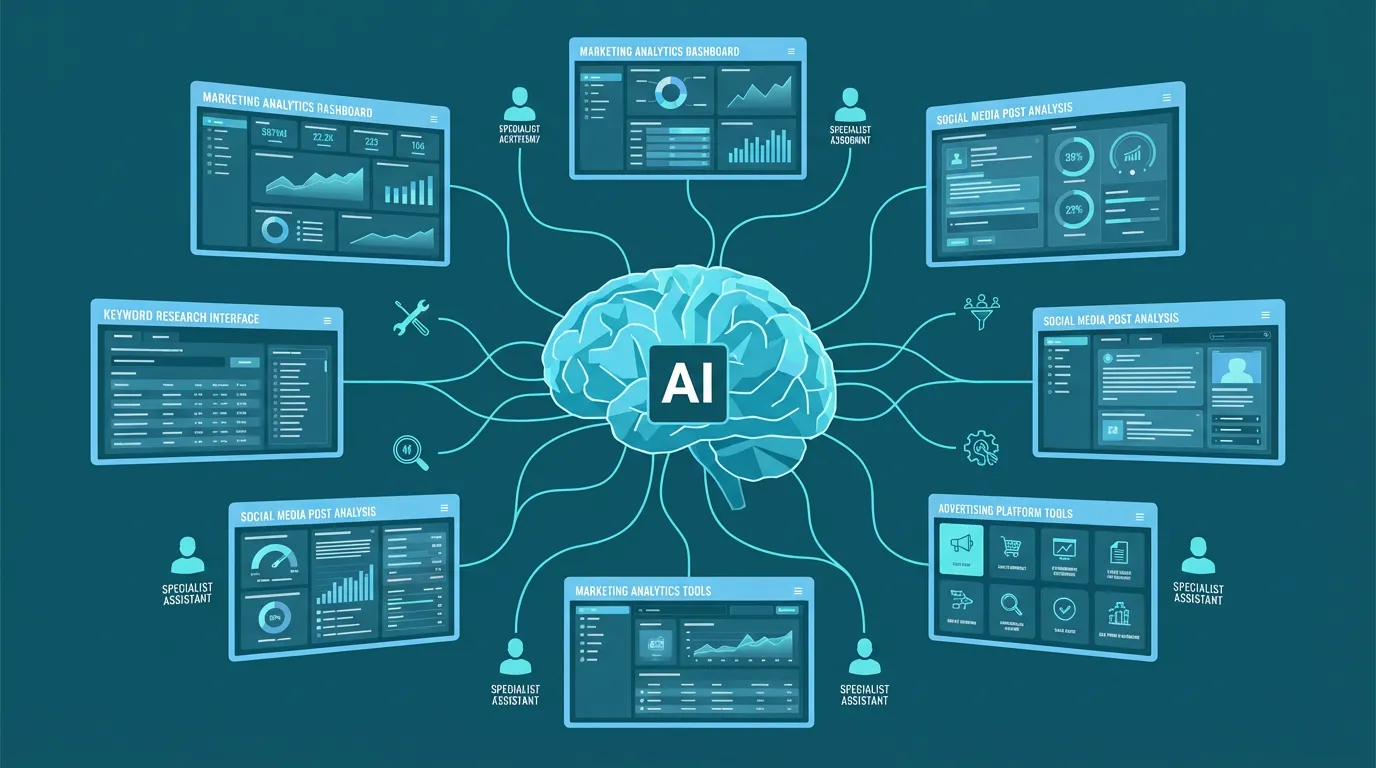
These products will be guiding the user into what's possible.
And then, they'll get it done.
You won't need to know how to do something, as long as you know what is possible today and if this particular AI can get it done.
Core concepts which probably won't change
There are only a handful of good practices that are evergreen:
- Foundational Concepts
- AI works on probability and pattern recognition, not true understanding (this limitation shapes how to use it effectively)
- Providing rich context is more valuable than clever prompt engineering tricks
- Leveraging multimodal inputs (screenshots, images, documents) as context for more effective prompting
- Core prompting fundamentals
- Providing clear task and context about it, yourself, etc.
- Asking AI clarifying questions before diving into solutions, rather than trying to craft perfect prompts from scratch
- Universal AI interaction patterns
- Working iteratively with AI through conversation rather than expecting perfect first-draft results
- Using personas/roles to quickly establish context and expertise domains with minimal text
- Prompting by example (scientifically most useful technique)
Here's one evergreen document from 'ChatGPT for Work: The Interactive Course'.
Prompting Pdf
3.73MB · PDF file
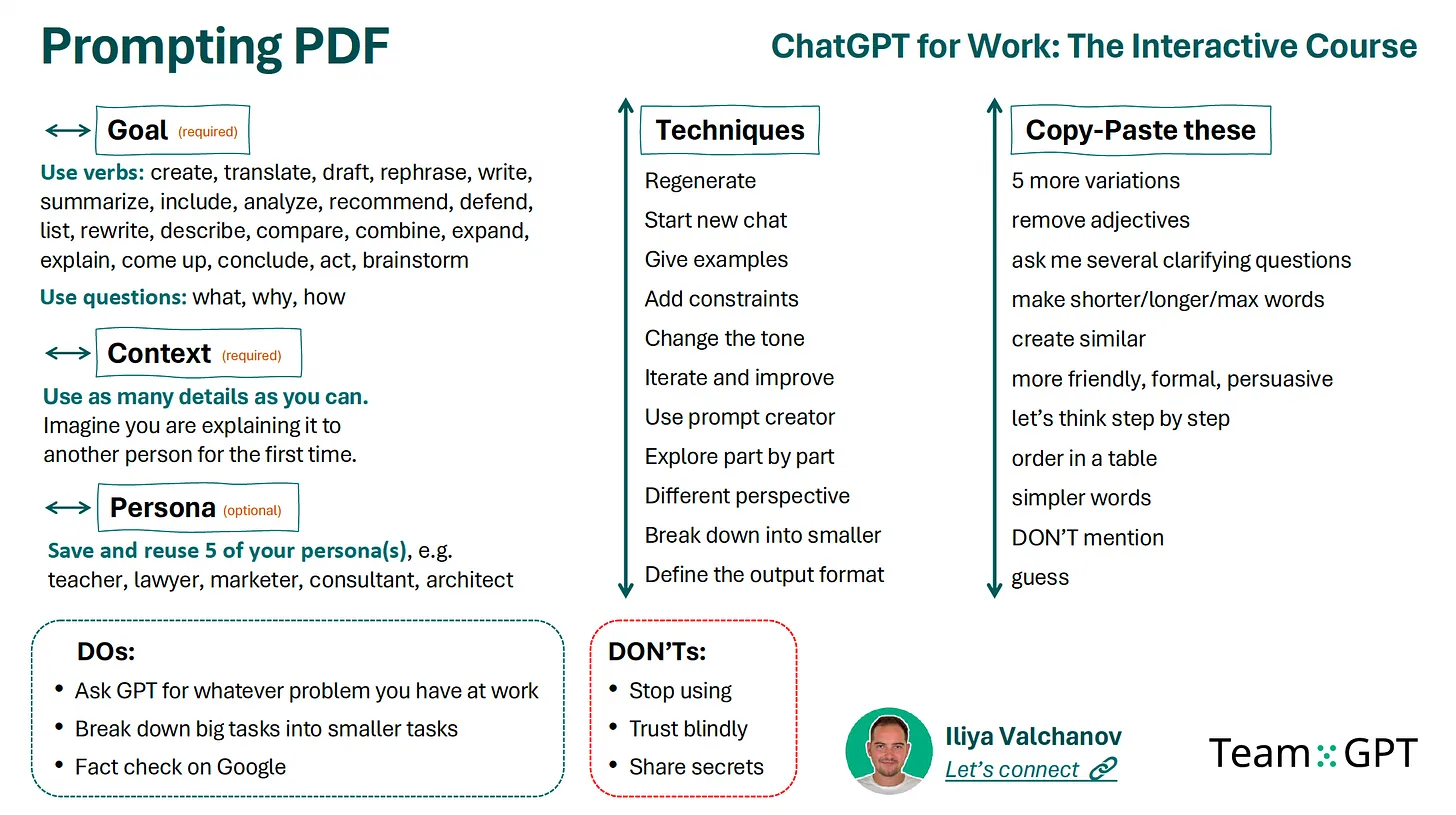
Everything else changes daily.
The products (agents) are becoming smarter by the day.
It's an open question which product can do what. Also, just 3 months after you try an agent, it is probably 10x better.

Agents improve rapidly, so interactive education is needed where the AI decides what skill to teach
As an attempt to be futureproof, we made Juma Journey: an interactive learning experience, consisting of 10 practical missions, showcasing different capabilities of the Juma superagent.
The course doesn't show stale information. You constantly communicate with the AI model itself, asking it what it can do, storing it in its memory and progressing further. This is a self-improving online course. As Juma becomes more powerful, the course fundamentally changes.
5 years from now, the same course will help people achieve completely different goals.
I don't know what will be possible. I just know the model will guide users.

The Context Layer
A good prompt engineer is simply a good domain expert who knows what context matters. Lawyers will always outperform general users on legal tasks because they understand which information is relevant. For AI to deliver value, organizations must curate the right context (brand guidelines, process documentation, client information) and make it accessible through organized Projects or knowledge bases.
Once you've placed the Fundament, i.e. understood why AI is the next big thing and how you can prompt it, it's time to make it actually useful.
Even if you have the best 'prompt engineer' on your team, they are only as good as the data or Context they provide to the AI.
A good prompt engineer is a good domain expert.
For instance, I'm awesome at prompting, probably better than almost any lawyer on Earth! But almost any lawyer (who knows the fundamentals) will be a much better law/legal prompt engineer than me. Why? Because they can define the tasks to be done and can provide better context about law than me.
Domain expertise matters a lot because only experts know what context is important (and what isn't).
To make AI work for marketing, you need domain experts to use it well. These will be providing the right context, at the right time.
- This can happen naturally (in the span of a chat), in which case you'd be set up for failure because:
- you depend too much on the memory of the particular product and
- this is an individual (and not collaborative experience).
- Or it can be a focused effort, where 1 or more people organize the info in a collaborative Project or similar, e.g. Juma Projects.
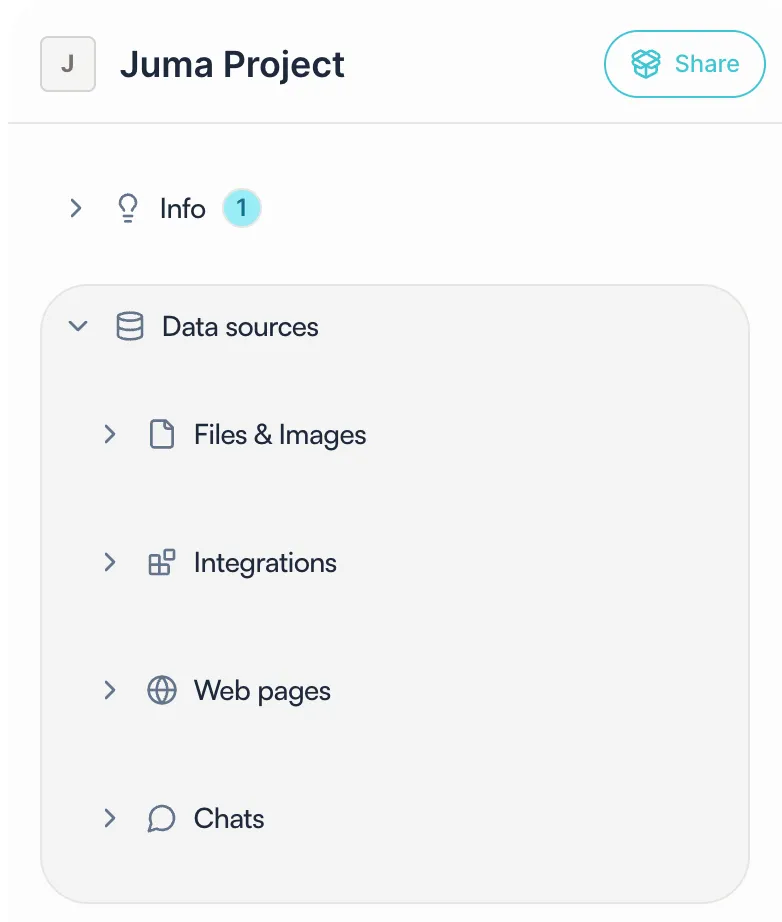
Some professions have it easier, e.g.
- Developers work in repositories, which they unify through GitHub for instance. So it's already super organized: you connect the repo and it has all the Context for the project at hand.
- Marketers work on campaigns, which often have a start and end date and must be executed rather fast, context is created at the start and evolves for each campaign
- Agencies collaborate on clients, ideally in the span of years, so they often have this stored somewhere
More often than not, context is scattered across tools, drives, archives.
An absolute key step to adopting AI well for your organization is to cherry-pick the right context that the AI will be stepping on.
This is so important, that nowadays we often talk about Context Engineering as opposed to Prompt Engineering.
Context is King.
Cherry-picking the right Context
In 2026, Context for coding is pretty much sorted. For everything else, we need to make an organized effort to collect the right data.
For instance, as I'm writing this, an AI agent is analyzing 1 year of meetings (a total of 1500 meetings) looking to identify pain points, common objections, winning phrases across sales calls. The agent will be running for ~3 hours and then I'll be analyzing this data in Juma. There are also other agents on the market that can solve this problem.
But none of them can solve it without me providing the 1500 meeting recordings/transcripts.
Context is important and providing it in the easiest form possible to the agent is a key skill.
The right Context at the right time
You can't expect an AI to always know which context to use when.
Just think about your own knowledge and memories. The fresher they are, the more important they are. Thoughts, ideas, memories from 10 years ago should often be disregarded or at least discounted.
Now think about your company documents. Documents that are 10-20-30 years must NOT occupy the same space as documents from this year. But sometimes they do.
Often the people on your team don't know what's important and what's not.
How do you expect the AI agent to work it out?
Using the right context at the right time can largely be solved by agents one day. But I cannot imagine it solving it completely.
Humans will curate Context for a long time
I think for much longer than expected, humans will be curating the Context for the AI.
Whether it's PDFs, images, integrations, audio files, videos, social media accounts, web pages, MCP servers, or whatever is trendy in the future… it will be us making sure the right context is provided and/or used.
As we create the products of the future, we fantasize about the AI being able to select the right context at the right time, but unless we transmit our thoughts directly via Neuralink, I hardly see it happening.
In-house AI Champions
Quick Answer: Every organization that successfully adopts AI treats it as a project with a clear owner. AI Champions are typically younger, tech-savvy, ambitious employees genuinely excited about the technology. Their responsibilities include ensuring team access, defining KPIs, organizing training, identifying high-value use cases, and working individually with each person to demonstrate direct benefits to their work.
Internal AI champions are the backbone of the AI revolution.
All organizations that have successfully adopted AI have 1 thing in common:
They treat adoption as a project with a clear owner, who is responsible for getting it done.
Оrganizations with dedicated AI leadership roles see 2.5x faster adoption rates compared to those without clear ownership.
Who are these AI champions
These are people who are usually genuinely excited about the technology and want to make their colleagues successful. They champion AI because they see it as an opportunity to fast-track their career.
Ideally, you want to find someone who hits both of these.
They will likely be young(er), tech-savvy, and rather ambitious.
You should give them full responsibility (and accountability), send them this resource, and empower them as much as possible.
What does an AI champion do?
There are many jobs that can be done, here's a non-exhaustive list: know their team and their AI aptitude, make sure everyone has access to AI, make sure everyone uses the company AI, define KPIs and later measure the success of the rollout, organize workshops, 1:1s, educational sessions, find the use cases that matter, and surface them.
Here's an example 12-week AI adoption plan to start from.
AI Adoption Plan - 12 Week
Excel file
AI Adoption Plan - 12 Week
PDF file
I would advise against hiring external people to get this done. You want it to be someone who knows how the company works from the inside.
Finally, AI champions must work individually with every person to make sure they see direct benefit of AI to their work. If that's not feasible, they must find 'sub-champions' within each department.
AI champions and Context
The first job of the AI champion is to ensure everyone in the org has the Fundament in place.
The second (and most important job) is to to bring the domain expertise of the company inside the software in question.
Mastery
Mastery occurs when you stop thinking "how can AI help me" and AI becomes an automatic extension of your capabilities. Neuroscience shows that when tools become part of our workflow, our brains literally treat them as body extensions, the same phenomenon that makes experienced drivers feel "one with the car." At this level, AI-enabled individuals achieve 10x-100x productivity gains and conceive goals that were previously impossible.
At the top of the pyramid is Human+AI Mastery.
Mastery is when it becomes hard to distinguish if something was done by human or AI.
Mastery is when you stop thinking about 'how can the AI help me' and just know it.
Mastery is when you dream bigger because the AI is already an extension of yourself.
I really believe the right metaphor is: extension of one's self.
AI as an extension of the human brain
When the first humans started using tools: hammerstones, stone cores, sharp stone flakes, this allowed them to hunt, build houses and so on. Without going through the whole history of humanity, tools have been very useful and were practically the big reason why humanity was evolving.
When talking about tools, there is a very interesting neuro-phenomenon.
When a tool in your hand "becomes part of you," it's not just a metaphor… It's real. Your brain makes it real. Even if the brain just pretends that the tool is part of its body, then the tool is a part of its body.
For example, when you are inside a car, especially driving, you become one with the car. You stop thinking about the car, you are the car. In every maneuver in your head, you are no longer just human. You are also a car.
In the same way, pilots are one with the plane, captains are one with the ship. You are experiencing a similar feeling when holding: a tennis racket, baseball bat, knife, phone, computer mouse, or any other object that can be used as a tool. You are extended with these tools.
This is true Mastery. It's not just not just a metaphor.
It's real because your brain makes it real.
Can you afford to skip on AI adoption?
The times they are a-changin'
10 years from now, every company will be an AI company.
People who have adopted AI already have an unfair advantage. They are not only more productive but also disproportionately more capable.
Much bigger goals are now conceived and realized by smaller groups of people as it takes less time and resources to get things done.
For those behind, this is your last call to get serious about AI adoption for business.
For those ahead, technology is accelerating at an ever-faster rate. Whole businesses are erased after a model upgrade. In this new economy, nothing is defensible. Not even your 3-year AI adoption advantange.
Frequently Asked Questions
How long does AI adoption take?
With the right AI adoption framework and an AI Champion, you can see meaningful enterprise AI adoption in 12 weeks. Week 1-4 focuses on building the Fundament, Week 5-8 on organizing Context, and Week 9-12 on reaching initial Mastery. However, true mastery is an ongoing journey as AI capabilities evolve.
What if my team resists using AI?
Resistance usually comes from fear or lack of understanding. Start by lighting the spark. Show them one task that AI can complete in minutes that normally takes hours. Once they experience the "aha moment," resistance turns into curiosity. This is why the Fundament layer is so critical for successful AI adoption.
Do we need technical people to adopt AI?
No. The whole point of modern AI agents is that they handle the technical complexity. You need domain experts who understand your business problems, not programmers. A good prompt engineer is simply a domain expert who knows what context matters.
How do we measure AI adoption success?
Track three metrics: (1) Usage rate (% of team using AI weekly), (2) Time saved (hours per week), and (3) Output quality (measured through your existing quality standards). AI Champions should review these monthly and adjust the adoption strategy accordingly.
Should we build our own AI or use existing tools?
Unless you have significant AI expertise and resources, use existing tools. Building from scratch is like building your own email server: possible, but not strategic for most companies. Focus your energy on the Context Layer (organizing your company knowledge) rather than building infrastructure.
\\\\\
- Juma Journey - 30-min AI learning experience to build the Fundament
- Juma - marketing superagent
- Connect with Iliya on LinkedIn
LinkedIn Carousels

Competitor Analysis

GEO Optimized Articles

Google Analytics Reports


%20(1).webp)



Private cloud deployment - AWS, Azure, GCP
SSO / SAML + platform administration
Security review support + DPA
Custom contract & SLA
Dedicated account manager & priority onboarding
Invoicing + custom billing terms