Set up your client project: Budget History & Channel Performance, Business Goals & KPIs & Spend Constraints
Marketing budget planning is a recurring engagement. Agencies build quarterly plans, rebalance mid-flight, and model new scenarios for the same client across the year. Without a shared project, every new planning session means re-establishing the client's historical spend, their target KPIs, which channels are non-negotiable, and what's coming up in the calendar. A Juma Project stores that context once. Set it up and every allocation, scenario model, and pacing guide the team builds after that starts from the client's real numbers, not from scratch.
What to add
Budget History & Channel Performance
Prior quarter spend by channel and the results it produced: leads, ROAS, CPL, traffic. This is the baseline the allocation builds from. Without it, channel recommendations rely on benchmarks rather than what has actually worked for this client.
Business Goals & KPIs
The metrics the client measures success by: cost-per-lead targets, ROAS floors, monthly traffic goals, pipeline contribution. These connect channel-level dollar amounts to real business outcomes and make the reasoning behind each allocation defensible in reviews.
Spend Constraints
Contractual minimums, platform commitments, channels leadership wants to test, and anything that is off the table. The plan works around reality when it knows the boundaries upfront, so the team does not build an allocation that gets vetoed in the first review.
Seasonal & Campaign Calendar
Upcoming product launches, seasonal peaks, events, and campaign windows. Budget allocation shifts around real milestones — without the calendar, the monthly roadmap cannot account for the weeks that need heavier front-loading or the quiet periods where spend should pull back.
Guide Juma with project info
Add a short description to each knowledge item in the project's info field so Juma knows what each file contains and when to use it. For example:
- Budget History & Channel Performance: "Prior spend by channel with results: leads, ROAS, CPL. Use as the baseline for all channel allocation recommendations."
- Business Goals & KPIs: "Client's success metrics: CPL targets, ROAS floors, traffic goals. Use to connect channel splits to business outcomes."
- Spend Constraints: "Contractual minimums, platform commitments, and off-limits channels. Check before building any allocation plan."
- Seasonal & Campaign Calendar: "Upcoming launches, seasonal peaks, and campaign windows. Use to shape the monthly roadmap and front-loading decisions."
Model the budget, stress-test the scenarios, ship the plan
Frequently Asked Questions
What does the channel-by-channel allocation cover?
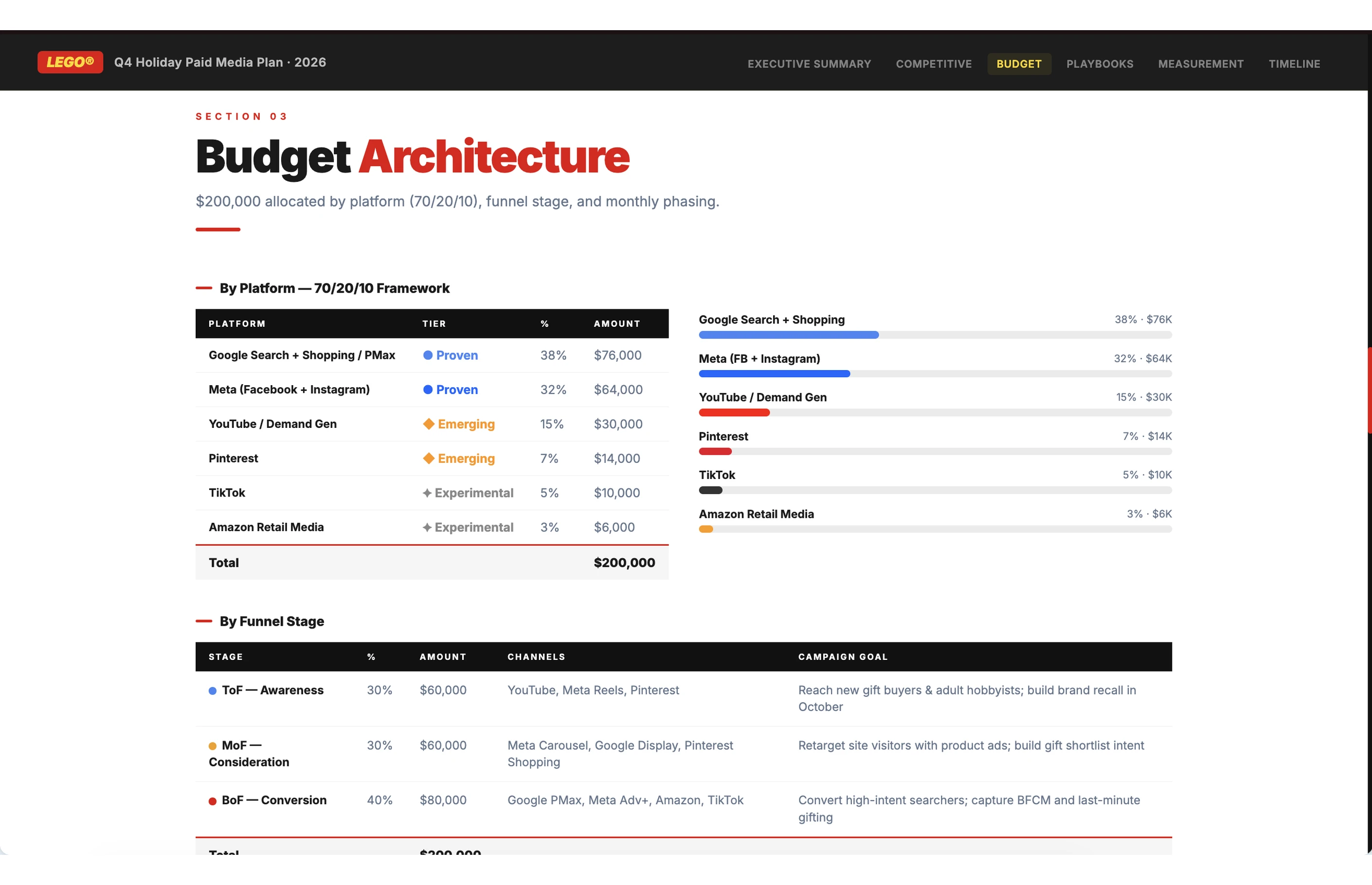
The allocation includes specific dollar amounts for each channel, the percentage split across the total budget, and the reasoning behind each recommendation. It covers digital marketing budget allocation across paid search, paid social, email, SEO, and content, as well as broader mixes that include events, sponsorships, or offline spend.
Each recommendation connects to the goals and constraints you provide at the start. If you flag a minimum ROAS target or a contractual spend floor for a specific channel, the allocation respects those boundaries and works within them.
The reasoning section is as important as the numbers. It explains why a channel received more or less budget relative to your goals, which helps the team defend decisions in reviews and gives a clear rationale for adjusting the split when performance data changes mid-quarter.
How does the three-scenario model work?
The Flow builds three versions of the plan: best case, base case, and worst case. Each scenario maps different outcomes based on variables like cost-per-click, conversion rates, and channel mix. The team sees the full range of possibilities before committing to a single budget direction.
Each scenario covers a specific set of assumptions:
- Best case: Key variables outperform - CPC comes in below target, conversion rates exceed forecast
- Base case: Realistic expectations based on your current inputs and historical performance
- Worst case: Conditions deteriorate - ad costs rise, or a channel underperforms for a full quarter
Using three scenarios changes how teams approach the plan. Instead of treating the budget as a fixed commitment, the team has a decision framework. When early data comes in, the team identifies which scenario the quarter is tracking toward and adjusts spend before results fall off target.
What does the sensitivity analysis tell the team?
The sensitivity analysis identifies which variables have the most impact on your target metrics. Not every budget line carries the same risk - a 20% shift in Google Ads CPC can significantly affect total lead volume, while the same change in display spend might barely register on overall results.
The analysis produces a ranked priority list for the team to monitor:
- High-impact variables: Track weekly - shifts here require fast reallocation decisions
- Medium-impact variables: Check monthly, build tolerance thresholds into the plan
- Low-impact variables: Review quarterly, tolerate more variance without triggering a rebalance
In practice, this replaces reactive budget fire-fighting with a structured, pre-prioritized response plan. When a variable shifts mid-quarter, the team already knows which inputs matter most and responds with a revised allocation rather than a gut reaction.
Can the budget plan be updated if spend changes mid-quarter?
Yes. Step 2 of this Flow handles mid-quarter rebalancing. Provide the new budget total and any performance targets to protect, and the Flow redistributes channel allocation while flagging what to scale back first. It prioritizes channels with the lowest cost-per-lead over even cuts across all channels.
The most common triggers for a mid-quarter rebalance:
- Leadership reduces the total budget
- A new channel opportunity opens up and needs to be funded
- A channel underperforms and the team wants to pause or reallocate its spend
The rebalanced plan preserves the structure of the original so the team can compare both versions directly. This makes it easier to communicate tradeoffs to stakeholders and explain which channels stayed in the plan and which ones the team chose to pause.
What inputs make the marketing budget allocation most accurate?
Specific, data-backed inputs produce the best results. Sharing last quarter's channel spend, target KPIs, contractual minimums, and any channels leadership wants to prioritize gives the plan a real baseline. Following marketing budget allocation best practices starts with real performance data rather than assumptions or industry averages.
The most useful inputs to provide:
- Prior channel performance: Even rough numbers ("$12K on Google Ads, 90 leads") anchor the channel recommendations
- Target KPIs: Cost-per-lead, ROAS, monthly traffic targets — whatever the business measures success by
- Budget constraints: Floors by channel, committed platform spend, and leadership-mandated tests
- Business context: Seasonality, upcoming launches, or audience shifts that affect channel mix
If you don't have historical data, flag that in the input. The plan notes where assumptions fill gaps rather than treating benchmarks as fact.