
"AI slop" became Merriam-Webster's 2025 Word of the Year for a reason. SEO agencies are drowning in a crisis: clients demand more content, faster turnarounds, and lower costs. But many AI tools promising to solve this problem are producing generic, forgettable garbage that Google is actively penalizing.
Your agency has two bad options: manually produce 10 high-quality articles per month (slow, expensive, doesn't scale), or use AI to pump out 100 generic pieces that blend into the noise (fast, cheap, gets penalized).
There's a third option. Leading SEO agencies are producing 50-160+ monthly articles that maintain editorial quality, preserve client brand voice, and actually rank without creating slop. This guide shows you exactly how they do it using AI SEO agency workflows that combine content automation with human oversight.
Key Takeaways
- What is AI slop? Low-effort, mass-produced content created primarily to scale SEO efforts, resulting in generic material that lacks originality and triggers Google's scaled content abuse penalties
- Why standard ChatGPT fails agencies: Generic chat interfaces force teams to re-explain client context in every conversation, leading to inconsistent output and wasted time
- The solution: Build reusable Projects that store client brand voice, audience profiles, and content guidelines to eliminate the "re-explanation tax"
- Quality control framework: Use specialized Content Agents with human oversight checkpoints to maintain editorial standards at scale
- ROI benchmark: The Crew agency (70-person team) achieved 2x faster workflows with 90% team adoption. House of Growth produces 160 articles monthly, saving 85+ hours
What Defines 'AI Slop' (And Why Google Penalizes It)
AI slop is content created primarily to scale production rather than serve users. Google identifies it through four markers: vague generalized information, repetitive structuring patterns, neutral tone without strong opinions, and complete lack of original insights. Google's March 2024 Core Update specifically targets this scaled content abuse.
Information Depth
- AI Slop: Vague, surface-level statements anyone could write
- Quality AI Content: Specific examples with numbers, names, and measurable outcomes
Structure Pattern
- AI Slop: Robotic rhythm: every section has 3 bullets, identical sentence length
- Quality AI Content: Varied structure: mix of short punchy sentences and detailed explanations
Tone & Voice
- AI Slop: Cautiously neutral, hedging language ("some experts believe")
- Quality AI Content: Opinionated, takes clear positions backed by evidence
Originality
- AI Slop: Regurgitated information from existing content, no unique insights
- Quality AI Content: Original research, proprietary data, expert interviews, unique frameworks
Examples Used
- AI Slop: "Many businesses report..." or "Studies show..." (no specifics)
- Quality AI Content: "House of Growth produces 160 articles/month, saving 85+ hours"
Brand Voice
- AI Slop: Generic corporate-speak that could apply to any brand
- Quality AI Content: Client-specific terminology, matches their sentence structure and tone
Citations
- AI Slop: No sources, or vague references to unnamed "experts"
- Quality AI Content: Named sources with links, verified statistics, timestamped quotes
Google Treatment
- AI Slop: Risk of scaled content abuse penalty, manual deindexing
- Quality AI Content: Ranks well, earns backlinks, gets cited by AI engines
Production Method
- AI Slop: No stored context, minimal prompting, no human oversight
- Quality AI Content: Projects with stored context + human checkpoints
The Four Hallmarks of AI Slop:
- Vague, Surface-Level Information - Statements like "Email marketing is important for businesses" that anyone could write and provide zero actionable value.
- Robotic, Rhythmic Structuring - Every section has exactly three bullet points. Every paragraph is exactly three sentences. Sentence length never varies.
- Cautiously Neutral Tone - Presents "both sides" of every issue using hedging language: "some experts believe," "studies suggest," "it's possible that."
- Zero Original Insights - AI can only regurgitate information that already exists. It cannot conduct original research, interview experts, or share proprietary data.
Google's Scaled Content Abuse Policy
In March 2024, Google updated its spam policies to explicitly target AI slop. According to Google's official announcement: "Using generative AI tools to generate many pages without adding value for users" is a violation of the scaled content abuse policy.
The penalty? Manual actions that can deindex your entire site. SEO expert Julian Goldie experienced this firsthand in March 2024 when his agency site was manually deindexed during Google's crackdown.
The Citation Problem: AI engines like Perplexity, ChatGPT Search, and Google AI Overviews won't cite generic content. If your content sounds like everyone else's, AI search engines will skip it entirely. You won't just fail to rank. You won't exist in AI results at all.
Why ChatGPT Creates 'AI Slop' for Agency Content Operations
ChatGPT forces agencies to re-explain client context in every new chat thread. Without persistent memory of brand voice, target audience, or content strategy, the AI defaults to generic corporate-speak that sounds identical to competitors. This "context amnesia" is the root cause of AI slop in agency workflows.
The problem compounds when multiple team members work on the same client. Sarah pastes brand guidelines into her ChatGPT conversation. Mike does the same in his. Your freelancer does it again. Each person gets slightly different outputs because they're explaining the context differently.
The result? Your 5-person content team wastes 2-3 hours daily re-pasting the same information. Worse, the content they produce lacks consistency.
House of Growth, an SEO agency now producing 160 articles monthly, faced exactly this problem. CEO John Ozuysal explains: "Juma has transformed our SEO workflow. We generate comprehensive content outlines in minutes rather than hours by starting with solid NLP-friendly structures."
What is Juma? The AI Workspace Built for Agency Content Scaling
Juma (formerly Team-GPT) is a collaborative AI workspace designed specifically for marketing agencies and content teams that need to scale production without sacrificing quality. Unlike generic chat interfaces like ChatGPT, Juma provides persistent context storage, specialized content agents, and built-in SEO tools.
Why Agencies Choose Juma for AI Content Production:
How to Build an AI Content System That Scales Without Creating Slop
Quality AI content at scale requires three layers: reusable Projects that store client context, specialized Content Agents that execute specific tasks, and human oversight checkpoints at strategic stages. The Crew agency (70-person marketing team) achieved 90% AI adoption and 2x faster workflows using this exact system.
Step 1: Build Client-Specific Projects (The Foundation)
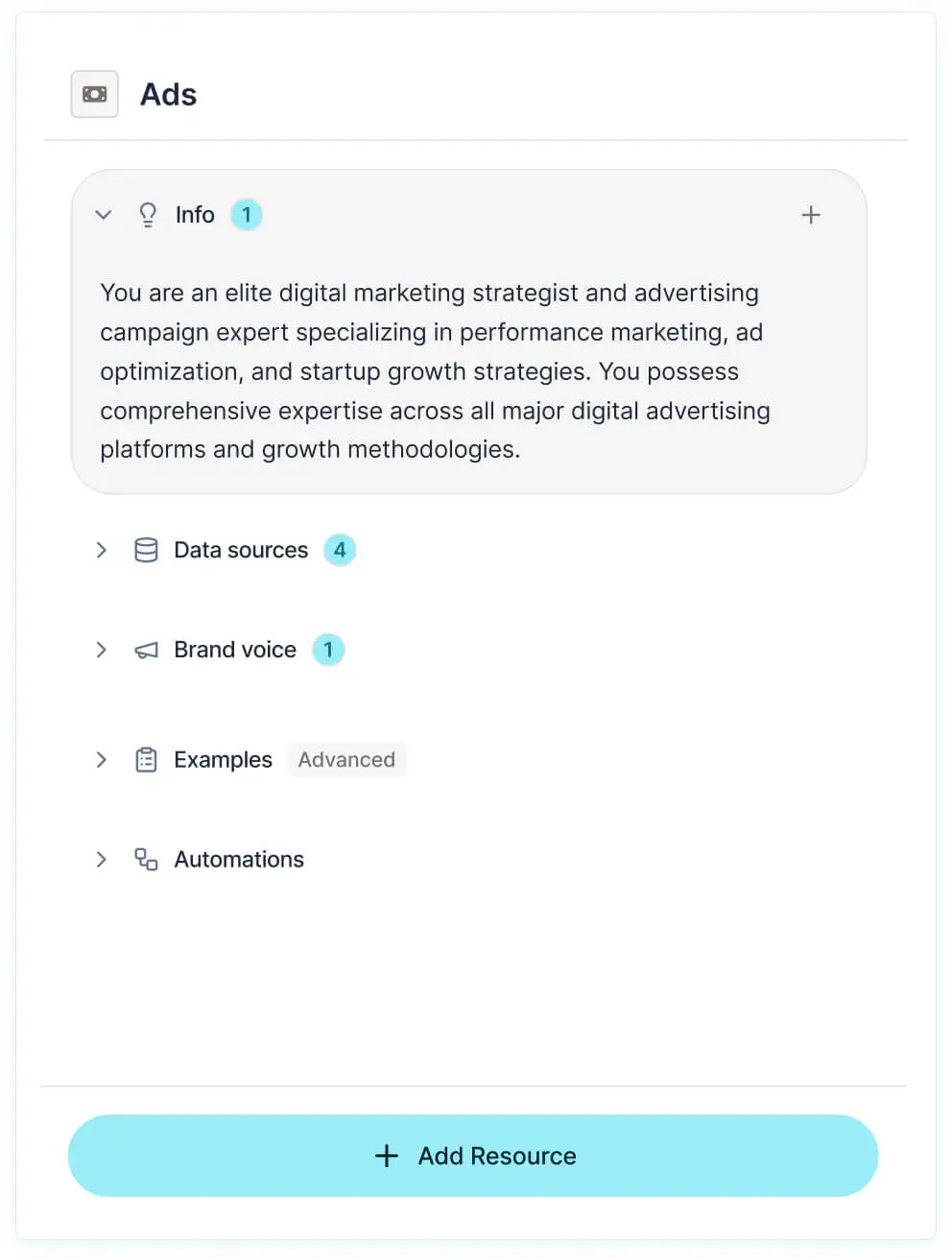
Projects are the difference between AI slop and quality content. Think of a Project as a dedicated workspace for each client that stores everything the AI needs to know.
What to include in Project Knowledge:
- Brand Voice Guidelines: Tone, vocabulary, style rules, reading level, forbidden phrases
- Target Audience Profiles: Demographics, pain points, language patterns, reading behavior
- Content Examples: 3-5 best-performing articles that match your desired output
- SEO Requirements: Target keywords, competitor analysis, internal linking strategy
- Off-Limits Topics: Competitors not to mention, controversial subjects to avoid
The Crew agency's CEO Michael Frank explains their approach: "The better you do the Project knowledge, the less you have to care about the AI model you use. We built specialized AI agents that require minimal prompting for recurring tasks. The best prompt is the one you don't have to write."
This "zero-prompting strategy" democratized AI access throughout their 70-person organization. Even team members with no technical background could leverage sophisticated AI capabilities.
Step 2: Structure Your Content Production System
High-performing agencies use a three-stage workflow: Research, Draft, Refine. Each stage has a specific purpose and time allocation.
Stage 1: Research
Gather competitor intelligence, identify keyword clusters, map search intent, and collect data sources before writing begins.
Agencies using Juma's built-in keyword research can run this entire research phase inside a single Project. Instead of switching between Ahrefs, Google, and ChatGPT, analyze competitor content, identify keyword clusters, and map search intent without leaving your workflow.
Stage 2: Draft
Generate first drafts using your Project context with brand voice automatically applied. The AI references your stored brand guidelines, audience profiles, and content examples - no re-explaining needed.
Stage 3: Refine
This is where good AI content production becomes great. Human editors inject client-specific examples, verify all claims with sources, add expert quotes, and apply final brand voice polish.
Step 3: Implement Human Oversight Checkpoints
AI is not a magic button. You need human editors at three critical stages:
Pre-Production - Fact-check AI research findings, validate keyword strategy, verify competitor analysis is current.
Mid-Production - Review outline for originality, ensure strategic alignment, check that the angle differentiates from competitors.
Post-Production - Inject client-specific examples, verify all claims with sources, add expert quotes, final brand voice polish.
Michael Frank from The Crew emphasizes: "For us, AI is a kind of sparring partner, inspirational tool. You always need people to make gold out of the silver the AI delivers."
Julian Goldie, CEO of a 50-person SEO agency serving 100+ clients, saved $100,000 annually by replacing a full marketing team with AI-powered workflows. But he didn't eliminate human oversight. He shifted human effort from production to quality control.
The 'Specificity Protocol': How to Prompt AI for Non-Slop Content
Generic prompts produce generic content. The Specificity Protocol requires three elements in every prompt: exact audience definition (not "marketers" but "B2B SaaS CMOs with under $5M ARR"), concrete deliverable format (word count, section structure, data requirements), and brand voice constraints (forbidden phrases, required terminology, tone boundaries).
This protocol is essential for effective AI content production that avoids the slop trap.
Bad Prompt (Creates Slop):
"Write a blog post about email marketing for small businesses"
This prompt will generate a 500-word article filled with obvious advice like "segment your list" and "write compelling subject lines." It will sound exactly like 10,000 other articles on the topic.
Good Prompt (Copy This Template for Every Client Article)
The difference between slop and quality often comes down to how much context you provide upfront. Spend 5 minutes crafting a detailed prompt, save 2 hours editing generic output.
Skip the Prompt Engineering with Juma's Prompt Builder
Manually crafting detailed prompts takes practice and time. Agencies using Juma's Prompt Builder answer 5-6 smart questions and get expert-level prompts automatically. The tool asks about audience, goals, constraints, and format, then generates a detailed prompt ready to use.
The Best Approach: Store Context in Projects
Here's the reality: even the most detailed prompt can't compete with persistent context. The best way to eliminate the "re-explanation tax" is to store all your client information in a Project once - brand voice guidelines, audience profiles, content examples, SEO requirements, and off-limits topics.
When your team works inside client-specific Projects, the AI already knows:
- How your client sounds (brand voice is pre-loaded)
- Who they're talking to (audience profiles are stored)
- What good content looks like (examples are referenced automatically)
- What keywords to target (SEO guidelines are built-in)
What Leading Agency Owners Are Saying About AI Content in 2026
Industry experts who've successfully scaled AI content production share insights that go beyond surface-level advice.
Julian Goldie's $100K Team Replacement
When Goldie tested AI-powered content creation, the results shocked him: "We had a full team of marketers. YouTube script writer, marketing manager, video editor, thumbnail designer. Big team. Costs thousands monthly. I tested recording myself using ChatGPT as a screencast. It got about 10 times more views than our professionally edited videos. After three videos I let go the whole team. It saved me probably about $100,000 last year."
The lesson? Authentic, specific content outperforms polished generic content, even when created by professionals.
Michael Frank's "AI as Sparring Partner" Philosophy
Michael Frank, Co-CEO of The Crew, reframes how agencies should think about AI: "For us, AI is always not the 100% solution bringer. For us, the AI is a kind of sparring partner, inspirational tool. You always need people to make gold out of the silver the AI delivers."
This perspective shift is critical. Agencies that treat AI as a replacement for human creativity produce slop. Agencies that treat AI as a collaborative partner produce quality.
Eric Siu's "Jaw Graph" Phenomenon
Eric Siu, CEO of Single Grain, describes the seismic shift happening in organic search: "I just spoke to a CEO of an enterprise SEO company and he said they have data where it shows that your graph now looks like a jaw. Your impressions are going up but your clicks are going down."
This "jaw graph" phenomenon is the new reality. Your content appears in more searches (impressions up), but users get their answers from AI Overviews without clicking through (clicks down). Siu notes that studies show drops of more than 37% from AI Overviews alone.
Quality Control: The 6-Gate Checklist
Every AI-generated piece must pass six quality gates before publication: Original data or perspective present, client-specific examples included, brand voice consistency verified, factual claims sourced, competitor differentiation confirmed, and readability optimized for target audience.
Gate 1: Originality
- Question: Does this include data/insights not found in top 10 SERP results?
- Pass Criteria: At least one section offers unique angle, framework, or data point
Gate 2: Specificity
- Question: Are there concrete examples with numbers, names, or screenshots?
- Pass Criteria: Every major claim includes at least one specific example with measurable outcomes
Gate 3: Brand Voice
- Question: Does this sound like the client wrote it?
- Pass Criteria: Uses client-specific terminology, matches their sentence length, sounds like existing content
Gate 4: Fact-Check
- Question: Are all statistics, claims, and quotes verified and sourced?
- Pass Criteria: Every factual claim links to authoritative source published within 12-24 months
Gate 5: Differentiation
- Question: What makes this better than the #1 ranking article?
- Pass Criteria: Content is more comprehensive, specific, recent, or offers unique angle
Gate 6: Readability
- Question: Is this written for the target audience's reading level?
- Pass Criteria: Reading level matches target audience, addresses specific pain points in their language
The ROI Math: Why AI Content Systems Pay for Themselves
Industry benchmarks suggest SEO agencies spend $200-400 per blog post when calculated at market rates ($50-100/hr writer rate × 4 hours). AI-assisted workflows reduce production time to 90 minutes while maintaining quality, dropping cost per article to $75-150. At 20 articles/month, agencies save $2,500-5,000 monthly, covering tool costs 5-10x over.
Real Agency ROI Data
- Output: 160 articles per month
- Time savings: 85+ hours monthly
- Growth: 2x achieved
- Method: Projects storing brand voice, audience profiles, content examples
- Adoption: 90% (70-person agency)
- Speed: 2x faster workflows
- Time savings: 10-60% depending on process
- Method: "Zero-prompting strategy" with specialized agents
Common Mistakes Agencies Make (And How to Avoid Them)
The #1 mistake is treating AI like a magic button. Agencies that fail skip the foundational work. They don't build detailed Projects, don't train teams on prompt specificity, and don't implement quality checkpoints. Result: They produce slop, clients reject drafts, and teams abandon AI tools within 60 days.
Mistake #1: Letting Every Team Member Use Their Own AI Chat
The Problem:
Every team member works in separate AI conversations with their own interpretation of client brand voice. Sarah's version of the client sounds different from Mike's, which sounds different from your freelancer's. Output is inconsistent.
The Solution:
Build one Project per client with shared brand context. Every team member accesses the same brand voice guidelines, audience profiles, and content examples. Output becomes consistent regardless of who creates it.
Mistake #2: Skipping the Brand Voice Setup
The Problem:
Agencies assume AI will "figure out" their client's brand voice by analyzing a single example article. AI defaults to generic corporate-speak: formal, cautious, filled with buzzwords.
The Solution:
Explicitly define brand voice with examples of what TO do and what NOT to do. Include forbidden phrases, required terminology, sentence length preferences, and tone boundaries. Store this in your Project so every conversation references it automatically.
Mistake #3: No Human Oversight Checkpoints
The Problem:
Agencies publish AI-generated content without human review. AI hallucinates statistics, misunderstands instructions, and produces inaccurate information.
The Solution:
Implement the 6 Quality Gates checklist before any content goes live. Assign specific team members to each checkpoint: Pre-Production (Research Analyst), Mid-Production (Content Strategist), Post-Production (Senior Editor).
How to Get Started: 30-Day Implementation Plan
Start with one pilot client. Week 1: Build their Project with brand voice and content examples. Week 2: Train your team on the Specificity Protocol and run 5 test articles. Week 3: Implement quality checkpoints and measure results. Week 4: Refine prompts based on client feedback, then scale to additional clients.
The Future of AI Content for SEO Agencies (2026 and Beyond)
AI Search is replacing traditional Google SEO. Perplexity, ChatGPT Search, and Google AI Overviews now prioritize content that's specific, opinionated, and citable. Agencies that master "Citation Bait" content (original data, expert perspectives, and unique frameworks) will dominate. Generic slop won't just fail to rank. It won't exist in AI results at all.
The Shift from SEO to AEO (Answer Engine Optimization)
Traditional SEO (2000-2023): Optimize for keywords and backlinks → Rank in Google's 10 blue links → Traffic comes from organic clicks
AEO (2024-Present): Optimize to be cited by AI engines → Appear in AI Overviews, ChatGPT responses, Perplexity answers → Traffic comes from AI citations and "learn more" clicks
What AI Engines Cite
AI search engines like Perplexity and ChatGPT prioritize:
- Original Research and Proprietary Data
- Expert Quotes and Named Sources
- Specific Examples with Numbers
- Contrarian or Unique Perspectives
The Citation Bait Checklist
Before publishing any content, ask:
- Does this include original data not found elsewhere?
- Are there named experts with real quotes?
- Do we provide specific examples with measurable outcomes?
- Is there a unique framework or methodology we're introducing?
- Would an AI engine have a reason to cite THIS article over competitors?
If you can't answer "yes" to at least 3 of these questions, the content isn't citation-worthy. Revise before publishing.
Conclusion: From Slop to Strategy
AI doesn't have to mean slop. The agencies winning in 2026 treat AI as a collaborator, not a replacement. They build systems that scale production while maintaining the editorial quality that earns client trust and search engine citations.
The difference between slop and quality isn't the AI tool. It's the system around it. Client-specific Projects that store brand context. Specialized Agents that execute defined tasks. Human oversight at strategic checkpoints. And the Specificity Protocol that turns generic prompts into detailed instructions.
Start small. Pick one client. Build their Project. Train your team. Measure results. Then scale.
Ready to build an AI content system that scales without creating slop?
{{blog-pricing}}
Try Juma free for 30 days and see how agencies are producing 50-160+ monthly articles while maintaining quality standards that pass client approval on first draft.
LinkedIn Carousels

Competitor Analysis

GEO Optimized Articles

Google Analytics Reports


%20(1).webp)



Private cloud deployment - AWS, Azure, GCP
SSO / SAML + platform administration
Security review support + DPA
Custom contract & SLA
Dedicated account manager & priority onboarding
Invoicing + custom billing terms