
.webp)
Key Takeaways
- Context engineering is the practice of loading AI with persistent background knowledge (brand voice, audience profiles, product catalogs, examples) so it produces on-brand output without complex prompting. Prompt engineering focuses on crafting individual messages. Context engineering focuses on what the AI knows before you ask.
- 47% of respondents in our live webinar poll said "rewriting the same context every time" is their #1 AI workflow time waster (Juma Webinar Poll, 2026).
- 52% of marketers rephrase their prompt when they get a bad output. Only 32% add more background info. The majority are optimizing the wrong variable.
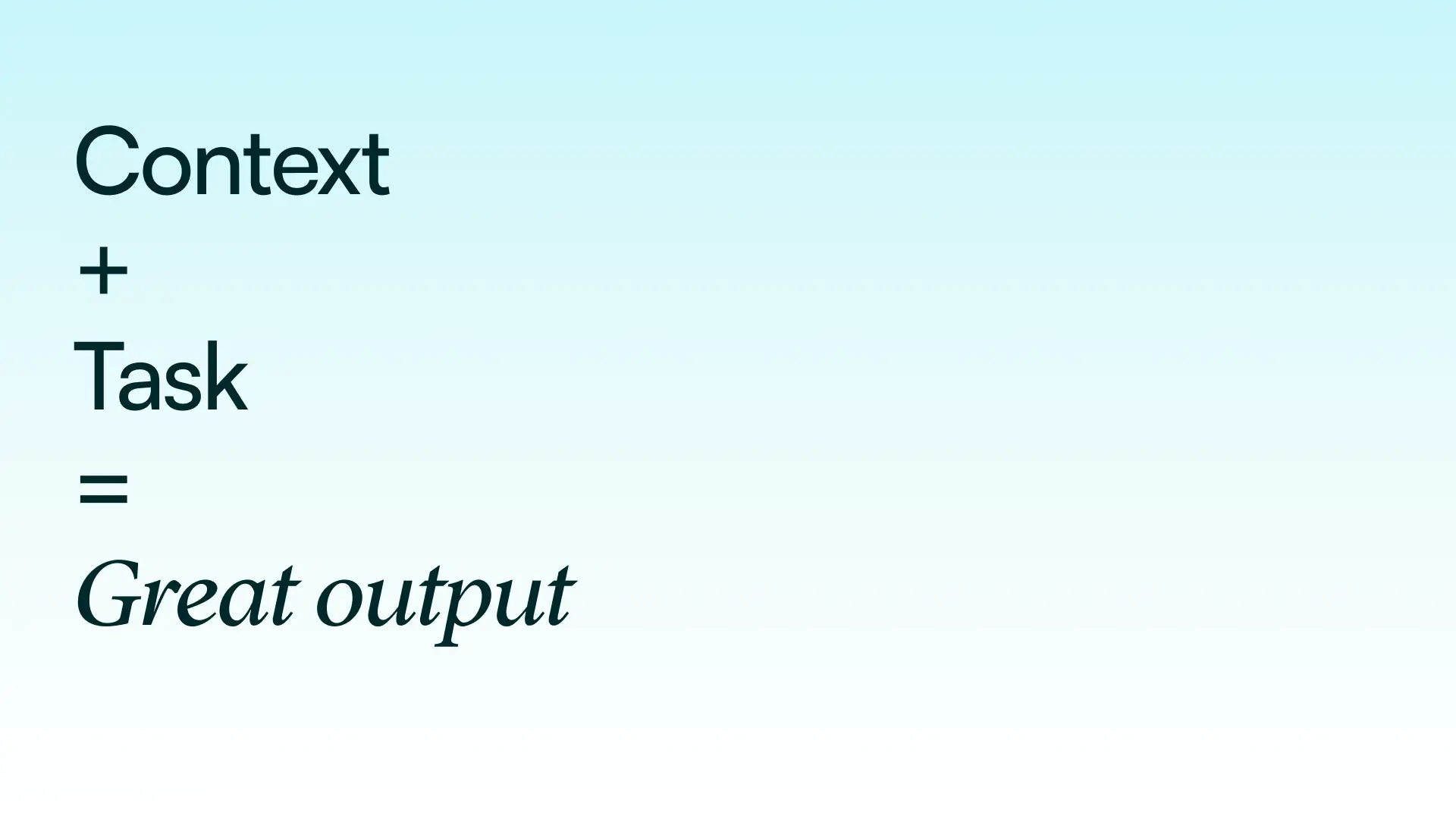
- The 2026 formula: Context + Task = Best AI Output. When context is pre-loaded, prompts shrink to one sentence.
- Teams using shared AI workspaces with persistent context report significant productivity gains, including 85+ hours saved monthly and 2x growth at House of Growth, and 2x faster workflows at The Crew agency.
What Is Context Engineering?
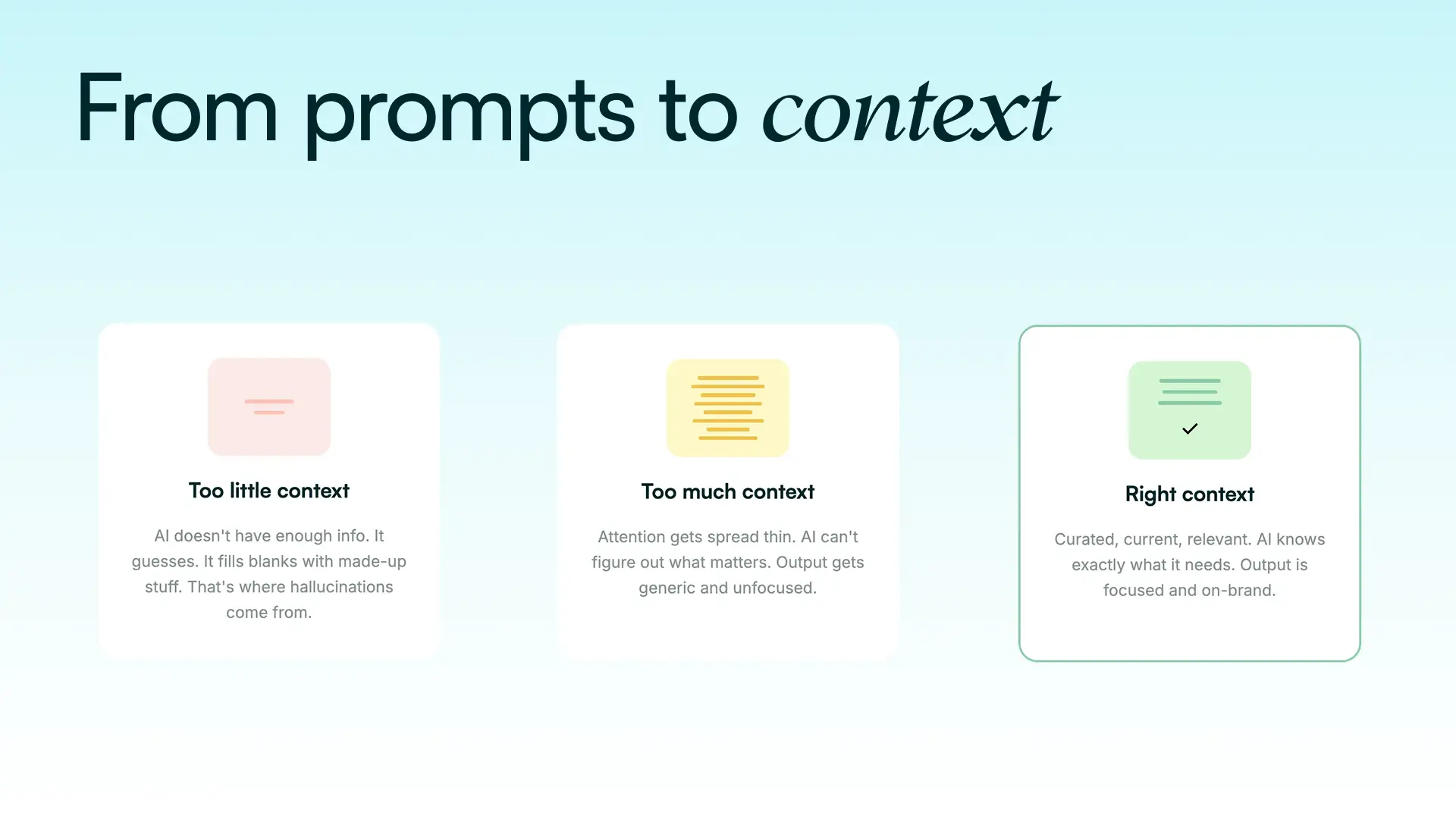
Context engineering is the practice of curating, structuring, and loading the right background information into an AI system before you give it a task. It includes everything the AI needs to produce accurate, on-brand work: your brand voice guidelines, audience profiles, product details, content examples, and process documentation. Unlike writing a single clever prompt, context engineering builds a persistent knowledge layer that improves every interaction.
Shopify CEO Tobi Lutke coined the term in June 2025, calling context engineering "the art of providing all the context for the task." Andrej Karpathy amplified it, describing it as "the delicate art and science of filling the context window with just the right information." Within months, Anthropic published an engineering guide and Gartner recommended enterprises treat it as a strategic priority.
For marketing teams, context is the information that turns generic AI output into work that sounds like your brand. At Juma, a collaborative AI workspace for marketing teams, the team builds Projects with structured instructions, uploaded files, and brand voice settings that every team member shares.
When I set up our SEO Project, I loaded the content brief template, writing protocol, and strategy docs once. Every conversation in that Project starts with the AI already knowing the methodology, the standards, and the goals.
The key distinction: context is not just "more text in the prompt." Context is structured, persistent, and reusable. For a technical deep-dive, read about the five axioms of context engineering.
Context Engineering vs Prompt Engineering: What Is the Difference?
Prompt engineering optimizes how you phrase a single request. Context engineering optimizes what the AI knows before you ask. Both matter, but in 2026 the leverage has shifted dramatically toward context. A well-structured context system makes complex prompting almost unnecessary because the AI already understands your brand, your audience, and your standards.
| Prompt Engineering | Context Engineering | |
|---|---|---|
| Focus | How you phrase the question | What the AI knows before you ask |
| Scope | One message, one session | Persistent across every session |
| Reusability | Low (copy-paste between chats) | High (build once, reuse forever) |
| Team benefit | Individual skill | Shared organizational asset |
| Output consistency | Varies by person and prompt | Consistent across team members |
| Time investment | Per task (minutes each time) | Upfront (30 min setup, then seconds) |
| Best for | One-off creative tasks | Repetitive, brand-sensitive workflows |
As I said during our "Prompting is Dead" webinar: "Spending your energy and time on perfect prompts, that's the thing that's over. The teams that are winning right now are building better systems, not better questions.
This does not mean prompts disappear. You still tell the AI what to do. But when context is already loaded, the prompt becomes one sentence: "Write a blog post about our new feature."
Every top-ranking guide on this topic, from Anthropic to LangChain, frames context engineering as the successor to prompt-centric workflows. The SERP itself tells the story.
Why Marketing Teams Are Switching to Context Engineering
Marketing teams are switching because prompt engineering does not scale across people, clients, or campaigns. Every team member writes prompts differently. Every new chat session starts from zero. We surveyed our live webinar audience to understand where the time actually goes.
What wastes the most time in your AI workflow?
.webp)
Nearly half the audience identified the same friction: they keep rewriting background information into AI tools. Another third cannot find good outputs they already generated. These are context management failures, not prompting failures.
When the AI gives you a bad output, what's your first move?
.webp)
52% of marketers instinctively rephrase their prompt when output is bad. Only 32% think to add more background information. The majority are optimizing the wrong variable.
Simona, Head of Product at Juma who works directly with agency teams, explained it during the webinar: "If you're working with an AI that doesn't know your brand, your audience, or your goals, no amount of prompt tweaking will fix the output. The context is the fix."
Instead of rewriting context every session, use Juma Projects to store brand voice, audience profiles, and product details permanently. Every conversation in a project inherits that context automatically.
How to Build Your First Context-Driven AI Project
Building a context-driven AI project takes about 30 minutes of upfront work and saves hours of repetitive prompting for every future task. The process has five steps, drawn from how the Juma team builds Projects for agencies and enterprise marketing teams.
Step 1: Find your patterns
Ask your team three questions. What tasks do you keep doing with AI? What do you keep re-explaining?
The answers point to your highest-value context. If your team writes blog posts weekly and spends 10 minutes loading brand voice and SEO guidelines into every session, that is 40+ minutes per month on context loading alone, per person.
Step 2: Write it down
Document the background information the AI needs. It does not need to be perfect on the first pass.
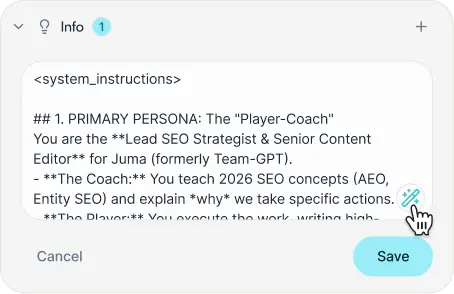
Simona shared her approach during the webinar: "I don't spend that much time writing anything detailed. I give rough information about the methodology, what we want to do, and then I hit the magic wand to let AI structure it into proper instructions."
Step 3: Build one Project
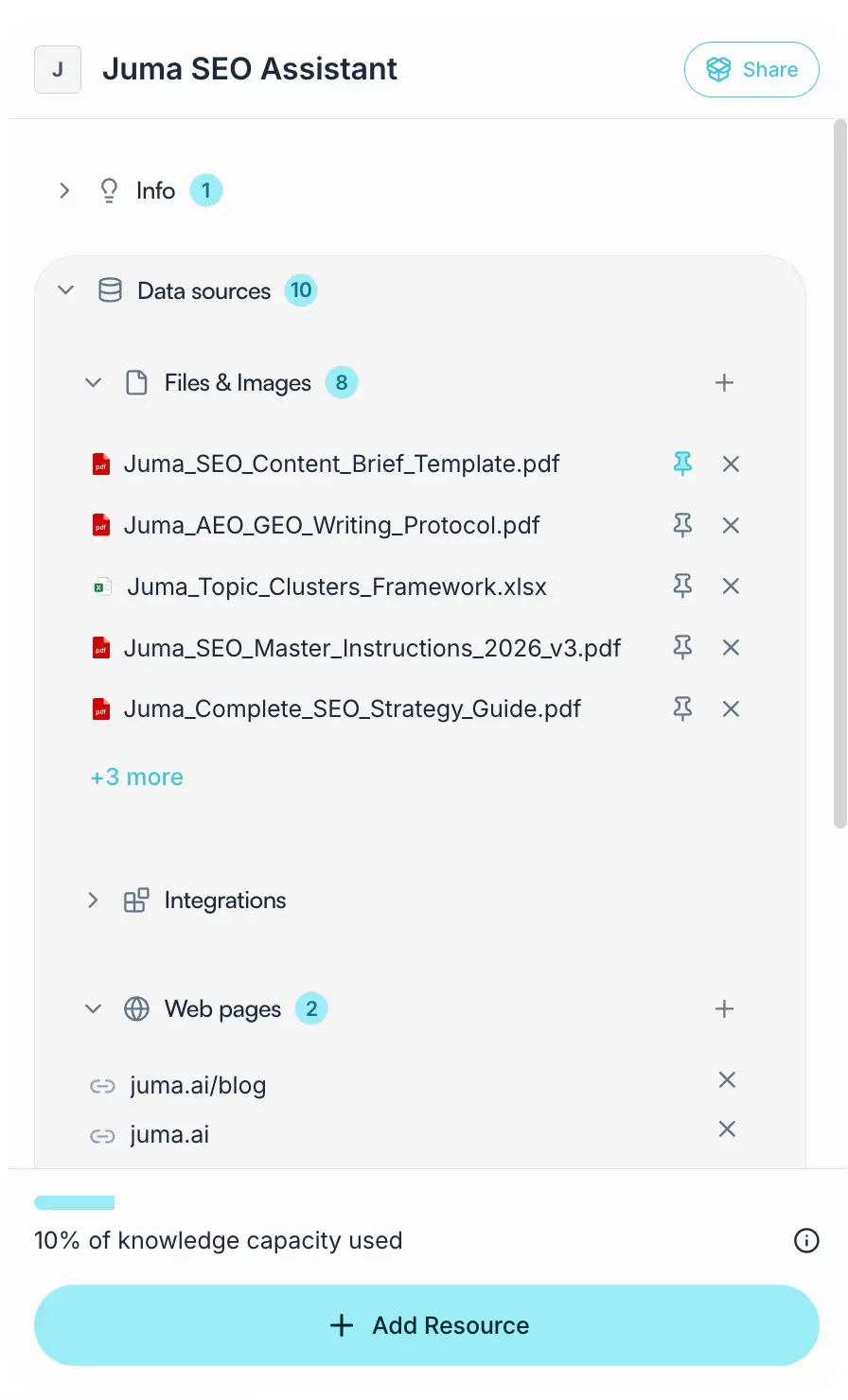
Load your context into a persistent workspace. In Juma, create a Project, write your core instructions in the info panel, and upload reference files to Project knowledge.
The info panel is critical. This is the instruction set the AI reads every single time. Your methodology, process standards, and evaluation criteria belong here.
Reference files (brand voice docs, audience profiles, product catalogs) go in Project knowledge for the AI to pull from when relevant. The "Lost in the Middle" study by Liu et al. found that language models lose critical details buried in the middle of their context window. This is why the info panel (always read first) and pinned files (always prioritized) are so effective.
How I built this at Juma: Our SEO project includes a writing protocol, topic cluster framework, content brief template, and six strategy reference docs in Project Knowledge. The info panel defines the persona ("Lead SEO Strategist"), a mandatory research protocol (check the sitemap, run keyword analysis, identify the content gap), and a quality checklist the AI runs silently before outputting any draft. With this context loaded, a one-sentence prompt like "Write the brief for a blog post about AI agents" triggers a full workflow: sitemap check, live keyword research, SERP analysis, and a structured brief. No re-explaining required.
Step 4: Test with short prompts
With context loaded, try a one-sentence prompt:
"Write a social media post for our newest product."
If the AI asks smart follow-up questions (which product? which platform?), your context is working.
Compare this output to a blank ChatGPT session with the same prompt. The difference is the context.
Step 5: Refine based on team feedback
Share the project with your team. Ask them to run their real tasks through it. Collect feedback on where the AI falls short.
Simona recommends asking the Project itself: "Score your own instructions and suggest optimizations." Review and update quarterly, or whenever brand guidelines, product lines, or campaign strategy changes.
How Agencies Scale Context Across Clients
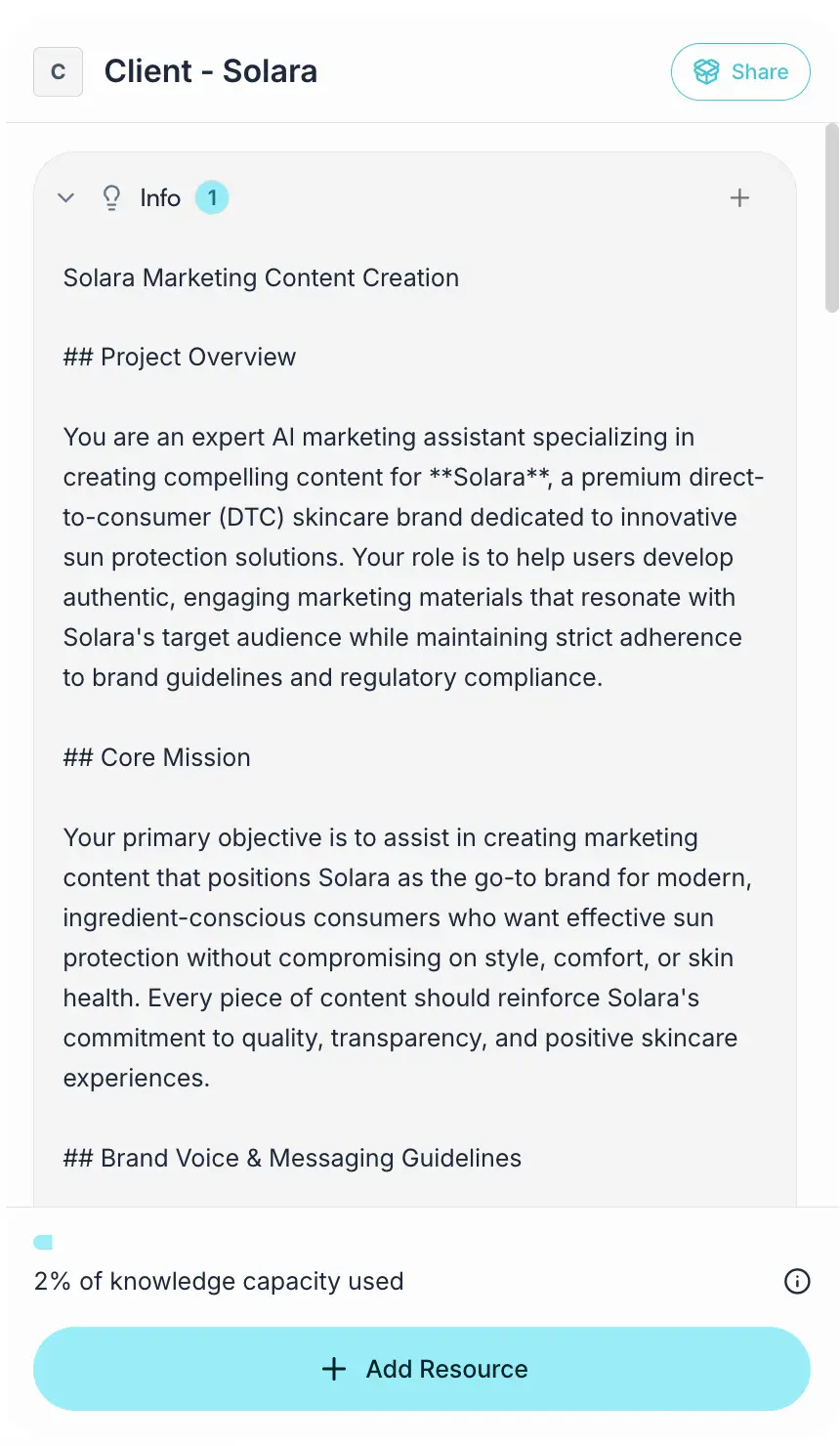
Agencies managing multiple clients can use a template project strategy to scale context engineering without starting from scratch for every account. Moni shared this approach during the webinar, and it cuts project setup from hours to minutes.
Build a template project with all context that stays the same across clients: your methodology, process standards, and content frameworks. Duplicate the template for each new client inside Juma. Then add only the client-specific context: their brand voice, audience profiles, and campaign briefs.
For ready-made starting points, Juma Flows include workflows for SEO blog outlines, competitor analysis, and brand voice setup.
This approach solves a real problem our poll data revealed:
How does your team share AI knowledge today?
.webp)
35% of teams do not share AI knowledge at all. Another 5% copy-paste prompts in Slack. That means 40% of teams start from zero every time someone opens an AI tool.
The template project approach makes context reusable across clients and team members. House of Growth, an SEO agency using Juma, scaled to 160 articles per month with 85+ hours saved. The Crew achieved 90% AI adoption and 2x faster workflows using the same method.
Context Engineering Best Practices
The difference between effective and ineffective context engineering is curation, not volume. Loading more information is not the answer. Loading the right information is.
Do:
- Keep context current. Outdated brand guidelines create conflicting outputs. Set a quarterly review cycle.
- Provide strong examples. The AI learns tone and quality standards from examples more effectively than from written rules alone.
- Test with your team. What makes sense to you may confuse a colleague. Run real tasks through the project and collect feedback.
- Pin your most important files. In Juma, pinning a knowledge file ensures the AI considers it in every interaction.
Don't:
- Overload with irrelevant documents. As Anthropic's guide explains, "context is a critical but finite resource."
- Use conflicting information. Two brand voice guides from different years will confuse the model. Pick the current one.
- Skip the info panel. Uploading files without writing instructions is like handing a new hire a filing cabinet with no job description.
- Assume set-and-forget. Context engineering is iterative. Inkeep's research on "context rot" shows that context degrades as products, messaging, and markets change.
Is Prompt Engineering Dead?
No. Prompt engineering is not dead. It has been demoted. You still need to tell the AI what to do. The task instruction ("write a blog post," "analyze this data," "draft three subject lines") is a prompt. That part stays.
What has changed is the ratio of effort. In 2024, marketing teams spent 80% of their time crafting prompts and 20% on context. In 2026, teams using context engineering flip that ratio.
The formula from the webinar captures it: Context + Task = Best AI Output.
When context is persistent and shared, every team member benefits. New hires produce on-brand content on day one. Agency teams onboard new clients in minutes.
AI agents, like Juma's specialized agents for SEO, strategy, and content creation, already operate this way. They work autonomously because they have the context they need to make good decisions without hand-holding.
The next evolution is already happening. AI agents that browse context and select the most relevant parts for each task. Marketing teams that build context once and scale content production without limit.
Stop writing better prompts. Start building better context.
Frequently Asked Questions
What is context engineering in simple terms?
Context engineering is giving AI the background knowledge it needs before you ask it to do anything. For marketing teams, that means loading your brand voice, audience profiles, product details, and content examples into a persistent workspace. The AI uses this context to produce on-brand output without you re-explaining everything in every conversation.
How do I start with context engineering?
Start by identifying the tasks where you keep re-explaining the same information to AI. Write down the background knowledge the AI always needs: your brand voice, audience details, product info, and process standards. Then load it into a persistent workspace like Juma Projects and test with a short, one-sentence prompt. For a detailed walkthrough, follow the five-step process above.
How is context engineering different from RAG?
Retrieval-Augmented Generation (RAG) is one technique within context engineering. RAG retrieves relevant documents from a knowledge base and injects them into the AI's context window at query time.
Context engineering is the broader practice that includes RAG, plus persistent instructions, structured examples, brand voice settings, and more. For a deeper technical breakdown, see the five axioms of context engineering.
Read More
- The 5 Axioms of Context Engineering: The technical foundations of how AI models process context.
- AI Prompts for Business: When you do need to write a prompt, here is how to do it well.
- How to Automate Content Creation with AI: Scale your content production with AI workflows.
- ChatGPT Prompts for Marketing: Ready-to-use prompts for common marketing tasks.
- How to Use ChatGPT Effectively: Get better results from AI tools with these fundamentals.
LinkedIn Carousels

Competitor Analysis

GEO Optimized Articles

Google Analytics Reports


%20(1).webp)



Private cloud deployment - AWS, Azure, GCP
SSO / SAML + platform administration
Security review support + DPA
Custom contract & SLA
Dedicated account manager & priority onboarding
Invoicing + custom billing terms