Set up your client project: LinkedIn Profile & Post History, Ghostwriting Brief, Voice Reference Examples & Content Themes
Voice extraction is rarely a one-time task. Ghostwriting teams return to the voice profile every time a new batch of posts goes out, when a new writer joins the account, or when the executive's role shifts and the tone needs to evolve with it. Without a shared project, every new session means re-pulling the profile, re-establishing what sounds right, and rebuilding context that the previous writer held in their head. A Juma Project stores the voice guide, the reference posts, and the guardrails once. Set it up and every draft, every comparison, and every new post series the team writes after that starts from the same source of truth.
What to add
LinkedIn Profile & Post History
The executive's or company's LinkedIn URL and any saved post examples worth preserving. The AI pulls live data directly from the profile, but saving high-performing posts in the project ensures the best reference material is never lost to LinkedIn's post history limits.
Ghostwriting Brief
Who the writer is drafting for, what the executive wants to be known for, and any role or company changes that affect how the voice should evolve. This context tells Juma whether to carry over historical voice patterns or adapt them to a new position.
Voice Reference Examples
Two to four posts the executive considers their best work, with a short note on what made each one land. These serve as the primary benchmark when Step 4 puts the voice profile to work — new drafts get measured against posts the executive has already approved, not just extracted patterns.
Content Themes & Off-Limits Topics
Topics the executive returns to regularly and subjects that are off the table — competitors not to mention, internal matters to avoid, opinions the brand has decided not to take publicly. This prevents the ghostwriting team from drafting posts the executive will immediately reject.
Guide Juma with project info
Add a short description to each knowledge item in the project's info field so Juma knows what each file contains and when to use it. For example:
- LinkedIn Profile & Post History: "Executive's LinkedIn URL and saved high-performing posts. Use as the primary data source for voice extraction and pattern analysis."
- Ghostwriting Brief: "Who we're writing for, their positioning goal, and any recent role changes. Use to frame the voice guide and adapt historical patterns to the current context."
- Voice Reference Examples: "Executive-approved posts with notes on what worked. Use as the benchmark when drafting new posts in Step 4."
- Content Themes & Off-Limits Topics: "Recurring topics the executive owns and subjects that are off the table. Check before drafting any post series."
Extract the voice. Write every post like the executive wrote it themselves.
Frequently Asked Questions
How much time does this Flow save compared to manually reviewing LinkedIn posts?
This Flow reduces a three-to-five-hour manual process to minutes. Manually reading 20-30 posts, identifying patterns, and writing a style guide from scratch takes a typical ghostwriter half a day. Give Juma a LinkedIn URL and a short briefing note, and it returns a structured, six-dimension voice guide ready to share with the writing team.
The time saving compounds across a full client roster. Instead of scheduling a briefing session, pulling scattered screenshots, and writing a document from scratch for each new client, you share the voice guide in the same conversation where the scope is set. For agencies managing multiple LinkedIn ghostwriting accounts at once, voice profiles for the entire roster can be created and updated in the time it previously took to document a single one. The output arrives formatted as a working reference document, not a raw analysis, so the ghostwriting team can start using it immediately without restructuring the content.
What does the LinkedIn voice profile include?
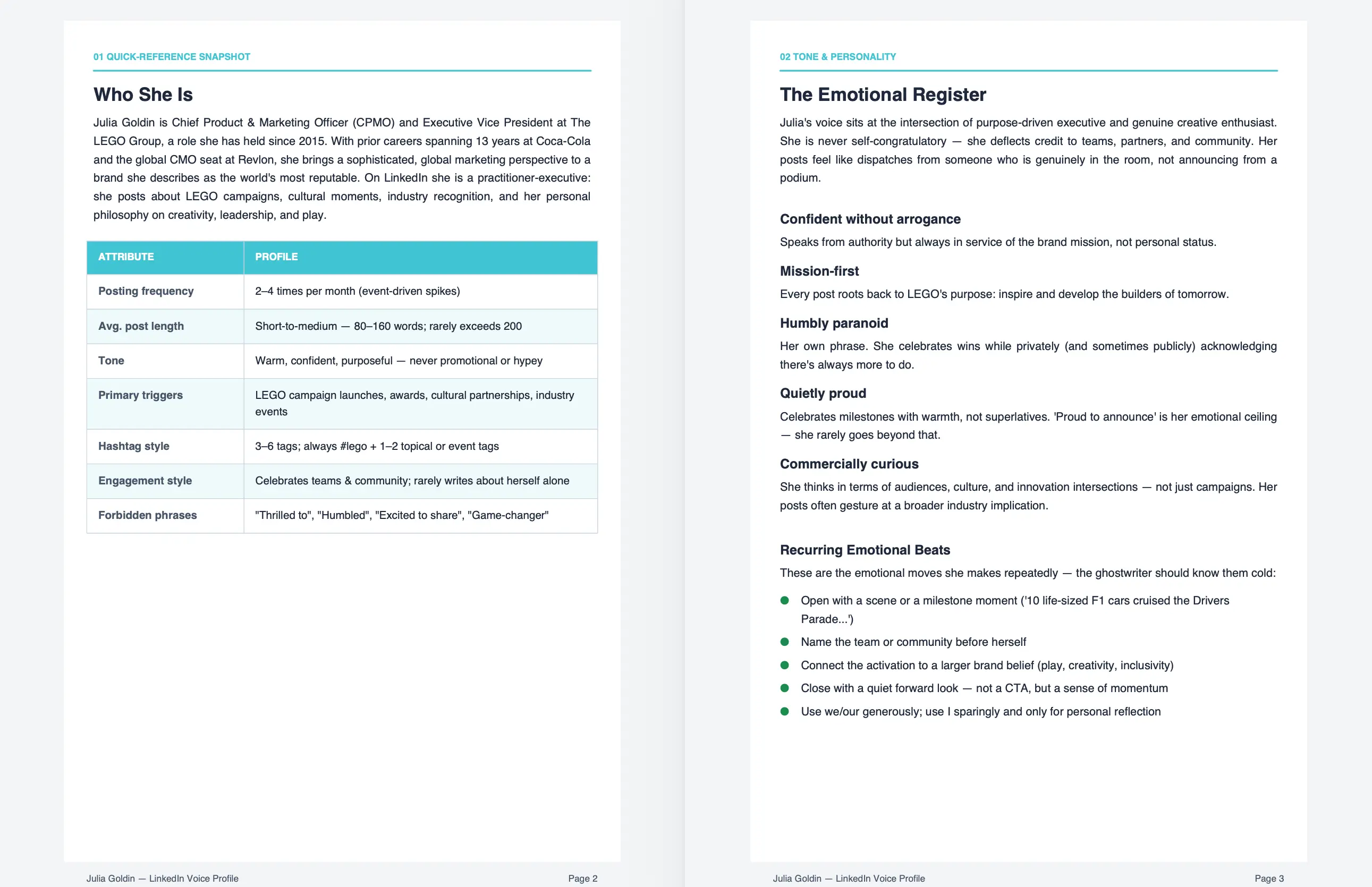
The voice profile covers six dimensions: tone, vocabulary, post structure, content themes, engagement patterns, and a "write like / don't write like" section with annotated examples. Each dimension draws from the person's real posts, not from how they describe their own writing, so the output reflects how they actually communicate rather than how they think they do.
Tone maps where the person falls on the formal-to-casual spectrum with specific post markers. Vocabulary documents repeated phrases, avoided jargon, and how they handle industry terminology. Structure records average post length, paragraph style, line break patterns, hook types, and CTA conventions. Content themes identifies the topics they return to and the angles they take. Engagement patterns records which post types earn the most audience response. The "write like / don't write like" section is the most operationally useful part for a ghostwriter: it provides direct examples of what to replicate and what to avoid, formatted as a checklist a writer reviews draft by draft.
Why does a voice profile built from real posts outperform a brand voice document?
A brand voice document describes how someone wants to sound. A voice profile built from real posts shows how they actually write. The gap between the two is where ghostwriting fails: a brief that says "authoritative but approachable" will be interpreted differently by every writer who reads it.
A profile built from 20-30 real LinkedIn posts captures the specific patterns that make someone's writing recognizable, including habits they would never think to list in a workshop. These include how they open a personal experience post versus an industry commentary, whether they favor rhetorical questions or direct statements, and which CTA types they use consistently versus which they never touch. A well-built voice profile turns adjective-based briefing into a concrete, testable set of rules. Building a LinkedIn personal brand on evidence rather than adjectives is what produces a voice that feels consistent across dozens of posts rather than recognizable only in isolation. When a writer finishes a draft, they check it against the profile instead of asking the client whether it sounds right.
Can this Flow analyze a LinkedIn company page, not just a personal profile?
Yes. Company pages follow different conventions than personal profiles, and the same Flow handles both. Provide a company LinkedIn URL and Juma returns the institutional tone, content themes, formatting conventions, and how the voice shifts across post types such as product announcements, thought leadership, and hiring content.
Company pages tend to have a more fragmented voice history than personal profiles because multiple writers often contribute over time. The analysis notes those inconsistencies and identifies the dominant patterns that have shaped the page's identity. If you are onboarding a company as a new client, running this analysis before your first briefing call gives you a working understanding of how they currently communicate on LinkedIn. This makes it easier to spot the gaps between their current voice and the direction they want to take, and it gives the briefing conversation a concrete starting point rather than a blank page. Step 2 of this Flow covers the company page analysis in full.
.webp)