Set up your client project: Client LinkedIn Profile, Competitor List, Content Goals & Positioning, Past Content Performance
Competitive LinkedIn analysis is not a one-off task. Agencies revisit it when a client launches a new product, enters a new market, or needs to refresh a stale content strategy. Without a shared project, every new session means re-establishing which competitors to watch, what the client is trying to own, and where their current LinkedIn presence stands. A Juma Project stores that foundation once. Set it up and every teardown, gap analysis, and content plan the team builds after that starts from the same competitive picture.
What to add
Client LinkedIn Profile
The client's LinkedIn company page URL, current content pillars, and recent post history. This gives Juma a baseline to compare against competitors — without it, the gap analysis has no reference point for where the client already stands.
Competitor List
Named companies with their LinkedIn URLs and a note on why each matters to the client. This prevents re-identifying the competitive set at the start of every session and keeps the analysis focused on the right reference points rather than a generic industry scan.
Content Goals & Positioning
What the client wants to own on LinkedIn: topics, audience, and the positioning they are working toward. This context shapes how Juma adapts competitor insights in Step 4 — formats and themes get filtered through what actually fits the client's direction.
Past Content Performance
Historical LinkedIn data: which formats, topics, and posting cadences have driven engagement for the client. Used when translating competitor research into a content plan so recommendations build on what the client's audience has already responded to.
Guide Juma with project info
Add a short description to each knowledge item in the project's info field so Juma knows what each file contains and when to use it. For example:
- Client LinkedIn Profile: "Client's LinkedIn page URL, current pillars, and recent post history. Use as the baseline for all gap and competitor analysis."
- Competitor List: "Named companies with LinkedIn URLs and context on why each matters. Use to focus teardowns on the right reference points."
- Content Goals & Positioning: "What the client wants to own on LinkedIn: topics, audience, direction. Use to filter competitor insights before building the client's content plan."
- Past Content Performance: "Historical LinkedIn engagement data: formats, topics, cadences that have worked. Use to weight recommendations in Step 4."
See exactly what's working in any company's LinkedIn strategy
Frequently Asked Questions
How much time does this Flow save compared to building a LinkedIn teardown manually?
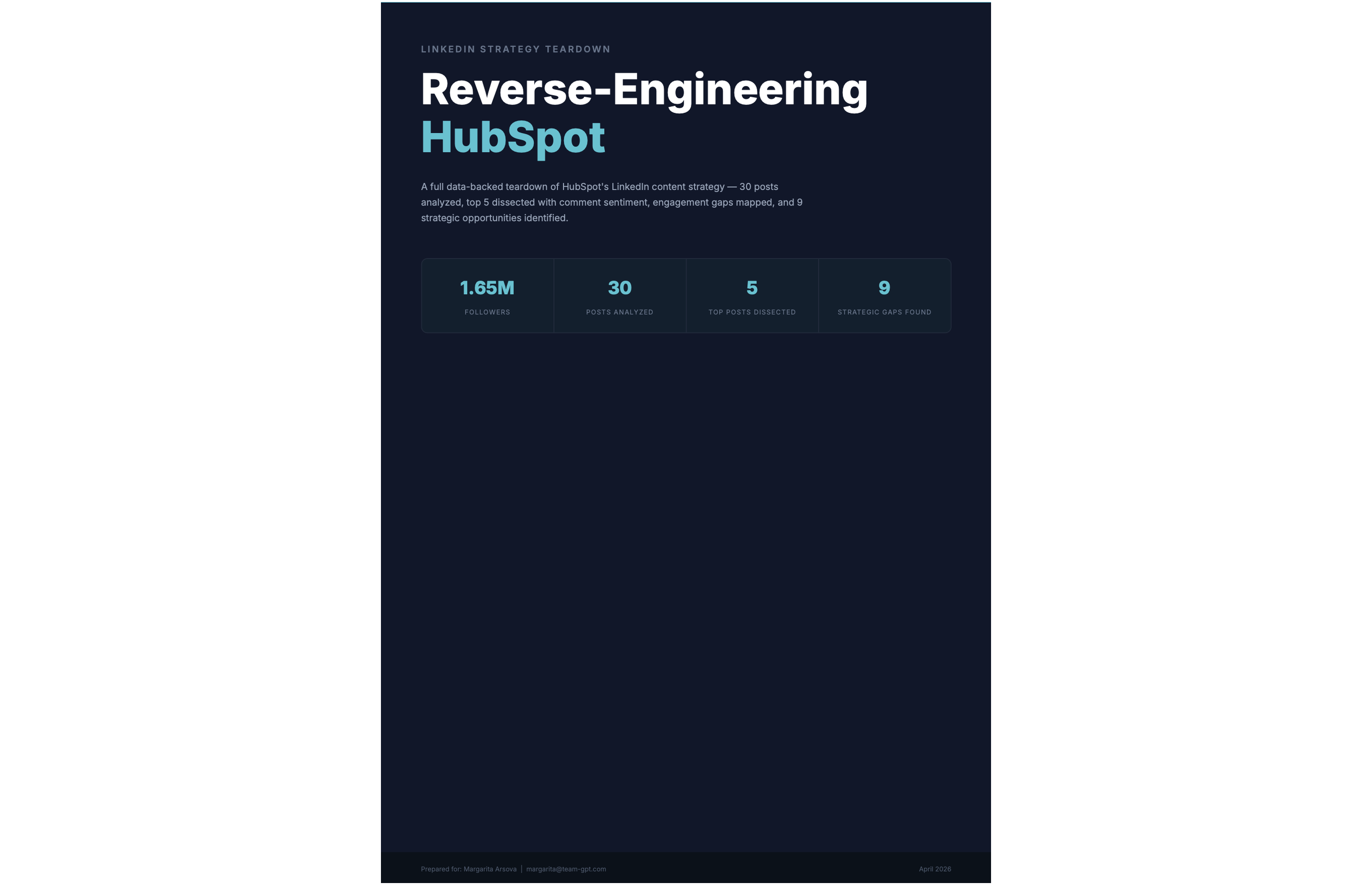
This Flow replaces 3 to 5 hours of manual LinkedIn research with a structured teardown document delivered in minutes. A manual review involves scrolling posts, categorizing content, estimating engagement ratios, and writing it all up. This Flow produces the same six-dimension output directly, formatted for sharing with a client or team.
The time saving is most significant at the point where research needs to become a document. Most analysts can observe what a competitor posts, but converting those observations into a structured teardown with six labeled dimensions, pattern analysis, and gap identification is where the time goes. The document comes formatted for review, not just for the analyst who ran the research.
Teams use it to align on a competitive brief, pitch a new content direction, or build the first draft of a strategy before a client meeting. A document produced in minutes can be reviewed, refined, and shared in the same working session.
What does the LinkedIn content strategy teardown actually cover?
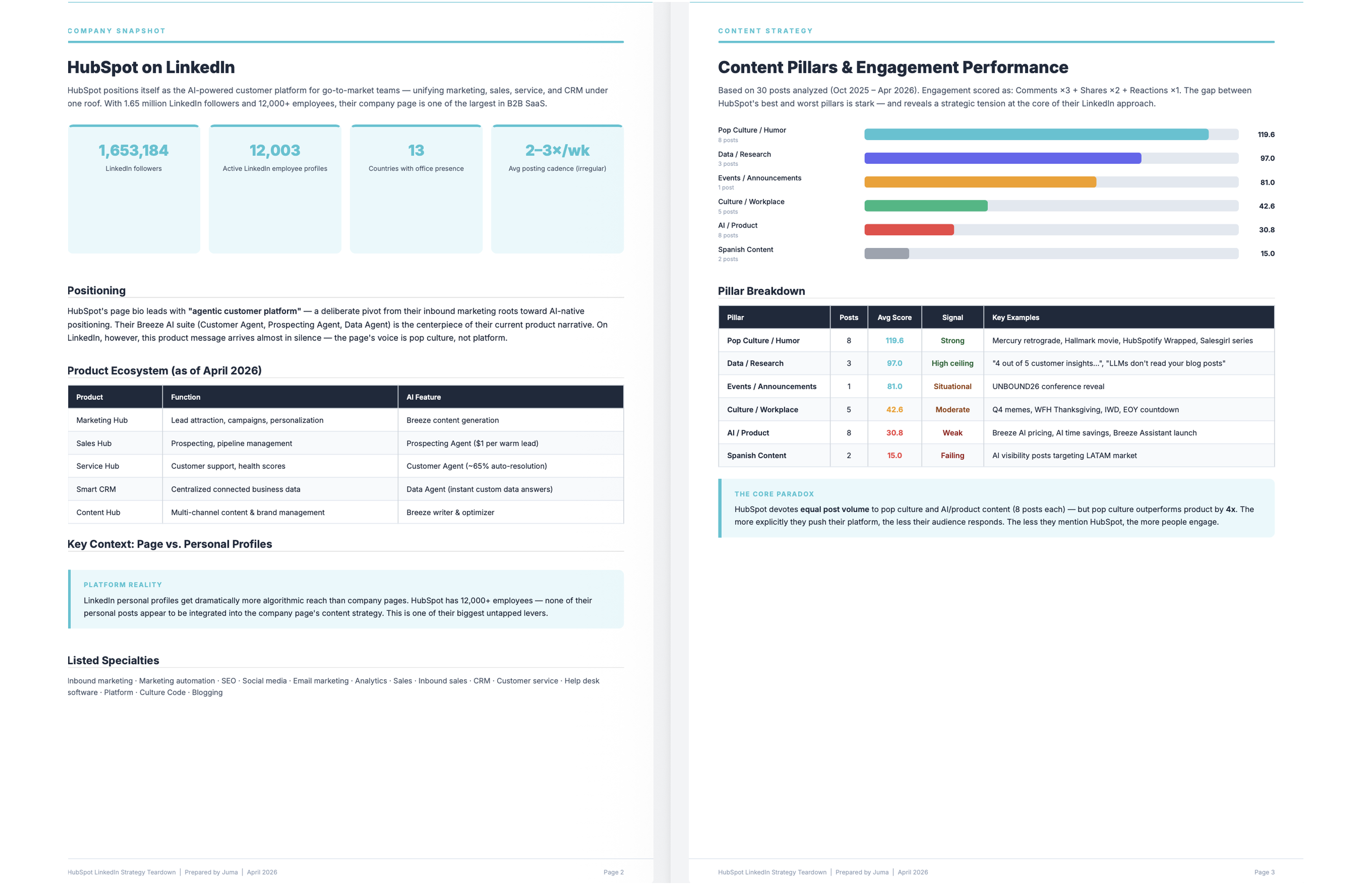
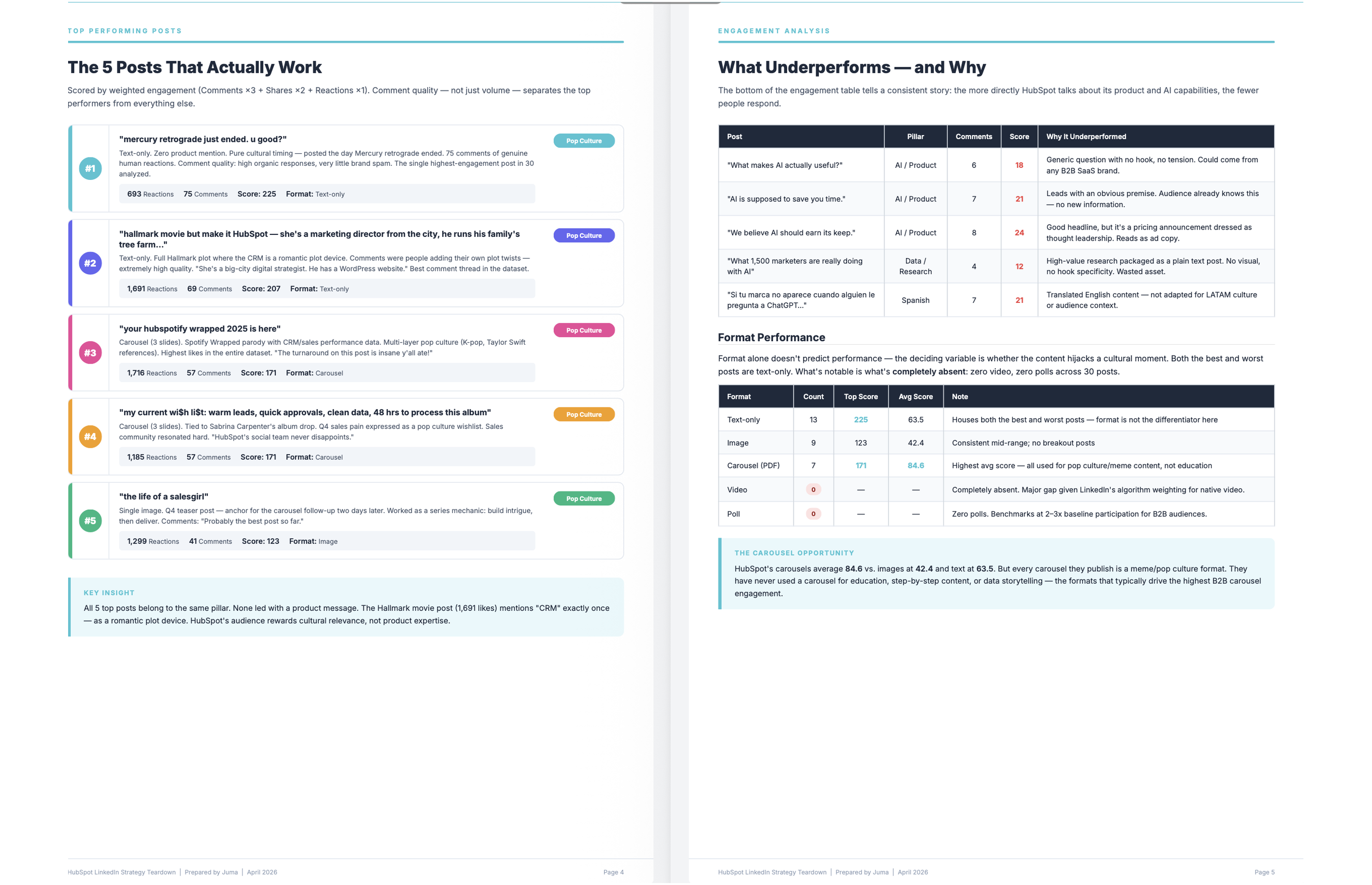
The teardown maps six dimensions of a company's LinkedIn presence: content pillars and how often each appears, format mix across text, carousel, video, and poll, posting cadence and consistency, engagement patterns by topic, voice characteristics, and content gaps. Each dimension draws on evidence from actual posts, giving you a structured document rather than a general impression.
Content pillars are the most revealing dimension. They show what the company has decided its LinkedIn presence should be about, which rarely matches how the company describes itself in marketing materials. Format mix matters because different companies achieve very different results from the same formats.
A teardown makes format analysis specific: not just "they use carousels" but "carousels generate the highest comment rates for this company on this topic." Engagement pattern analysis separates topics that generate genuine conversation from topics that generate passive reactions. Together, these six dimensions give you a complete read of how the company uses LinkedIn as a channel.
Can I run a LinkedIn competitor analysis on multiple companies?
Yes. Run the Flow separately for each company and compare the outputs side by side. This is the most effective way to run a LinkedIn competitor analysis: a single teardown shows what one company does, while comparing three reveals category-wide patterns, shared format conventions, and the topics no competitor addresses.
Comparing multiple teardowns reveals patterns that a single-company analysis cannot show. You can see whether all competitors share the same content pillars or whether one company has staked out a distinct position. You can identify format conventions: if every competitor uses carousels for product education, that is the category standard.
You can also spot the collective gap: topics that no competitor covers but that the audience asks about in comments. Most agency teams run this analysis at the start of a new engagement, producing teardowns on two or three competitors before building the client's LinkedIn content strategy. The comparison gives the strategy a competitive foundation rather than a blank page.
How does Juma identify gaps in a company's LinkedIn posting strategy?
Juma identifies gaps by comparing what the company posts on LinkedIn against what they publish on their website, blog, and other public channels. Topics covered in long-form content but absent from LinkedIn appear in the teardown as content gaps. The output also flags themes the audience raises in comments that the company never follows up on.
Two types of gaps appear in every teardown. The first is the website gap: topics covered in long-form content, product pages, or case studies that never surface in LinkedIn posts. This gap is common in companies where the content team and social team operate independently, with no systematic process for turning web content into LinkedIn distribution.
The second is the audience gap: questions and topics that surface in post comments, which the company acknowledges but never follows up on with dedicated content. Both gaps share the same root: the company treats LinkedIn as a broadcast channel for decided content, not a distribution channel for what it knows. The teardown makes both gaps explicit and prioritized.
What is the best way to use the teardown output?
The most effective use is as a comparison document, not a standalone report. Run teardowns on two or three competitors, organize the outputs side by side, and use the comparison to identify category-level patterns, what one company does differently, and the topics no competitor covers, which represent the strategic gap your client can own.
Teams also use the teardown as a reference before building a new LinkedIn strategy, as a benchmark for quarterly reviews, or as a briefing document before pitching a client on a content overhaul. It works as a training resource for understanding what effective LinkedIn content marketing strategy looks like in a specific industry.
For client-facing work, the teardown gives the strategy conversation a shared reference point. Both the agency and the client work from the same structured document rather than debating impressions of a competitor's LinkedIn page. Running the same analysis quarterly on the same company produces a picture of how their LinkedIn content strategy evolves over time.
.webp)