Set up your client project: customer data, sales process, and past ICP work
A Juma Project is a shared space where the team stores everything Juma needs to know about a client. Create one project per client, add context as you go, and Juma will use what's relevant every time the team runs a flow. The more the team adds over time, the sharper every output gets.
What to add
Customer Data Summary
What the team knows about existing customers: deal sizes, win rates, industry distribution, common churn patterns, and any CRM data that grounds the ICP in reality. This is the file that changes output quality the most. With real data, the ICP will reflect who actually buys, not who the team hopes will buy.
Sales Process Overview
How deals move through the pipeline: typical sales cycle, team structure, key evaluation criteria, and common blockers. This shapes the qualification scorecard and the buying committee personas so they match how the team actually sells.
Past ICP Documents
The most recent ICP. When updating, Juma will compare new research against the previous version and call out what shifted: new industries gaining traction, changing company size sweet spots, or competitive moves that altered the landscape.
ICP Template
If the team's ICPs need to follow a specific structure or format, upload a template or a past ICP as a reference. Juma will match the structure instead of using its default layout.
Guide Juma with project info
Add a short description to each knowledge item in the project's info field so Juma knows what each file contains and when to use it. For example:
- Customer Data Summary: "Closed-won deal analysis from 2025. Use to ground ICP in real customer patterns."
- Sales Process Overview: "How enterprise deals move through the pipeline. Reference for qualification scorecard."
- Past ICP: "Current ICP from Q3 2025. Compare against when doing a refresh."
Build an ICP your sales team will actually use
Frequently Asked Questions
How much time does this Flow save compared to building an ICP manually?
This Flow reduces ICP creation from 2 to 3 days of manual research to a single working session. Juma handles the research phase automatically, covering the brand's website, pricing, case studies, and competitive positioning before asking a single question. The team receives a complete, structured ICP document the same day rather than waiting for a multi-day sprint.
Manual ICP work typically involves pulling competitive data, synthesizing CRM patterns or customer interviews, drafting firmographic and technographic criteria, and formatting the full document for the sales team. It also requires multiple revision rounds before the team agrees on disqualification thresholds and buying signals. This Flow compresses all of that into one session by structuring the document, including firmographics, technographics, buyer personas, and a MEDDPICC scorecard, from the research and context it collects upfront.
What does a complete ideal customer profile document include?
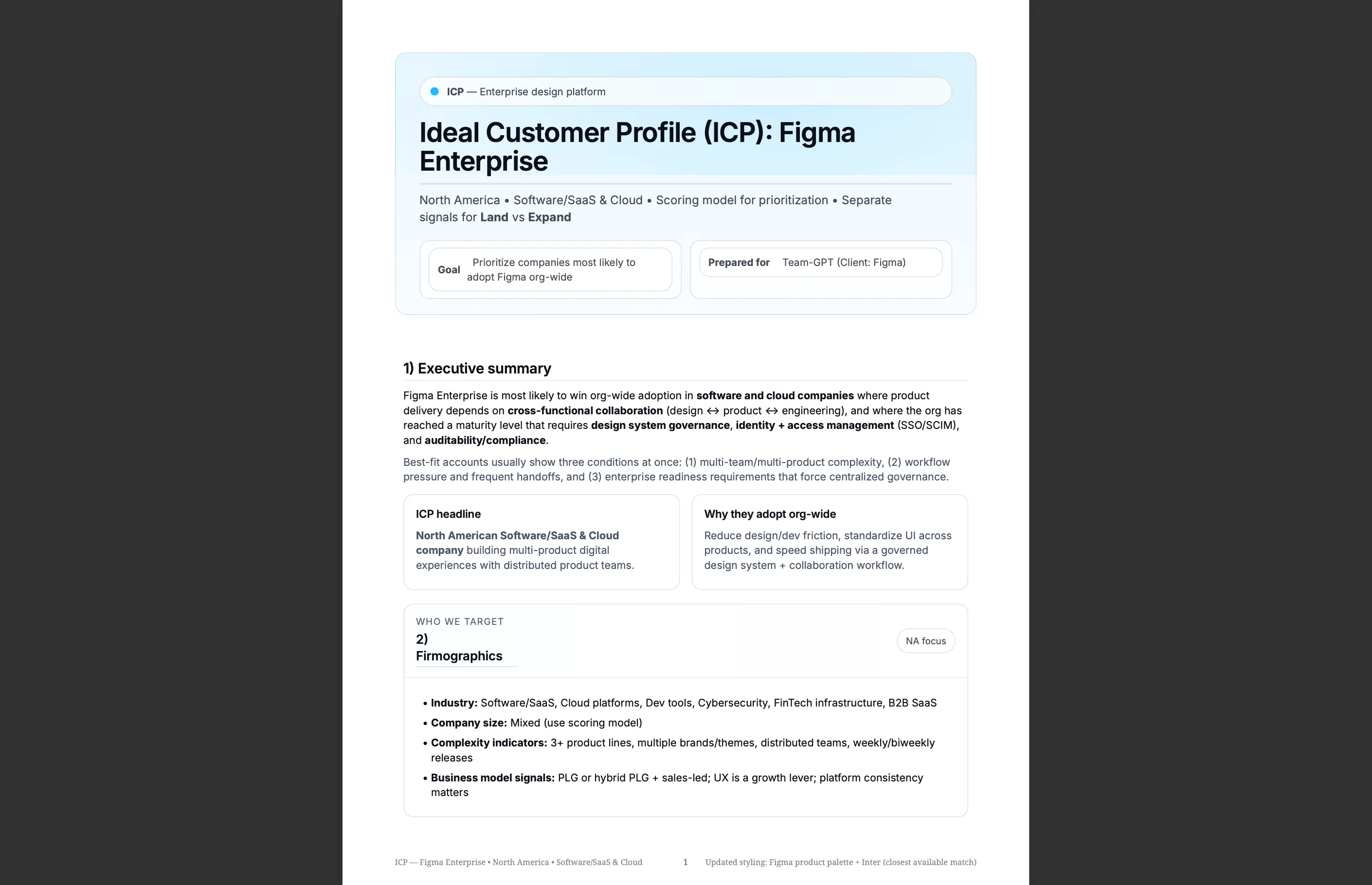
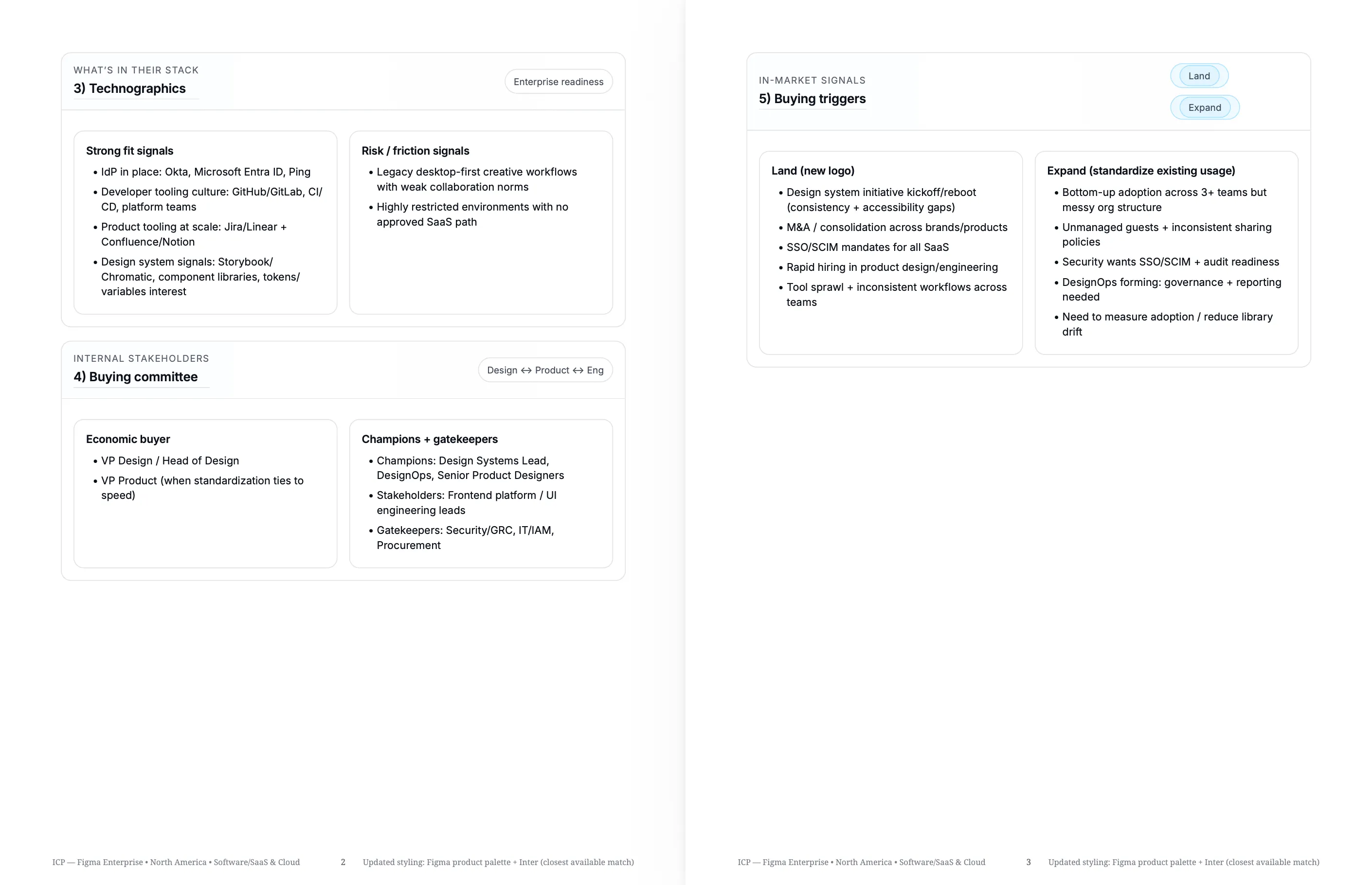
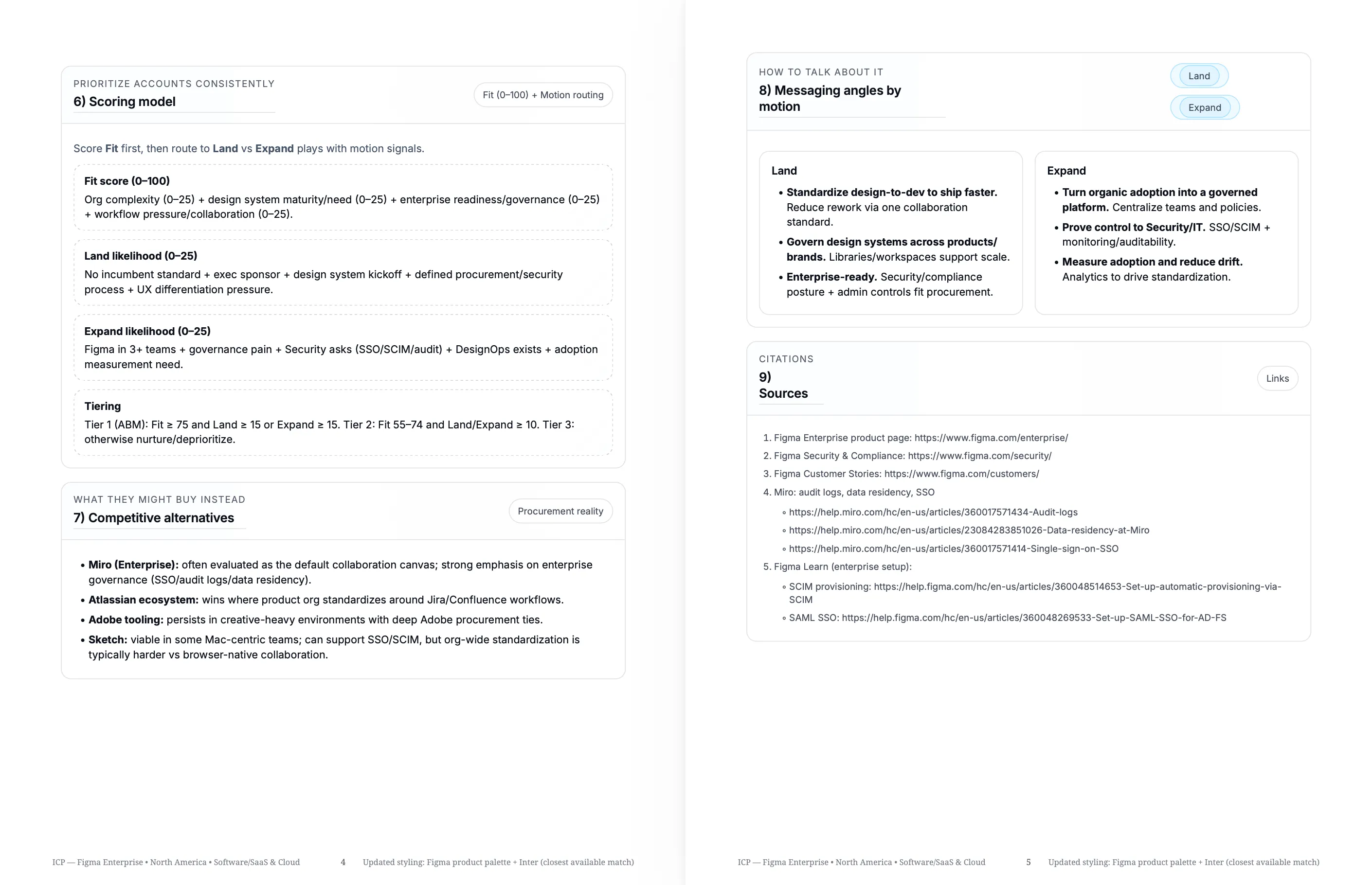
A complete ICP document covers nine components: firmographics, technographics, observable buying signals, buyer personas for each buying committee role, objection rebuttals, a MEDDPICC qualification scorecard, reference customers, look-alike target profiles, and explicit disqualification criteria. Every data claim in the document is sourced.
Each component is built out in full:
- Firmographics: Company size, annual revenue, headcount ranges, geographic spread, and industry tiers with the reasoning behind each threshold
- Technographics: Tools that signal readiness to buy and tools that signal migration friction or competitive conflict
- Buyer personas: Champion, economic buyer, blocker, and influencer, each with background, goals, pain points, evaluation criteria, likely objection, and winning message
- MEDDPICC scorecard: A qualification framework the team can apply to active deals
- Disqualification criteria: Specific conditions that tell reps to walk away before investing qualification time
Why do ICPs need disqualification criteria, not just fit criteria?
Disqualification criteria identify which accounts to walk away from, and this is as important as knowing who to target. Without them, sales teams spend cycles on accounts that match positive criteria but fail on signals the ICP never addressed: the wrong tech stack, the wrong buying committee structure, or a deal size that cannot support the sales cycle.
Most ICPs describe who to target in detail but say very little about who not to pursue. That gap creates real cost at the deal level. A company might look ideal on firmographic criteria but have a procurement process that makes a close impossible within a standard sales cycle, or a tech stack that creates migration friction the team underestimates during qualification. Clear disqualification thresholds give reps a binary check at the start of qualification: the account passes or it does not. This Flow builds disqualification criteria with the same rigor as fit criteria.
Can I use my own ICP template format?
Yes. Upload a custom ICP template to the project and Juma will match that structure instead of using the default layout, including section order, naming, and level of detail in each section. The uploaded template does not need to be complete; a working draft with the right structure is enough.
This is useful for agencies managing multiple clients where a consistent document format matters as much as the content itself. It is also useful for teams where ICP documents are shared with senior leadership or board members who expect a specific format. If the uploaded template includes placeholder language or explanatory notes, Juma will use those as guidance for what level of detail to include in each section. To use this feature, add the template as a file to the Juma project before running the Flow. Juma references it automatically when structuring the output.
Does this Flow work for both PLG and outbound sales teams?
Yes. This Flow produces a different ICP depending on the sales motion you describe. A PLG ICP focuses on activation signals, free-to-paid conversion thresholds, and expansion triggers. An outbound ICP focuses on prospecting triggers, buying committee access, and deal-size economics.
The sales motion shapes the ICP criteria at a structural level because the signals that predict success in a product-led model are fundamentally different from those in an outbound model. In a PLG ICP, technographic signals identify which companies will activate quickly. In an outbound ICP, they identify which companies have the infrastructure to adopt your product at the deal size the sales cycle requires. A hybrid model produces an ICP that distinguishes between the self-serve and enterprise paths and defines which firmographic signals route a company toward each. The Flow asks about your sales motion early in the session so every section reflects how the team actually sells.






.webp)
.webp)