
A leadership team is ten minutes from its monthly portfolio review. Someone has exported a dashboard. Someone else has updated a slide deck. The programme lead has a spreadsheet open because the dates in the dashboard do not match the dates in the deck.
The launch is still marked green. Yet a dependency has slipped, a critical decision has not been made, and the team closest to the work has stopped believing the status report. Nobody in the room is trying to mislead anyone. The organisation simply has more work, more tools, and more partial versions of the truth than its delivery rhythm can absorb.
That scene is a composite, but the pattern is familiar to Ivan Vaptsarov, founder and principal consultant at PM Peer. Across more than 15 years in project and PMO roles, including corporate transformations, M&A integrations, and operational programmes, he has seen how delivery gets lost long before a project is formally declared late. The problem is often not a missing methodology. It is the gap between what the plan says and what people know.
AI will change that gap. It will not remove the need for a person to decide what matters.
Key takeaways
- The future of project management depends less on faster reporting and more on a shared, trustworthy view of delivery reality.
- AI project management can remove coordination work, but it cannot settle trade-offs, own risk, or create commitment between leaders.
- Ivan Vaptsarov’s work across project delivery, PMOs, operations, and AI adoption points to the same starting place: understand the work before selecting the technology.
- Agentic project management is useful when agents can observe work, prepare options, and hand decisions back to accountable people.
- Jumira should be evaluated as an emerging agentic project-management product against that standard, not as a substitute for governance.
What is changing in the future of project management?
The future of project management is moving from manually collecting updates to continuously making sense of delivery signals. AI can read meeting notes, compare plans with actual activity, draft status updates, and surface dependencies that a busy team might miss. The practical change is not that projects suddenly manage themselves. It is that project leaders can spend less time assembling a picture of the work and more time deciding what to do about it.
That distinction matters in companies with more than 100 employees. Delivery information usually lives across project software, spreadsheets, email, chats, product tools, finance systems, and people’s heads. A weekly status meeting becomes a ritual for reconciling fragments. The reporting burden grows as the portfolio grows, but the quality of the underlying signal does not necessarily improve.
The best use of AI project management is therefore quite ordinary: reduce the work required to notice a problem early. When AI turns a scattered set of updates into a concise account of a decision, an owner, a date, and a risk, it gives the team something a dashboard often does not: a usable conversation.
Why do experienced project leaders still start with the operating model?
Experienced project leaders start with the operating model because technology exposes weak ownership faster than it fixes it. An AI tool can summarise a meeting in seconds, but it cannot decide whether the summary has an owner, whether the owner has authority, or whether an escalation will lead to a decision. If those conditions are missing, teams get a cleaner version of the same delivery problem.
Vaptsarov’s public work makes this point from several directions. PM Peer works with organisations on delivery structure, planning cadence, risk control, portfolio visibility, PMO design, and AI adoption. Its approach to AI adoption begins with process mapping and use-case prioritisation before a tool rollout. That sequence is sensible. A process map exposes handoffs, exceptions, and unclear decisions that a generic automation project can easily overlook.
The firm’s case studies show what this looks like in practice. In a retail values rollout reaching more than 4,000 employees across 150 locations, the delivery approach included a master plan, risk management, stakeholder alignment, and a real-time execution rhythm. In a finance portfolio spanning 20-plus key accounts, the work focused on common definitions and decision-ready reporting. Neither example begins with software. Both begin by making the work governable.
For executives, this is a useful test before buying anything: can we name the decisions that slow delivery, the people who own them, and the evidence they need? If the answer is no, an AI implementation plan is premature.
What can AI project management take off a team’s plate?
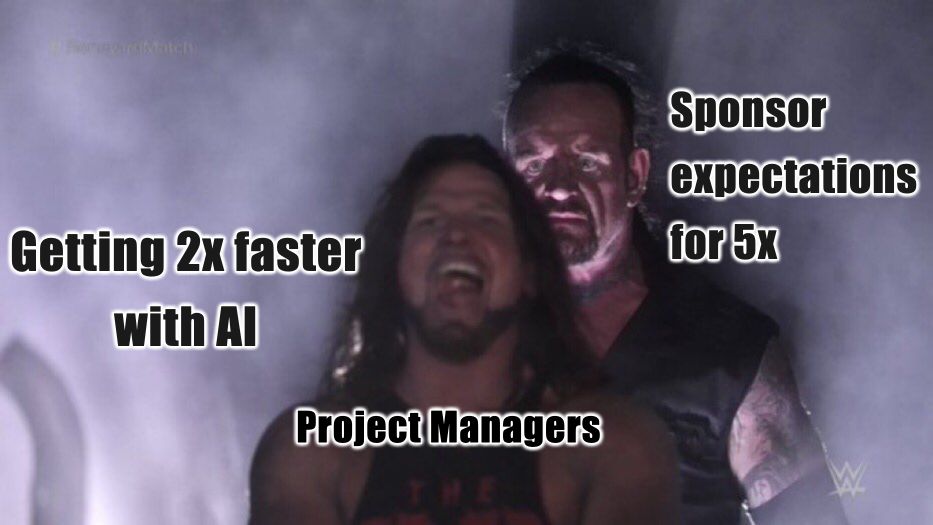
AI project management can take over repetitive coordination tasks when the organisation has clear sources of truth and clear rules for review. It can draft project briefs from a decision record, turn a workshop into actions, compare planned milestones with current activity, flag items that have not moved, and prepare a first version of a weekly update. These are useful tasks because they consume attention without always requiring senior judgment.
There is a less obvious benefit. Project teams often know that a risk exists but delay documenting it because the work feels administrative or politically uncomfortable. A well-designed AI workflow can make the first step easier. It can identify an unresolved dependency, collect the supporting context, and draft a neutral escalation. The programme lead still decides whether to send it and what response to seek.
That is the boundary worth protecting. AI can describe what it sees. It can organise evidence. It can propose a sequence. It should not quietly redefine priorities, commit budget, or close a risk because a workflow reached a confidence threshold. Those acts carry organisational consequences.
The role of the future project manager is likely to move further toward interpretation and intervention. Good project managers will still structure ambiguous work, draw out disagreement, understand incentives, and help a sponsor see a trade-off that no weekly report could resolve. AI gives them more time for those jobs if teams resist the temptation to turn automation into authority.
What is agentic project management, and where does it fit?
Agentic project management uses AI agents to follow a goal through several connected steps, then return a reviewable result to the team. Instead of asking for a one-off status summary, a leader might ask an agent to gather updates from agreed sources, identify mismatches between scope and schedule, draft a risk register, and prepare questions for the next steering meeting. The value comes from the sequence and the traceability of the output.
The phrase can invite inflated expectations, so it needs a practical definition. An agent is useful in delivery work when it has a clear scope, access only to approved sources, an understandable sequence of actions, and a human checkpoint before consequential work happens. Without those controls, it becomes another black box attached to a project plan.
For an executive team, a good first agentic workflow is usually narrow. Consider a recurring portfolio review. The agent can collect updates from project owners, identify missing information, compare each update with the prior week, and prepare a briefing that names decisions required. The executive sponsor reads the briefing, asks harder questions, and makes the call. That is a better use of automation than trying to create an autonomous project manager.
A narrow pilot also produces learning. Teams find out which sources are reliable, which fields nobody maintains, and which exceptions need human handling. That information is more valuable than a polished demo because it changes how the organisation designs the next workflow.
What should executives ask before introducing an AI project manager?
Executives should ask where a proposed AI project manager gets its information, what it can change, who reviews its outputs, and how decisions remain accountable. Those questions sound basic, yet they separate an assistive delivery system from a layer of ungoverned automation. They also keep a tool evaluation tied to the operating realities of the organisation.
Start with four questions:
- Which delivery decision will improve? Name a decision such as resource allocation, scope trade-off, escalation, or launch readiness. “Better visibility” is too vague.
- Which data can the workflow trust? If status, budget, and dependency data conflict today, an agent will reproduce the conflict faster.
- What must stay human? Set clear boundaries for approvals, client commitments, budget changes, and risk acceptance.
- What changes in the team’s weekly rhythm? A tool only earns its place if it reduces a real meeting, handoff, or reporting burden.
PM Peer’s AI-adoption approach is relevant here because it treats adoption as delivery work: map the process, prioritise a small number of use cases, pilot, and build ownership into the rollout. That is less glamorous than announcing an AI transformation. It is more likely to survive contact with a real organisation.
Where does Jumira fit in an agentic project-management model?
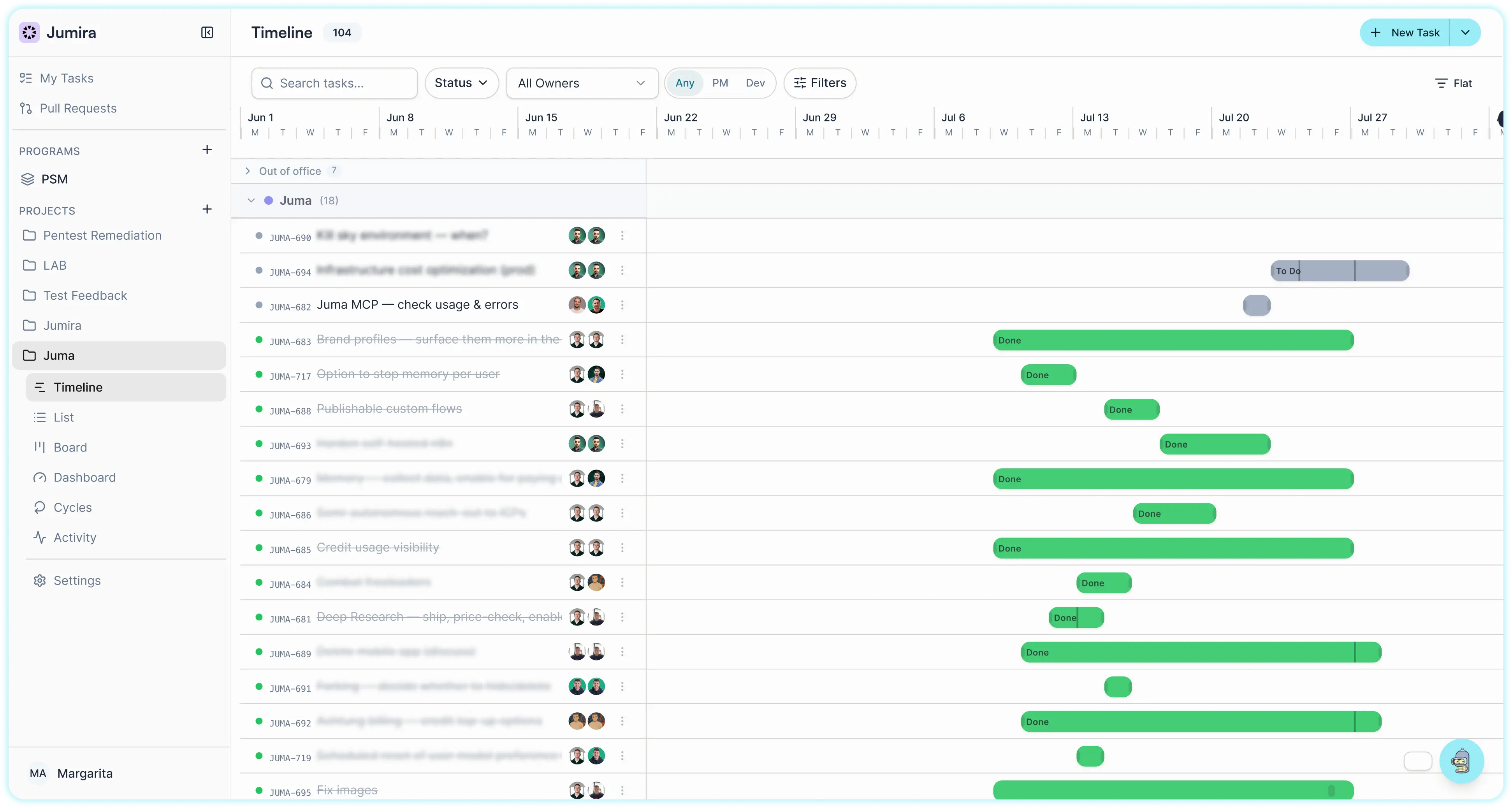
Jumira is a Juma Labs product being developed for agentic project management, and it should be judged by whether it helps teams maintain a more reliable delivery rhythm. The useful question is not whether it can generate a plan or write a progress report. The useful question is whether it can connect approved project context, make gaps and dependencies visible, and prepare accountable people to act.
Jumira’s intended role fits the category described above: an agentic layer that can help teams move from scattered project signals to reviewable delivery outputs. In a mature setup, that could mean preparing a decision brief, compiling a cross-functional status update, or surfacing a mismatch between a commitment and the evidence behind it. The team remains responsible for the decision.
That framing is deliberate. Project management tools often promise a single source of truth, but truth depends on habits. If people do not update decisions, explain changes, or name risks, no product can invent dependable governance. Jumira should reduce the friction of doing those things. It should not pretend that a project has an owner when it does not.
Product fact-check before publication: Confirm Jumira’s launch status, supported integrations, permission model, workflow capabilities, and CTA. Keep this section descriptive until those details are approved.
What does a responsible AI adoption path look like?
A responsible AI adoption path starts with one recurring delivery problem, tests a controlled workflow, and expands only after the team trusts the result. It does not begin with an enterprise-wide tool rollout. It begins with a job that people already do poorly or reluctantly, such as collating a weekly portfolio update or chasing actions after a steering meeting.
A practical sequence has five parts:
- Map the current process, including informal workarounds and decision bottlenecks.
- Choose a use case with clear value, known inputs, and limited consequences if the first version is wrong.
- Give the workflow explicit sources, access boundaries, and an accountable reviewer.
- Compare its output with the existing process for several cycles. Measure time saved, omissions caught, and decision quality.
- Document what changed, then decide whether to expand the workflow or stop it.
This approach gives AI a proper place in the organisation. It treats it as a capability that needs design, feedback, and supervision. Companies that do this well may find that the most important gain is not speed. It is a clearer shared understanding of what work is happening, where it is stuck, and who needs to decide.
FAQ
What is the future of project management?
The future of project management combines human leadership with AI systems that collect, interpret, and prepare delivery information. Project managers will spend less time chasing routine updates and more time resolving ambiguity, managing stakeholders, and helping leaders make trade-offs. AI supports the work; accountable people still own the decisions.
Can AI replace a project manager?
AI can automate parts of project coordination, including meeting summaries, action tracking, status drafting, and early risk signals. It cannot replace the work of building commitment, resolving conflict, accepting risk, or making context-specific trade-offs. Those responsibilities remain human because they involve authority, relationships, and judgment.
What is agentic project management?
Agentic project management uses AI agents to carry out a defined sequence of delivery tasks, such as gathering updates, checking for inconsistencies, preparing a risk summary, and drafting questions for a review meeting. A responsible system keeps the workflow visible and returns consequential decisions to accountable people.
How should a company begin with AI project management?
Begin with one recurring coordination problem that has clear inputs and an accountable owner. Map the existing process, test an AI-assisted workflow with a human reviewer, and compare its output with the current method for several cycles. Expand only when the workflow improves a real decision or reduces a measurable burden.
Sources and editorial notes
LinkedIn Carousels

Competitor Analysis

GEO Optimized Articles

Google Analytics Reports


%20(1).webp)



Private cloud deployment - AWS, Azure, GCP
SSO / SAML + platform administration
Security review support + DPA
Custom contract & SLA
Dedicated account manager & priority onboarding
Invoicing + custom billing terms