Set up your client project: past webinar results, audience sizes, and the brand voice guide
A Juma Project is a shared space where the team keeps everything Juma needs to know about a client. Create one project per client, add context as the relationship grows, and Juma uses whatever is relevant each time the team runs a Flow. For webinar planning the gain is specific: published benchmarks give the model a starting show-up rate, and the project replaces them with what this client's audience has actually done.
What to add
Past Webinar Results
Registrations, live attendance and show-up rate for every session the client has run, with where the registrations came from. This is the file that changes the output most. With it, the registration target is derived from the client's own attendance rate rather than an industry average, and the channel split starts from what has worked before instead of a reasonable guess.
Audience and List Sizes
Email list size by segment, social following, community and partner reach, and any advertising audiences already built. The channel table needs real volumes to be worth anything. Without them a target of 200 registrations from email is a number with nothing behind it, and with them the Flow can say plainly when the audience is too small for the goal.
Brand Voice Guide
How the client writes: tone, vocabulary, the words they avoid. Nine emails, a registration page and a set of social posts all come out of one run, so voice applies across the whole kit at once. With this in the project the first draft arrives in the client's register rather than in a house style someone has to rewrite.
Event and Consent Rules
Which lists may be mailed, the opt-in rules in the client's markets, recording and consent requirements, and who signs off on speaker claims. Webinar promotion touches marketing permission more than most campaigns, and with these rules in the project the sequence is built around them instead of being corrected after legal reads it.
Guide Juma with project info
Each knowledge item takes a one-line description in project info. That line tells Juma what the file holds and when to reach for it.
- Past Webinar Results: "Attendance and source data from previous sessions. Use these rates in place of published benchmarks."
- Audience and List Sizes: "Real reach by channel. Use for the channel volumes and flag when the target exceeds what the audience can produce."
- Brand Voice Guide: "How the client writes. Apply to every email, page and post in the kit."
- Event and Consent Rules: "Mailing permissions and sign-off rules. Build the sequence within them."
Fill the room before you book the speakers
Frequently Asked Questions
What does the webinar promotion plan include?
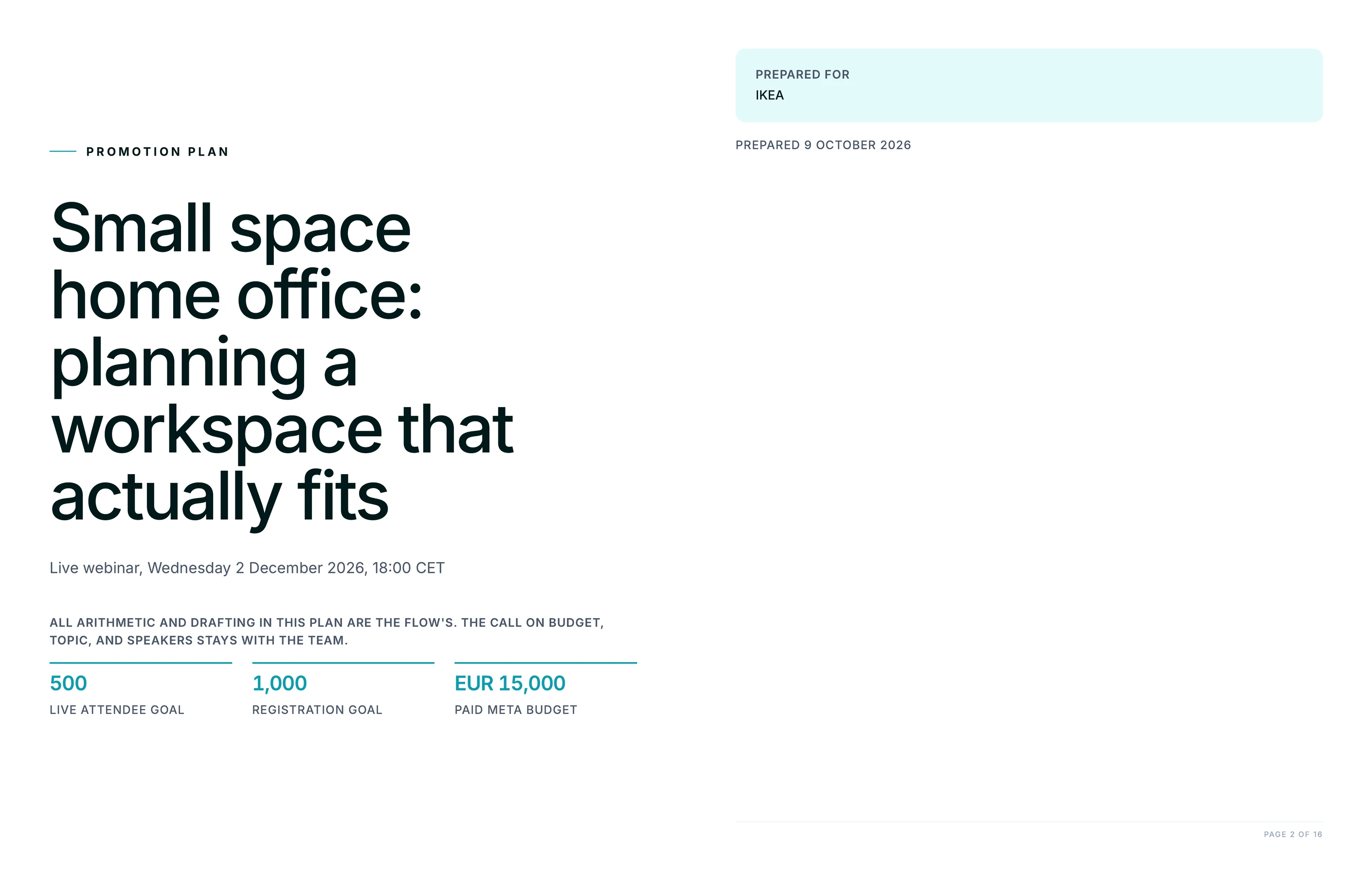
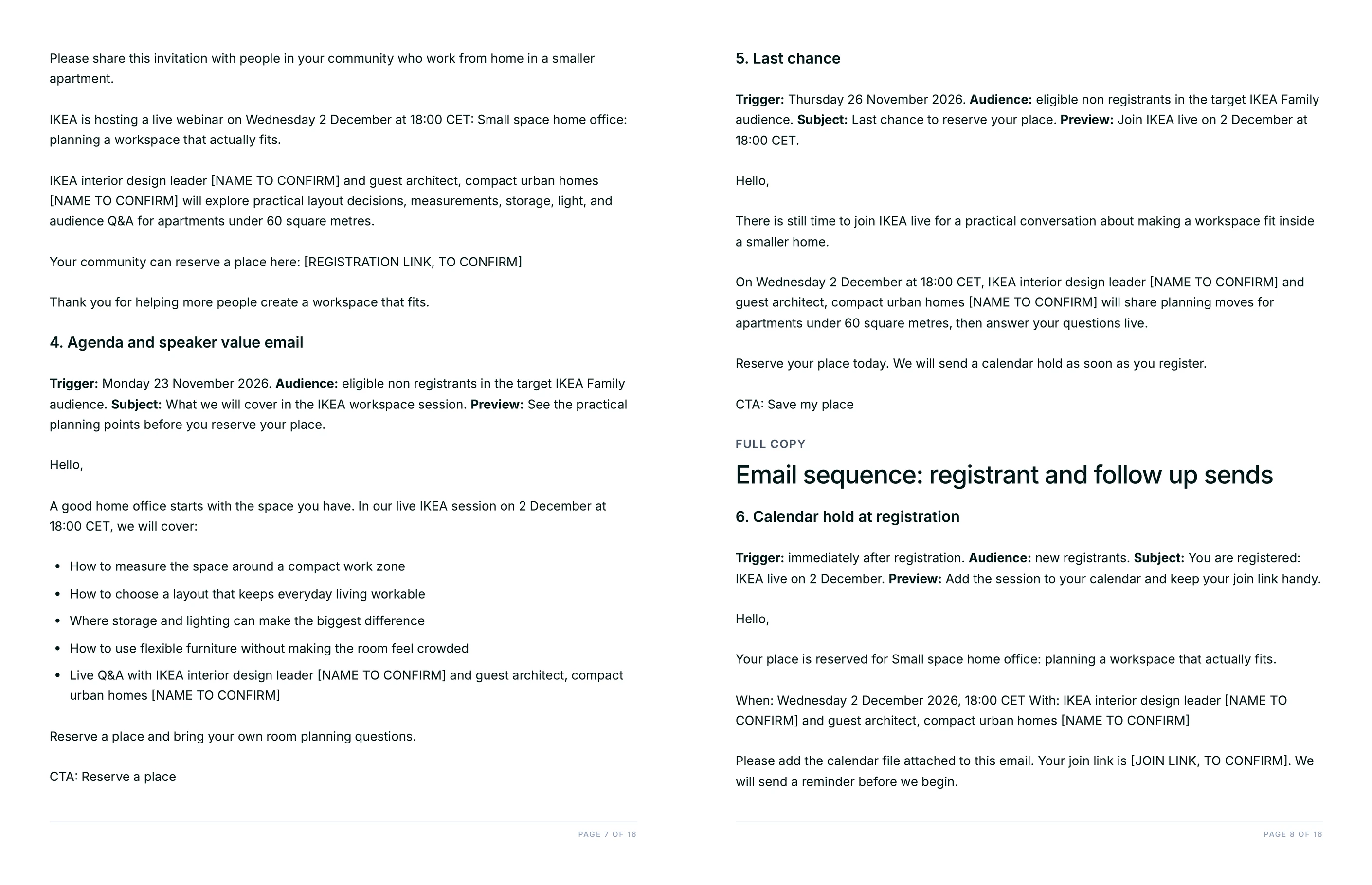
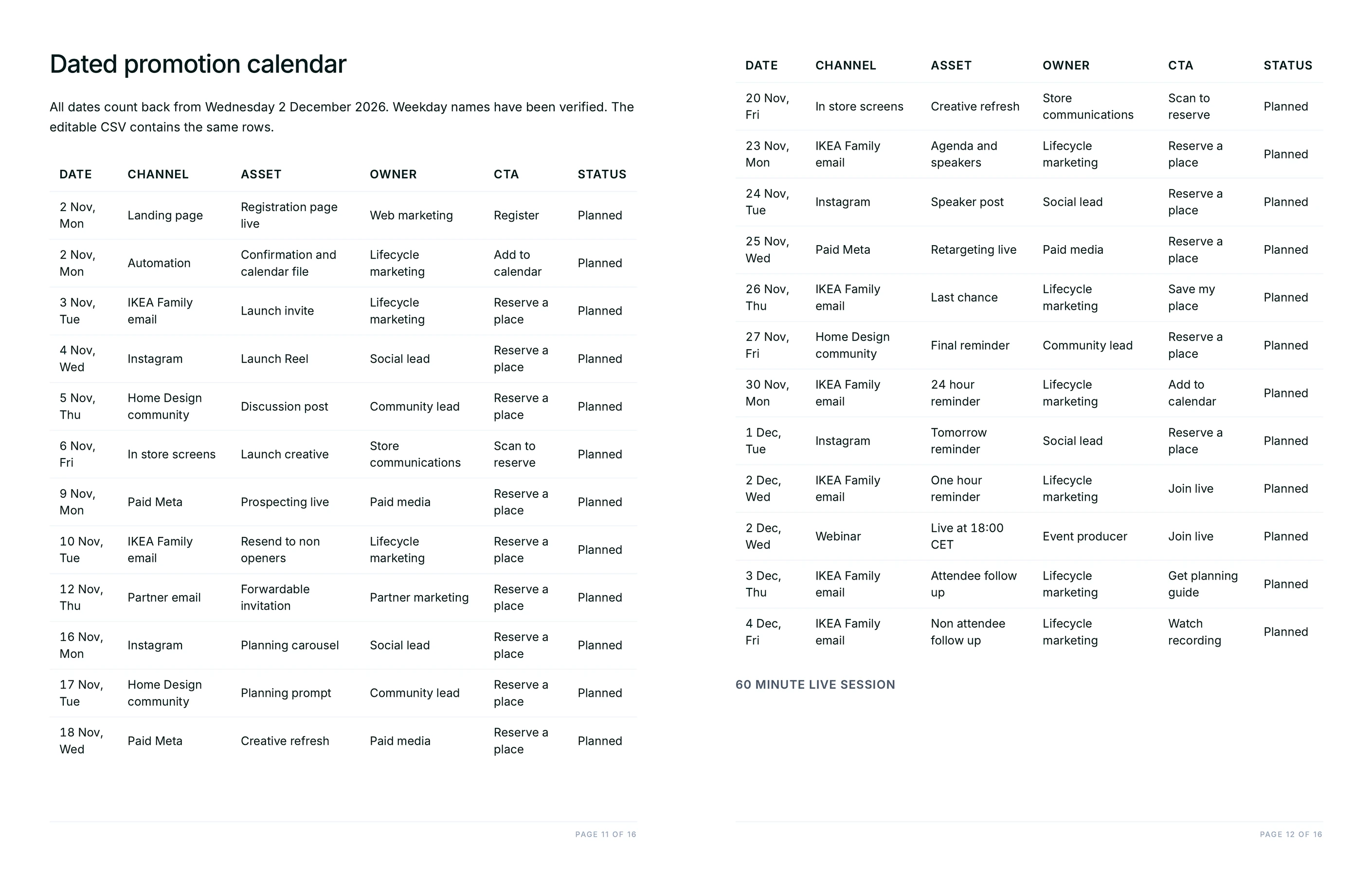
A branded PDF and an editable CSV. The PDF carries a go or no-go read on the topic, the registration model reconciled channel by channel, a paid budget with cost per registration, the landing page and social copy, nine fully written emails, a run-of-show with minute markers and a contingency decision with named thresholds. The CSV holds the promotion calendar.
The split matters in practice. The PDF is what a client approves in a meeting, and the CSV is what the person running the campaign works from, one dated row per asset carrying its weekday, channel, owner, call to action and status. Nobody has to retype a schedule out of a slide, and when the date moves the calendar is the single thing that gets rebuilt.
How does the Flow work out how many registrations are needed?
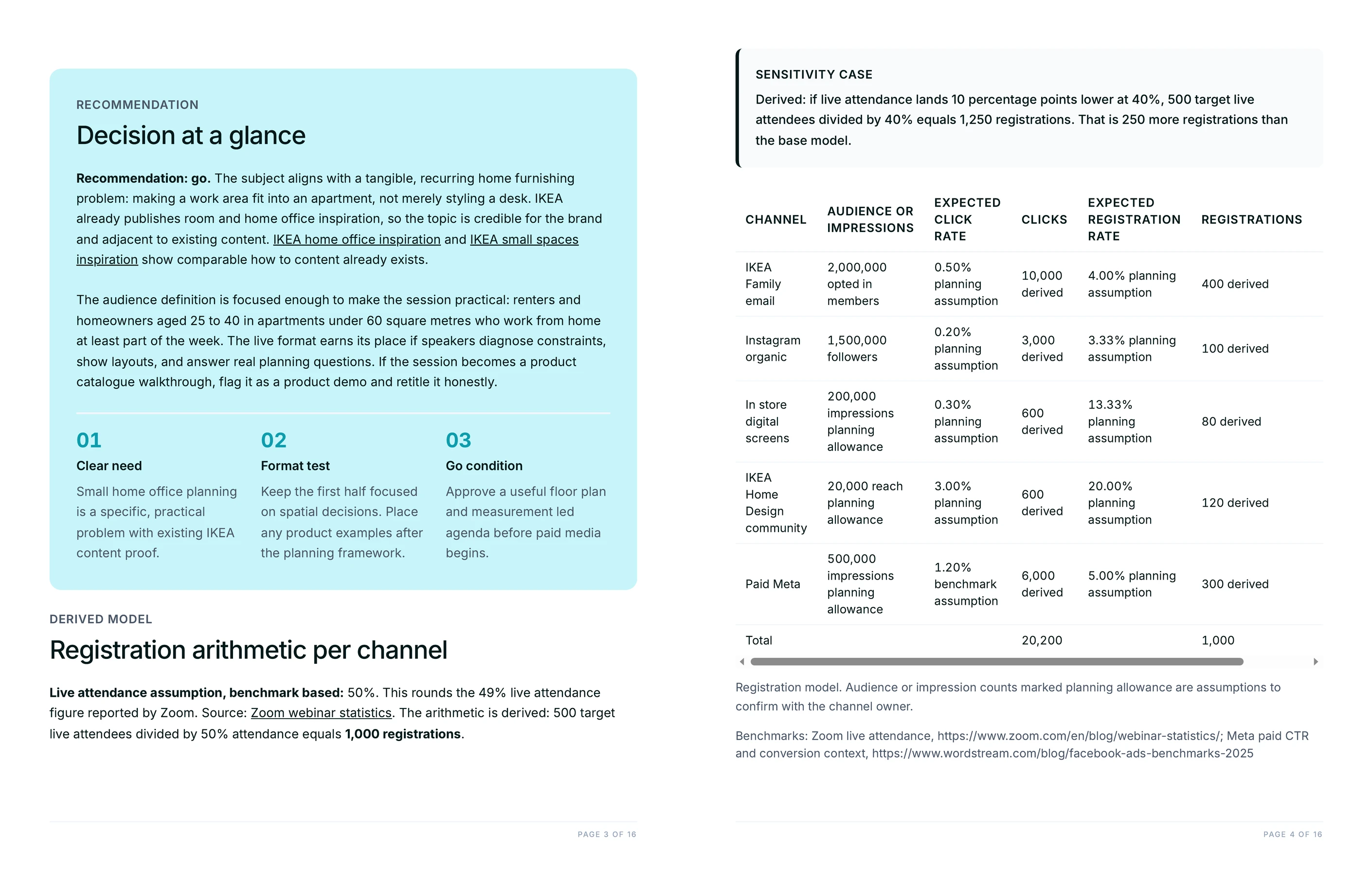
It works backwards from the number of people who need to be live. The attendance target is divided by a registration-to-attendance rate, which is stated as a labelled assumption with the source it came from, and the resulting registration goal is then split across channels with the arithmetic printed for each one.
Every channel row shows audience size or impressions, the expected click rate, the clicks that produces, the expected registration rate and the registrations that follow. The rows sum to the total, and the total multiplied by the attendance rate is reconciled against the original goal on the page, so the model can be argued with rather than taken on trust. A sensitivity case shows what the registration requirement becomes if attendance lands ten points lower, which is the number worth knowing before the budget is signed.
Why does the Flow write two different post-webinar emails?
Because the people who turned up and the people who did not need different things. Attendees get the replay as a reminder and a next step that assumes they heard the argument. Registrants who missed it get the replay as the main event, framed around what they still have not seen.
The second group is usually larger than teams expect and it is where most of the pipeline from a webinar sits. Sending both groups the same "thanks for joining" note wastes the no-shows entirely and reads carelessly to anyone who was there. Both emails come with their trigger, audience, subject line, preview line and body, alongside the suppression rule that takes a registrant out of the invite stream the moment they sign up.
How is this different from a campaign plan or a content calendar?
This Flow plans one dated event with a headcount to hit. A campaign plan sets direction across a quarter and a content calendar governs an ongoing posting rhythm, and neither one answers the question a webinar actually poses, which is how many people have to click for the right number to be in the room on the day.
If the job is the wider campaign, brainstorm marketing campaign ideas owns the concepts and build a campaign audience brief owns the segmentation. Create a social media calendar owns the ongoing cadence this event sits inside, and write an onboarding email sequence picks up the people who convert afterwards. They work well in sequence with this one.
Does this work for a webinar with no advertising budget?
Yes, and the plan changes shape rather than shrinking. With no paid line the model leans on owned email, partner and community forwards and organic social, and the cost per registration section is replaced by what each channel has to deliver instead.
It also becomes more honest about the ceiling. When the arithmetic shows the available audience cannot produce the registrations the target needs, the Flow says so and gives the options, which are a lower attendance target, more partner reach, or a longer promotion window. That is the conversation worth having three weeks out rather than on the morning of the event. Juma does the arithmetic and the drafting, and human review stays on every output before anything reaches a list.






.webp)