Content Writing
Social
No items found.

Write a YouTube video script with AI: Hook, story beats, B-roll notes & a timed CTA

Give Juma a brand and a topic, and this YouTube script generator returns a ready-to-shoot script: a timed hook, story beats, B-roll notes, lower-third captions, and a CTA.

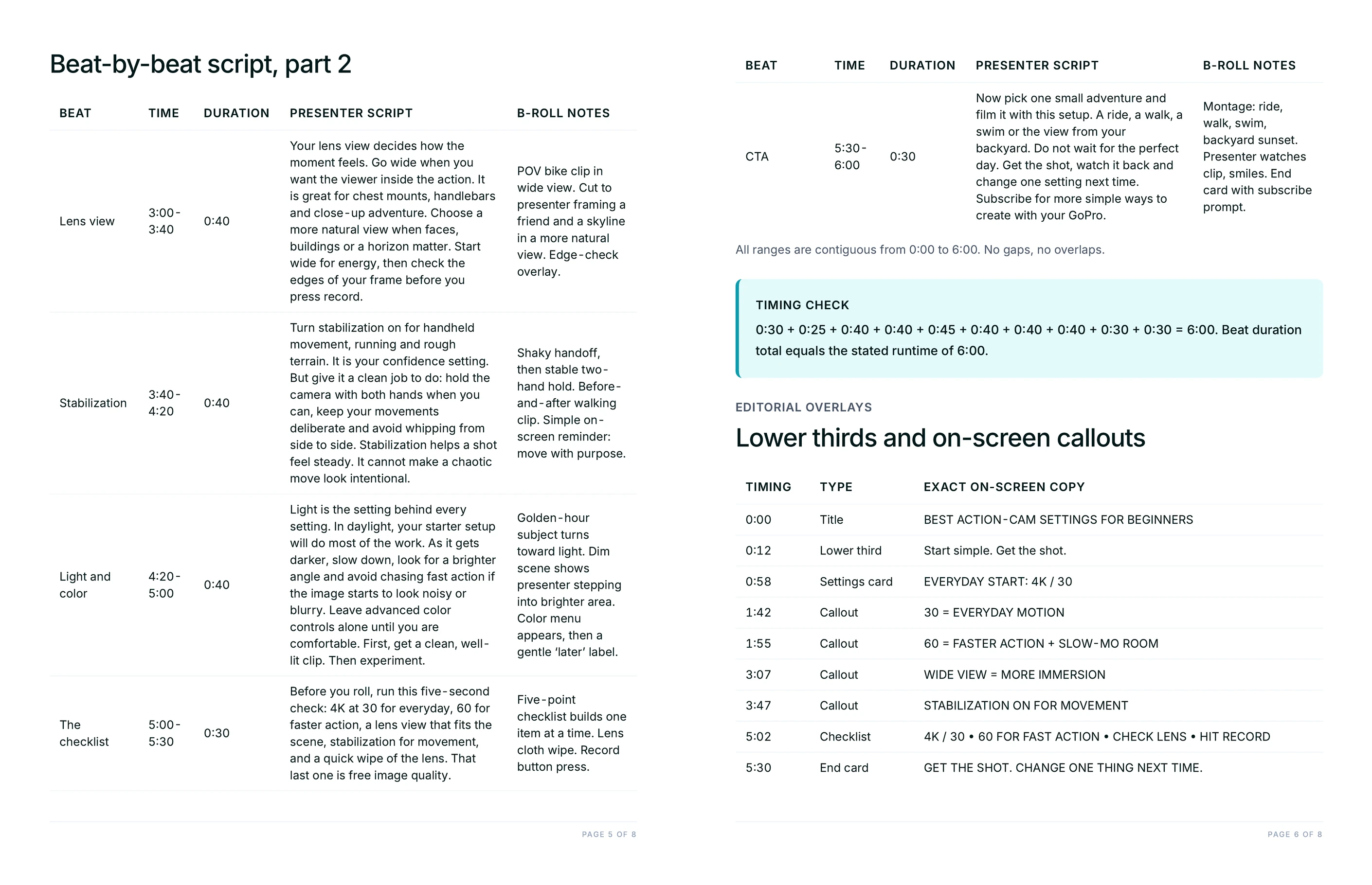
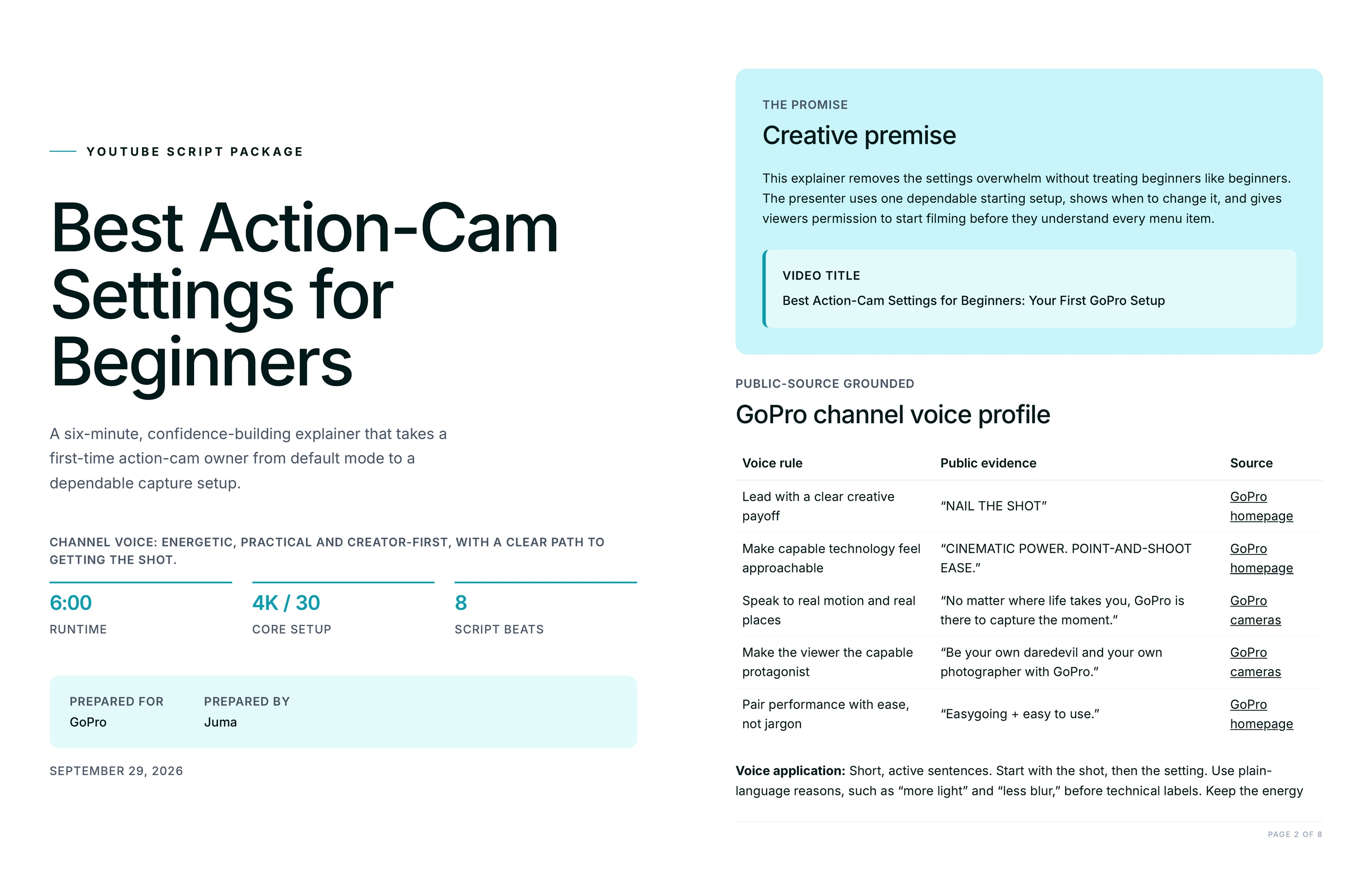
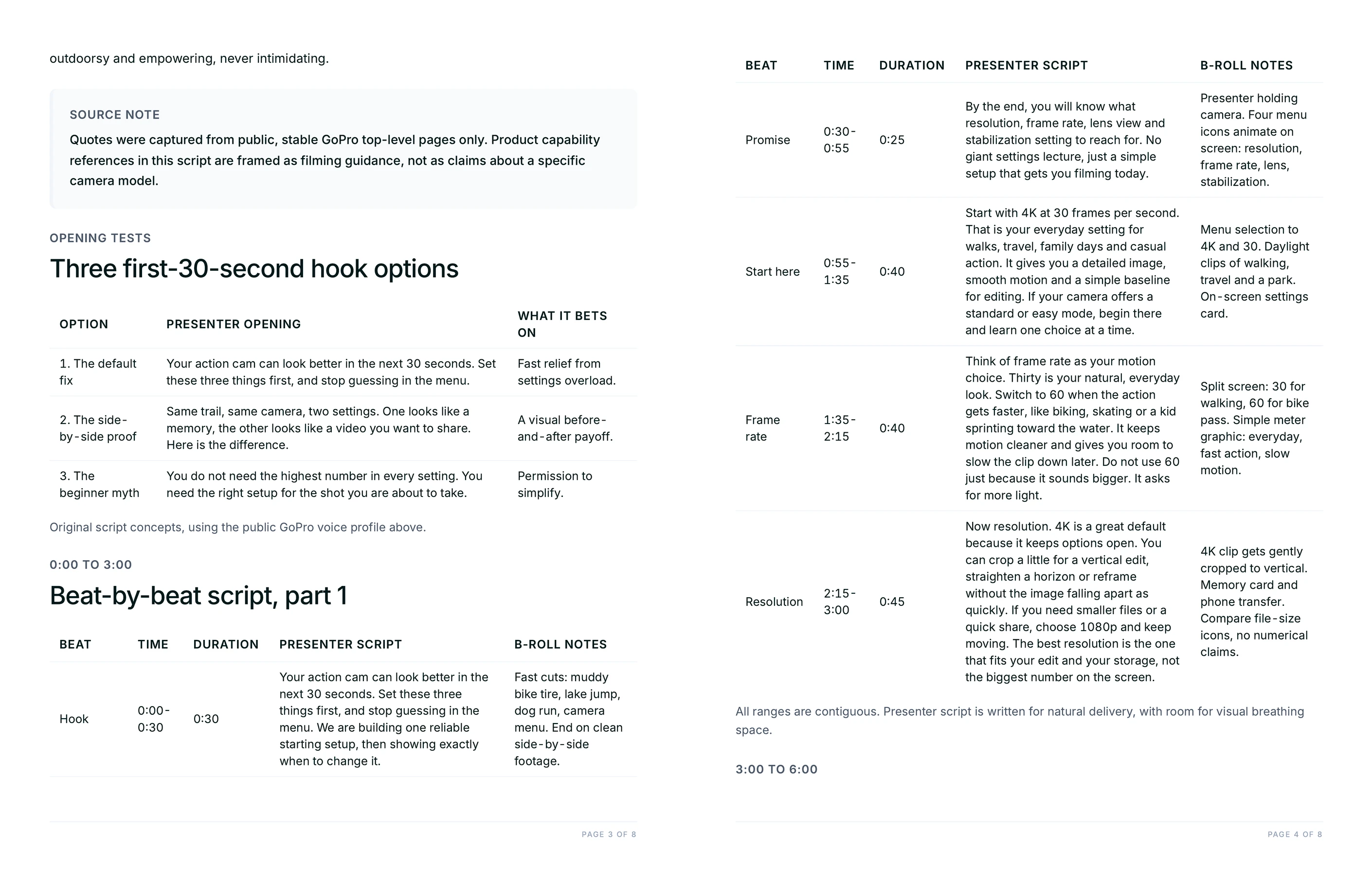
Name the client, the video topic, and the runtime, and Juma researches the brand's site, its audience, and how similar explainers are shot before writing a word. The Flow returns a presenter-led script built for camera: a timed hook, five story beats with on-camera lines and B-roll notes, lower-third captions, a recap checklist, and a timed CTA with end-card suggestions. It adds runtime math so the script lands on time, and production notes that flag where an emotional-payoff montage carries the middle. More than 400 marketing teams use Juma to turn a topic into finished assets, and a long-form YouTube script is one of the slowest things to write from a blank page.

‍

1

Write a 6-minute YouTube explainer script

Thank you! Your submission has been received!
Oops! Something went wrong while submitting the form.
Try This Flow

Example Flow result

Hide details
  • Name the runtime up front. "6-minute script" or "90-second cold open plus a 5-minute body" tells Juma how many story beats to write and how long each one runs, so the script lands on time instead of running two minutes over.
  • Give it the angle, not just the topic. "Best action-cam settings for beginners" hands the script a clear promise to open on. A vague topic like "our camera" produces a script with no hook to hang on.
  • Say who's on camera. A solo presenter, two hosts, or a voiceover over B-roll each need a different script format. Tell Juma the setup and it writes the lines the way they will actually be delivered.
  • Ask for the hook as options. "Give me three cold-open hooks" lets the team pick the one that fits the brand's energy before committing the rest of the script to it.
  • Add the channel's real voice. Drop a transcript of a past video or the channel's style notes into the project and the script comes back sounding like the host, not a generic narrator.
  • Keep the CTA specific. "Subscribe and grab the free settings cheat sheet" gives the end card a real next step, which beats a generic "like and subscribe" the audience scrolls past.
2

How do you write a hook that keeps viewers past the first 30 seconds?

The first 30 seconds decide whether the rest of the video gets watched, so it's worth writing the open as options rather than settling on the first idea. Ask for three cold-open hooks built on different instincts: one that leads with the payoff, one that names a mistake the viewer is probably making, and one that opens on a claim bold enough to earn a few more seconds of attention. Each hook comes back under 60 words, in the presenter's voice, with a one-line note on why it works. The team picks the one that matches GoPro's energy and Juma rewrites the cold open around it.

Prompt
Copy

Rewrite the first 30 seconds as three separate hook options: one that opens on the payoff, one that opens on a common mistake, and one that opens on a bold claim. Keep each under 60 words and tell me which one fits GoPro's energy best.

Try This Flow
3

How do you write titles and thumbnail concepts for the video?

The title and the thumbnail decide the click long before anyone hears the hook, so the packaging has to match the script. Get five title options and a thumbnail concept for each: the on-screen text, the shot or facial expression, and the single idea the frame has to sell in a scroll. The concepts pull directly from the script's promise, so the packaging and the payoff line up instead of over-promising something the video never delivers. Each option comes ranked by likely click-through with a short reason, so the team tests the strongest two rather than guessing which frame to shoot.

Prompt
Copy

Based on this script, give me five title options and a thumbnail concept for each: the on-screen text, the facial expression or shot, and the single idea the frame has to sell. Rank them by likely click-through.

Try This Flow
4

How do you turn one script into a whole video series?

One strong explainer is usually the start of a playlist, not a one-off. Turn the single script into a five-part beginner series, each episode built to teach one thing and hand the viewer to the next. For every episode the Flow returns the title, the single takeaway, the cold-open hook, and the bridge line that points to the following video, so the playlist pulls people through instead of leaving each video to fend for itself. The series shares one running structure, which keeps the channel consistent and gives the team a month of content from a single planning session.

Prompt
Copy

Turn this into a five-part beginner series for GoPro's channel. For each episode give me the title, the one thing it teaches, the hook, and how it links to the next episode so the playlist pulls viewers through.

Try This Flow
5

How do you repurpose the video into a blog post and shorts?

A six-minute video is also a blog post and a handful of shorts, if someone takes the time to cut it up. Repurpose the script into one SEO blog post and three vertical shorts in the same chat. Each short pulls the strongest 30-second moment from the script, rewrites the open so it stops a scroll, and adds the on-screen caption text ready to drop into the edit. The blog post follows the same story but reads for search, with a headline, subheads, and the key steps written out. One shoot, one script, and the whole week's content comes off it.

Prompt
Copy

Repurpose this script into one SEO blog post and three vertical shorts. For each short, pull the strongest 30-second moment, rewrite the hook for a scroll-stopping open, and add on-screen caption text.

Try This Flow

Set up your client project: channel voice, product claims, and past scripts

A Juma Project is a shared space where the team keeps everything Juma needs to know about a channel: how the host talks, what the product can claim, and how the videos are shot. Build one project per client or channel and every script pulls from the same context, so the tenth video sounds as on-brand as the first. Add these items once and the script stops guessing at the voice.

What to add

Channel Voice & Past Scripts

Transcripts of a few past videos, plus notes on how the host talks: pacing, running jokes, the words they always use. Drop in two or three and the script comes back sounding like the host from the first draft, not a generic narrator.

Product & Claims Notes

What the product actually does, the claims that are approved, and the words the brand will not say on camera. This keeps the demo beats and the CTA accurate, so nothing in the script needs a legal rewrite after it's shot.

Audience Profile

Who watches the channel and what they already know. This pitches the script to the right level, so a beginner explainer never talks over the viewer's head or spends a minute explaining something they already understand.

Visual & B-roll Guidelines

The channel's shot style and the footage the team already has. With this in the project, the B-roll notes point at things the team can actually film instead of describing shots that would need a second shoot day.

Guide Juma with project info

Add a short description to each knowledge item in the project's info field so Juma knows what each file is and when to use it. For example:

  • Channel Voice & Past Scripts: "Transcripts of our best-performing videos. Match this voice and pacing in every script."
  • Product & Claims Notes: "Approved product claims and words we never use on camera. Check before writing the CTA and the demo beats."
  • Audience Profile: "Who watches this channel and what they already know. Pitch the script to this level."
  • Visual & B-roll Guidelines: "Our shot style and the footage we already have. Point B-roll notes at what we can actually film."
Juma Logo
Turn a topic into a ready-to-shoot script

Frequently Asked Questions

How much time does this Flow save compared to writing a YouTube script by hand?

Writing a six-minute YouTube script by hand takes two to four hours: shaping the hook, sequencing the story beats, adding B-roll notes, and timing the whole thing so it lands. Juma researches the brand and returns a ready-to-shoot script in a couple of minutes, so the team spends its time editing and performing rather than staring at a blank page.

The draft is a starting point, not the final cut. Strategy, taste, and judgment stay human: the team rewrites the lines that do not sound like the host, cuts the beat that runs long, and sharpens the hook before anyone picks up a camera. Human review sits on every script before it shoots.

What does the finished YouTube script include?

The script comes back ready to shoot: a timed hook, five story beats, a recap checklist, and a timed CTA with end-card suggestions. Each beat carries the on-camera lines, the B-roll notes for what to film, and a lower-third caption. Runtime math keeps it on time, and production notes flag where an emotional-payoff montage carries the middle.

Because the script is timed beat by beat, the team knows the six minutes are real before the shoot, not a guess that falls apart in the edit. The production notes call out the two or three moments that carry the video, so shoot day prioritizes the footage that matters instead of spreading effort evenly across every second.

Does the script work for a solo presenter, two hosts, or a voiceover?

Yes. Tell Juma who is on camera and the script matches the format. A solo presenter gets first-person lines to deliver, two hosts get a back-and-forth with each part attributed, and a voiceover-over-B-roll video gets narration paired with the shot list it plays over.

The format changes how the whole script reads, not just the labels. A two-host script builds in the handoffs and the moments where one host reacts to the other. A voiceover script leans harder on the B-roll notes, because the footage is doing the work the presenter would otherwise do on camera. Name the setup at the start and every beat is written the way it will actually be delivered.

Can Juma match our channel's voice?

Yes. Add a transcript of a past video or a few notes on how the host talks to the client's Project, and the script comes back in that voice instead of a generic narrator. The channel's phrasing, pacing, and running jokes carry into every new script the team runs.

For agencies running several channels, this is where one Project per client pays off. Juma remembers each channel's voice, product claims, and visual style without a re-brief, so the script for one client never bleeds into another. Unlimited seats mean the whole team, from the strategist to the editor, works from the same context on every video.

How is this different from an AI that just writes a title or a video description?

A YouTube title or description tool writes the packaging around a video that already exists. This Flow writes the video itself: the spoken script, the shot list, and the on-camera lines. It's the difference between naming the thing and building it.

The two work together. Once the script is written, the team can run Juma's YouTube title and description Flows on it to package the finished video for search and for the click. The script sets the story, and the packaging Flows dress it for the feed. Together they cover the whole path from a topic to a video that gets found and watched.
Don't take our word for it

Ask AI about us

400+ marketing teams trust Juma. ChatGPT, Claude, and Perplexity know why. Ask them.

Ready when you are

What's on your plate today?

Start typing a task and Juma will figure out the rest.

Thank you! Your submission has been received!
Oops! Something went wrong while submitting the form.