Email
Content Writing
Strategy & Planning
Web analysis
Web Icon
Web analysis
PDF
PDF Icon
PDF
Excel
Excel Icon
Excel
Web analysis
Web Icon
PDF
PDF Icon
Excel
Excel Icon

Write a win-back email campaign with AI: reason-coded segments, a deliverability-safe send ramp & an ESP-ready sequence

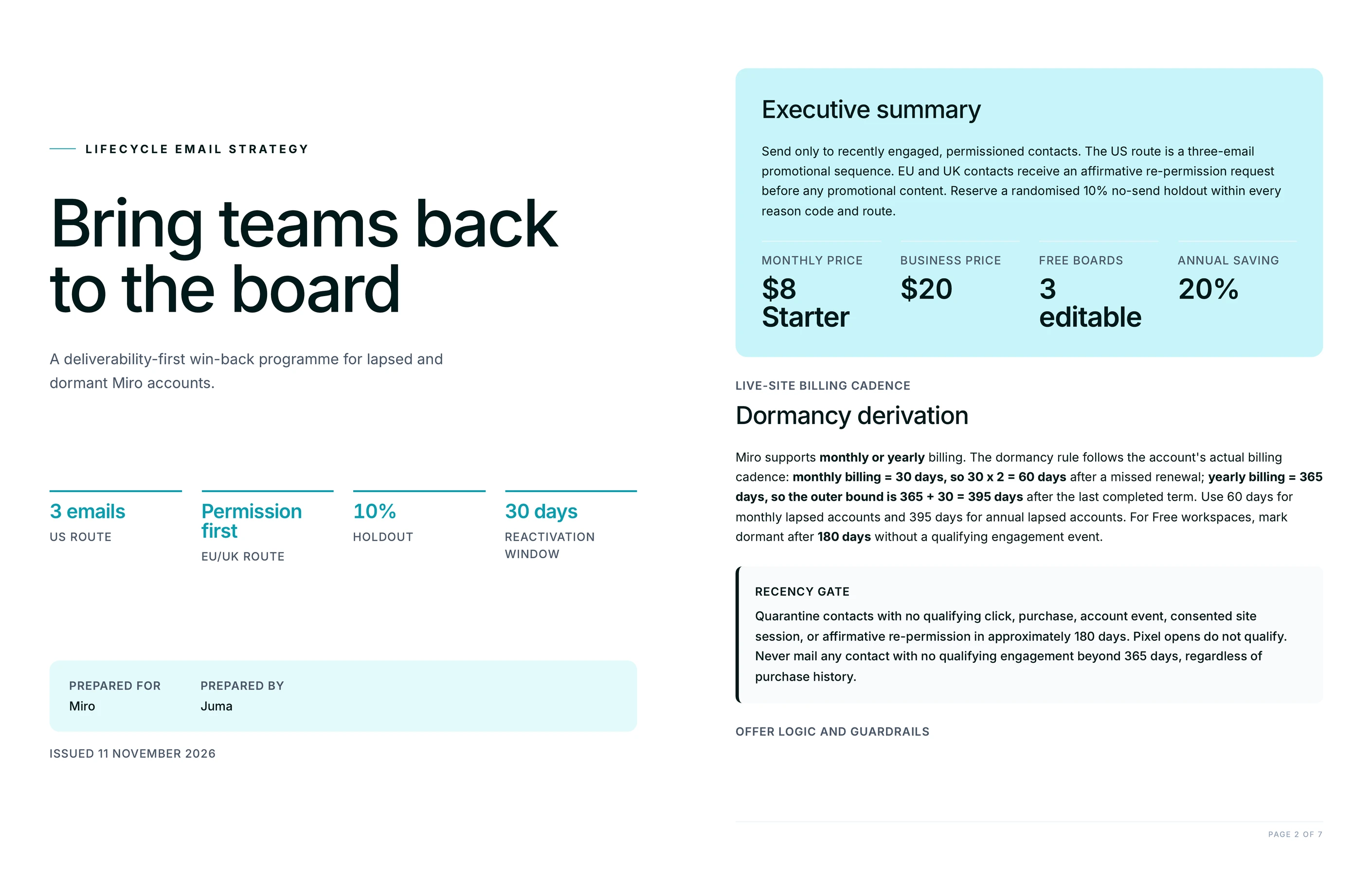
Name the client and their site, and the campaign comes back with the dormancy trigger derived from their own purchase cycle, a separate recovery path for each reason people lapsed, and a send ramp that stops itself before the complaint rate does damage.

Give Juma the client and their URL. The Flow reads the live site first to find the real purchase rhythm, the subscription intervals, the price range and the flexibility the brand already offers, then derives the dormancy trigger from that cycle and shows the arithmetic. A brand whose longest standard cadence is four weeks does not become dormant at a generic 90 days, and the difference is a recovery window the team would otherwise sit out.

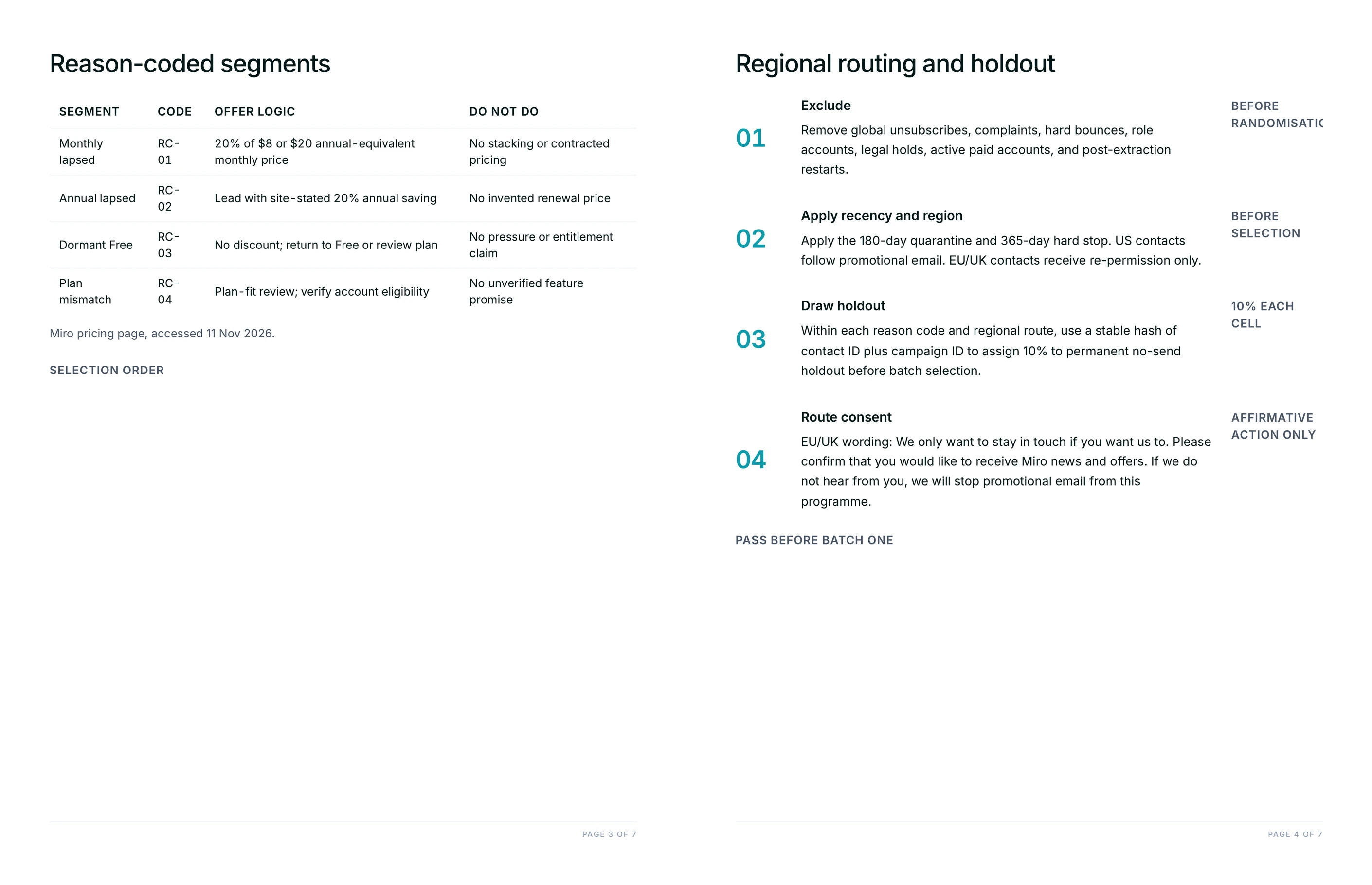
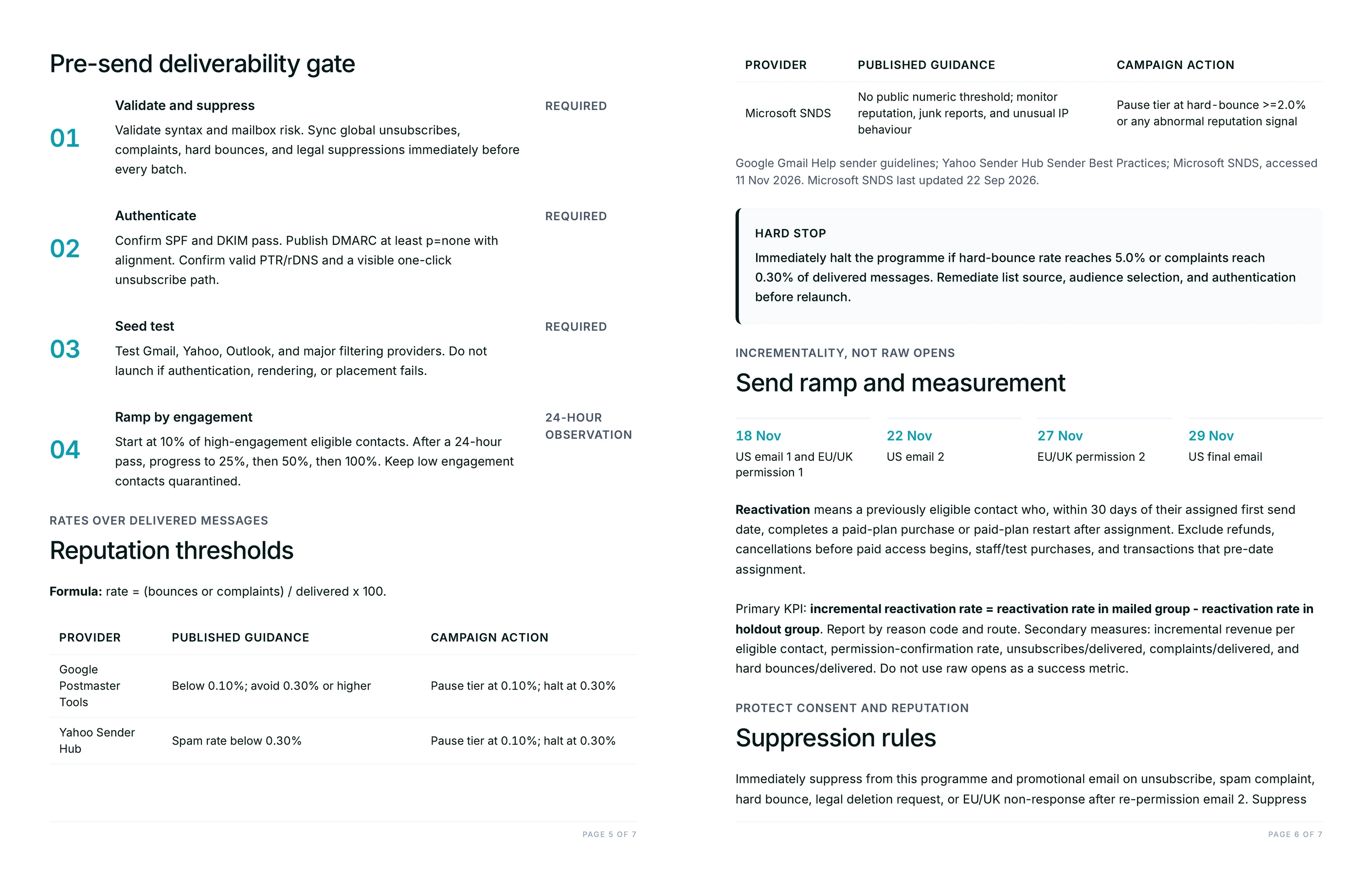
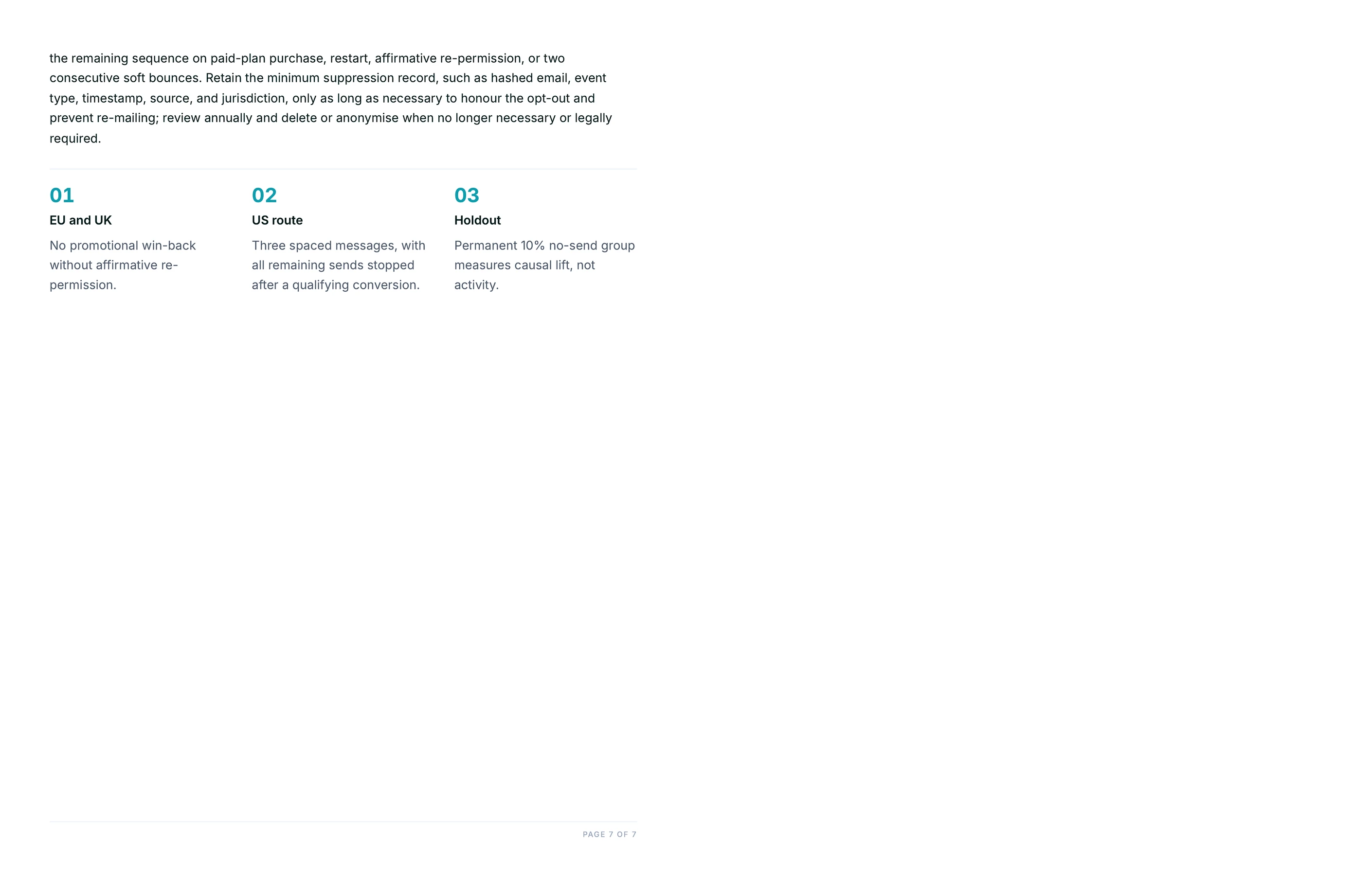
What comes back is a branded PDF campaign plan and an ESP-ready CSV. The plan carries reason-coded segments with their own offer logic and an explicit do-not-do rule each, a jurisdiction gate that routes US and EU or UK contacts differently, a pre-send validation gate, an engagement-tiered send ramp with every threshold expressed over delivered messages, a randomised holdout so incrementality is measurable, and the exact suppression and re-permission rules. The CSV carries one row per email, written and ready to load. 400+ marketing teams use Juma. Strategy, taste and judgment stay human: the offer economics and the consent position still need the client's finance and legal sign-off, and the plan says so on the page.

1

Win back lapsed customers without damaging the sending domain

Thank you! Your submission has been received!
Oops! Something went wrong while submitting the form.
Try This Flow

Example Flow result

Hide details
  • Point it at the subscription or pricing page, not just the homepage. The dormancy trigger is derived from the cadence options and the price range the brand actually publishes. A subscription hub gives the Flow the intervals and the bag prices it needs, and both the trigger and the offer sizing get sharper as a result.
  • Say which markets the list covers. The consent routing is the part most win-back plans get wrong. Tell it the list is US-only and the sequence runs three promotional touches. Say it includes EU or UK contacts and those route to a permission request first, because the soft opt-in does not stretch to a list that has been silent for months.
  • Name the reasons the team can actually observe. Reason codes are only useful if the data exists to populate them. Cancellation survey answers, payment failures, format history and coupon dependence each map to a different recovery path, so say which of those the client records and the segments come back populated rather than theoretical.
  • Keep the holdout. It is the first thing that gets cut and the only way to know whether the campaign worked. A randomised 10% no-send group per segment turns a reactivation number into an incremental one, and that is the figure worth putting in front of a client.
  • Run the seed test before batch one, not after a problem. The plan gates the first real cohort behind list validation, authentication checks and a seed-list placement test. That ordering is the whole point: a dormant list is where sender reputation goes to die, and the cheapest fix is the one that happens before the send.
  • Treat the CSV as the working file. The PDF is what gets circulated and signed off. The CSV is what gets loaded, so check the human-fill column first: promo codes, expiry dates and the postal address token all need a person before anything goes out.
2

How do you decide when a customer counts as dormant?

Most teams reach for 90 days because it is the number everyone else uses. It is arbitrary, and for a replenishment brand it is usually late. The better trigger comes from the product's own rhythm: find the longest standard purchase or delivery interval, count the missed cycles that signal a real lapse rather than a single skip, and add a buffer for fulfilment. This step does that derivation out loud, shows the arithmetic, and states what it excludes, because a trigger that catches active subscribers, recent pauses or gift-only buyers creates more problems than it solves.

Prompt
Copy

Derive the dormancy trigger for this client from their actual purchase cadence rather than a generic 90 days. Show the arithmetic inline, state every exclusion that keeps active subscribers, recent pauses and gift-only buyers out of the audience, and say what a 90-day rule would have cost in recovery time.

Try This Flow
3

How do you segment lapsed customers by why they left?

A single "we miss you" discount treats a payment failure, an unopened first delivery and a roast someone simply did not like as the same problem. They are not, and only one of them is about price. This step builds reason-coded segments from signals the team can observe, such as cancellation reasons, failed first shipments, seasonal purchase clustering and format history, then gives each one its own offer logic and an explicit do-not-do rule. The do-not-do column is the useful half: it is what stops a discount going to someone who never had a price objection.

Prompt
Copy

Split this client's dormant base into reason-coded segments using signals they can actually observe. Give each segment its own entry signal, offer logic and an explicit do-not-do rule, and size any incentive against the real price range on their site rather than a flat amount.

Try This Flow
4
Attention Icon
This is Important
Mailing a long-dormant list in one send is the fastest way to damage a sending domain. Run this step before the campaign goes anywhere near a live cohort, and have the client's deliverability owner approve the gate.

How do you run a win-back campaign without hurting deliverability?

Dormant addresses are where hard bounces and recycled spam traps live, so the order of operations matters more than the copy. This step builds the pre-send gate first: list validation written back to the ESP, SPF, DKIM and DMARC alignment confirmed, suppressions synced, then a seed-list placement test that has to clear the batch-one thresholds before any real contact is mailed. After that it batches most-recently-engaged first and expresses every bounce and complaint threshold as a rate over delivered messages, which is the denominator that actually decides whether a gate passes.

Prompt
Copy

Build the deliverability controls for this win-back campaign: a pre-send gate covering list validation, SPF, DKIM and DMARC alignment, suppression sync and a seed-list placement test that must pass before batch one, then an engagement-tiered send ramp. Express every bounce and complaint threshold as a rate over delivered messages, state the formula once, and name the mailbox-provider guidance the numbers rest on.

Try This Flow
5

How do you handle consent when the list has gone quiet?

A contact who has not engaged in months is a different legal proposition in Hamburg than in Houston. Under CAN-SPAM a US commercial message needs truthful headers, a working unsubscribe and a physical postal address. Under ePrivacy and PECR the soft opt-in only covers similar products to a prior sale, and a long silence weakens the position considerably. This step turns that into a routing rule rather than a disclaimer: US contacts take the promotional sequence, EU and UK contacts get a permission request first, and the suppression list is kept as a do-not-contact record that survives an erasure request, because deleting it is what causes someone to be mailed again.

Prompt
Copy

Write the consent routing for this win-back campaign as an entry rule, not a disclaimer. Give US contacts the full promotional sequence under CAN-SPAM controls and route EU and UK contacts to a re-permission request first. State the exact suppression rule, the re-permission wording, and a suppression-list retention rule that survives an erasure request.

Try This Flow
6

How do you prove a win-back campaign actually worked?

Some lapsed customers were coming back anyway. Without a control group the campaign takes credit for them, and the reported reactivation rate flatters everyone involved. This step reserves a randomised no-send holdout inside every reason-coded segment before batch selection, defines reactivation precisely as a paid order or subscription restart inside a stated window, and reports the incremental rate: treated minus holdout. It adds revenue per delivered message, complaint rate and unsubscribe rate alongside it, split by reason code and route, so the next run knows which path to keep.

Prompt
Copy

Add the measurement design to this win-back campaign: a randomised 10% no-send holdout in every reason-coded segment assigned before batch selection, a precise definition of reactivation with its window, and the scorecard the programme is judged on, including incremental reactivation against the holdout, revenue per delivered message, complaint rate and unsubscribe rate by reason code and route.

Try This Flow

Set up your client project: lifecycle data, consent records and the brand's voice

Win-back is the campaign type that most rewards context. One Project per client means the reason codes, the consent position and the tone the brand uses with people who already bought are all in place before anyone writes a subject line, and every later run starts from them instead of from a blank chat.

What to add

Lifecycle and cadence data

Subscription intervals, average repurchase gap, cancellation survey reasons and payment-failure counts. This is what turns reason codes from a nice idea into segments the ESP can actually build, and it sharpens the dormancy trigger beyond what the public site shows.

Consent and suppression records

Which contacts opted in, when, through what, and which markets they sit in. The routing rule is only as good as the consent record behind it, and this is what lets the plan say US or EU with confidence rather than hedging.

Brand voice guide

How the client sounds to someone who has already bought from them. Win-back copy that reads like acquisition copy is the fastest way to earn a complaint, so the voice guide matters more here than in almost any other sequence.

Guide Juma with project info

Add a one-line description to each knowledge item so the right file gets used at the right moment:

  • Lifecycle and cadence data: "Purchase intervals, cancellation reasons and payment failures. Use this to derive the dormancy trigger and populate the reason codes."
  • Consent and suppression records: "Opt-in source, date and market per contact. Use this to route contacts between the promotional and re-permission paths."
  • Brand voice guide: "How we sound to existing customers. Use this for all subject lines and body copy."
Juma Logo
Win them back without burning the domain

Frequently Asked Questions

What is a win-back email campaign?

A win-back campaign is a short, targeted email sequence aimed at customers or subscribers who have stopped buying, with the goal of restarting the relationship before the address is retired. It differs from a standard promotion in that the audience has already lapsed, which changes both the messaging and the risk: these addresses carry a higher chance of bounces and complaints than an engaged list.

The useful version is not one discount sent to everyone who has gone quiet. It identifies why each group lapsed, offers each the thing that actually addresses it, and controls the sending so a dormant list does not damage the domain that the rest of the programme depends on.

When should a customer be treated as dormant?

Derive it from the product's own purchase cycle rather than a round number. For a subscription or replenishment brand, find the longest standard interval, count the missed cycles that indicate a genuine lapse instead of a single skip, and add a buffer for fulfilment time. A brand whose longest cadence is four weeks reaches a meaningful signal well before 90 days.

The exclusions matter as much as the trigger. Active subscribers, recent pauses or skips, gift-only buyers, open support cases, prior complaints and hard bounces all need to be out of the audience before anything sends, or the campaign mails people it should not.

Can a win-back campaign hurt email deliverability?

Yes, and it is one of the most common ways reputable senders get into trouble. Dormant addresses are disproportionately likely to be invalid, abandoned or converted into recycled spam traps, so mailing a large silent list in one go produces a spike in bounces and complaints that mailbox providers read as a reputation signal.

The controls that prevent it are procedural. Validate and scrub the list, confirm authentication, sync suppressions, then send a seed-list placement test that has to clear the thresholds before any real cohort goes. After that, release in batches ordered most-recently-engaged first, measure bounce and complaint rates over delivered messages, and set a hard stop that pauses the programme rather than pushing through.

Is it legal to email customers who have gone quiet?

It depends on the jurisdiction and on the consent record, which is why the plan routes contacts rather than treating the list as one audience. In the US, CAN-SPAM permits commercial email to existing contacts provided the message carries truthful headers, a working unsubscribe and a physical postal address, and acts on opt-outs promptly.

In the EU and UK the position is tighter. The soft opt-in under ePrivacy and PECR covers only similar products to a prior sale, and a long period of silence weakens any argument that consent is still current, so those contacts are better served by a permission request before any promotional message. Treat this as a question for the client's counsel and their consent records: the Flow produces the routing structure and the wording, and a human signs off the legal position.

How do you know whether the campaign actually worked?

Hold out a randomised share of each segment and send them nothing. Some lapsed customers return on their own, and without a control group the campaign claims those returns as its own. Comparing the treated group against the holdout over the same window gives an incremental reactivation rate, which is the number worth reporting.

Pair it with revenue per delivered message, complaint rate and unsubscribe rate, broken out by reason code and route. That split is what tells the team which recovery path earned its place and which one to retire before the next run.

Don't take our word for it

Ask AI about us

400+ marketing teams trust Juma. ChatGPT, Claude, and Perplexity know why. Ask them.

Ready when you are

What's on your plate today?

Start typing a task and Juma will figure out the rest.

Thank you! Your submission has been received!
Oops! Something went wrong while submitting the form.