Set up your client project: research constraints, prior studies, and the brand's own claims
Run one project per client and the survey design stops starting from zero. Add the things that shape what is fieldable and what has already been asked, and every study built in that project inherits them. The second survey for a client is faster than the first, and the fifth is faster again, because the constraints only get entered once.
What to add
Research constraints
Panel access, the eligible customer base, languages and markets, consent requirements, and how often the client is willing to contact a customer. These decide whether a sample plan is realistic or just arithmetic.
Prior studies and their questions
Past surveys, the wording used, and the results. Repeating a question verbatim gives a trend line. Changing it quietly breaks one, and nobody notices until the readout.
Published claims and product reporting
The client's own public numbers, product pages, and filings. Concepts grounded in what the brand has actually said hold up in the room better than concepts invented from scratch.
Decision owners and thresholds
Who signs off and what size of difference would change their mind. The practical threshold in the decision table should come from them, not from a default.
Guide Juma with project info
Each knowledge item takes a short description. One line is enough, and it tells Juma when to reach for that item instead of guessing.
- Research constraints: "What we can and cannot field: panel size, markets, languages, consent rules, contact frequency."
- Prior studies: "Questions we have already asked and the results, so trend items stay worded the same way."
- Published claims: "The client's own public numbers and product descriptions, for grounding concepts and context."
- Decision owners: "Who signs off on the result and the size of difference that would change their decision."
Write the decision rules before the data arrives
Frequently Asked Questions
What does the survey design include?
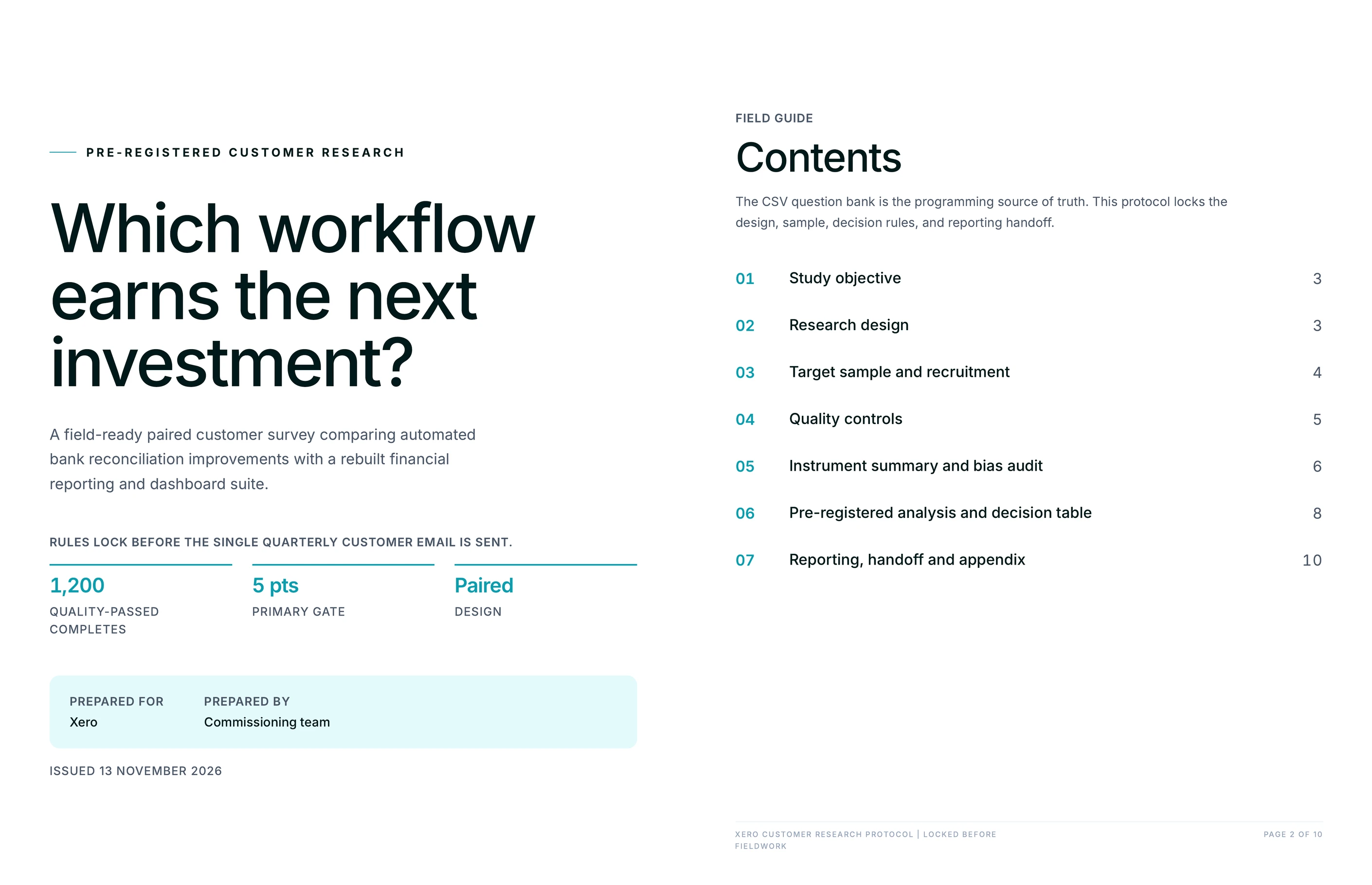
Two files. A branded PDF protocol covering the decision being settled, the concepts or topics tested, the sample plan with its arithmetic shown, the full question bank, the analysis plan, and the fieldwork quality rules. Alongside it, an editable CSV with every question in programmer-ready form.
The CSV carries the respondent-facing text, response type, response options, display order, randomization, skip logic, programming notes, and the analysis variable each item maps to. It imports into a survey platform without retyping, and the team can edit wording in place before it goes anywhere near a respondent.
How many responses does the survey need?
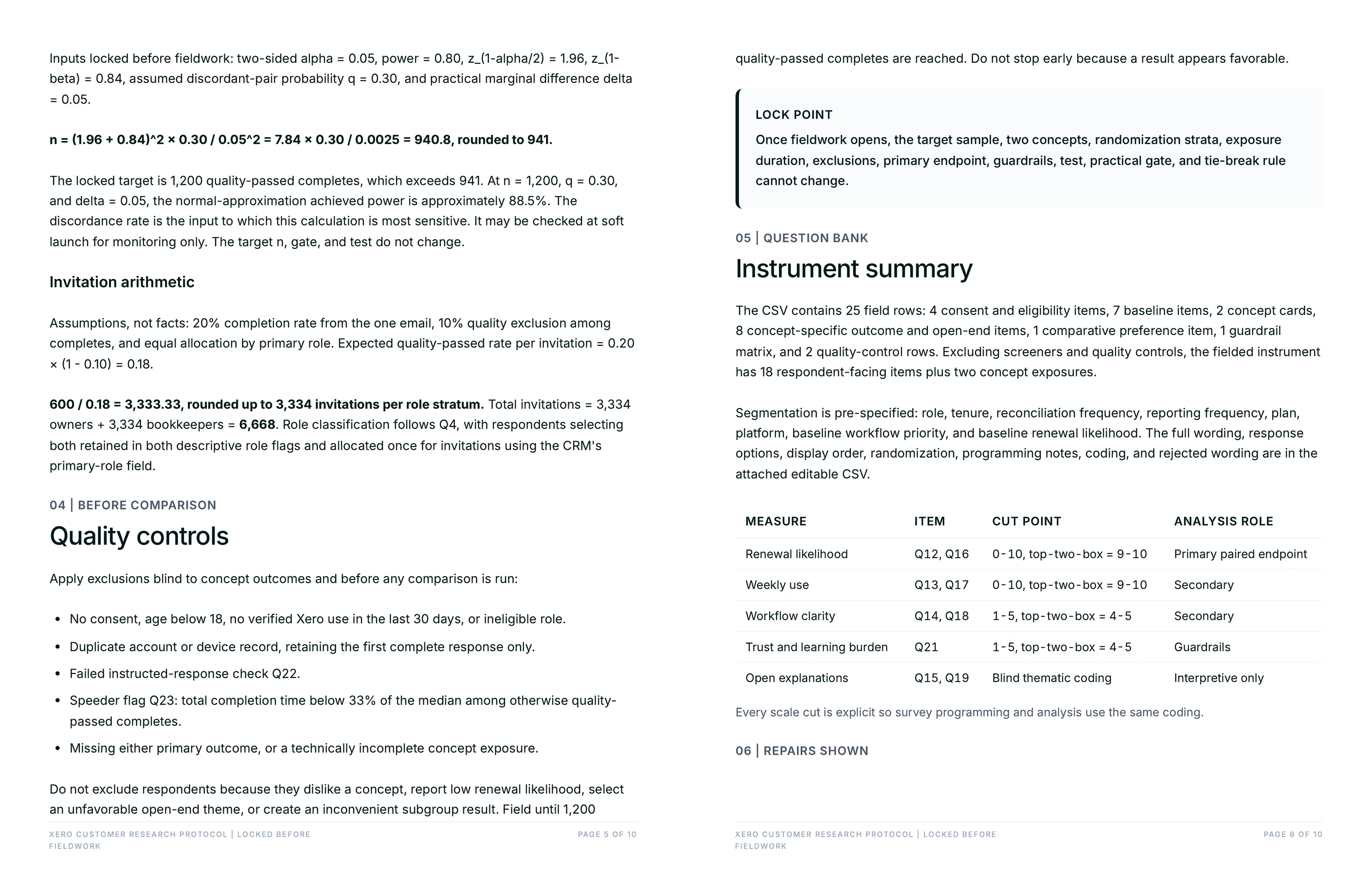
It depends on the size of difference that would change the decision, and the Flow computes it rather than quoting a round number. The protocol prints the formula, every input, and the resulting completes, then converts that into invitations at a stated response rate and exclusion rate.
The design matters as much as the number. A paired design, where one respondent evaluates both options, needs materially fewer people than two independent groups, because each respondent acts as their own control. Getting that distinction wrong is the most common way a sample-size estimate ends up off by roughly half.
Every assumption is labelled as an assumption. Swap in the client's real panel figures and the arithmetic recomputes.
Can Juma check the questions for bias?
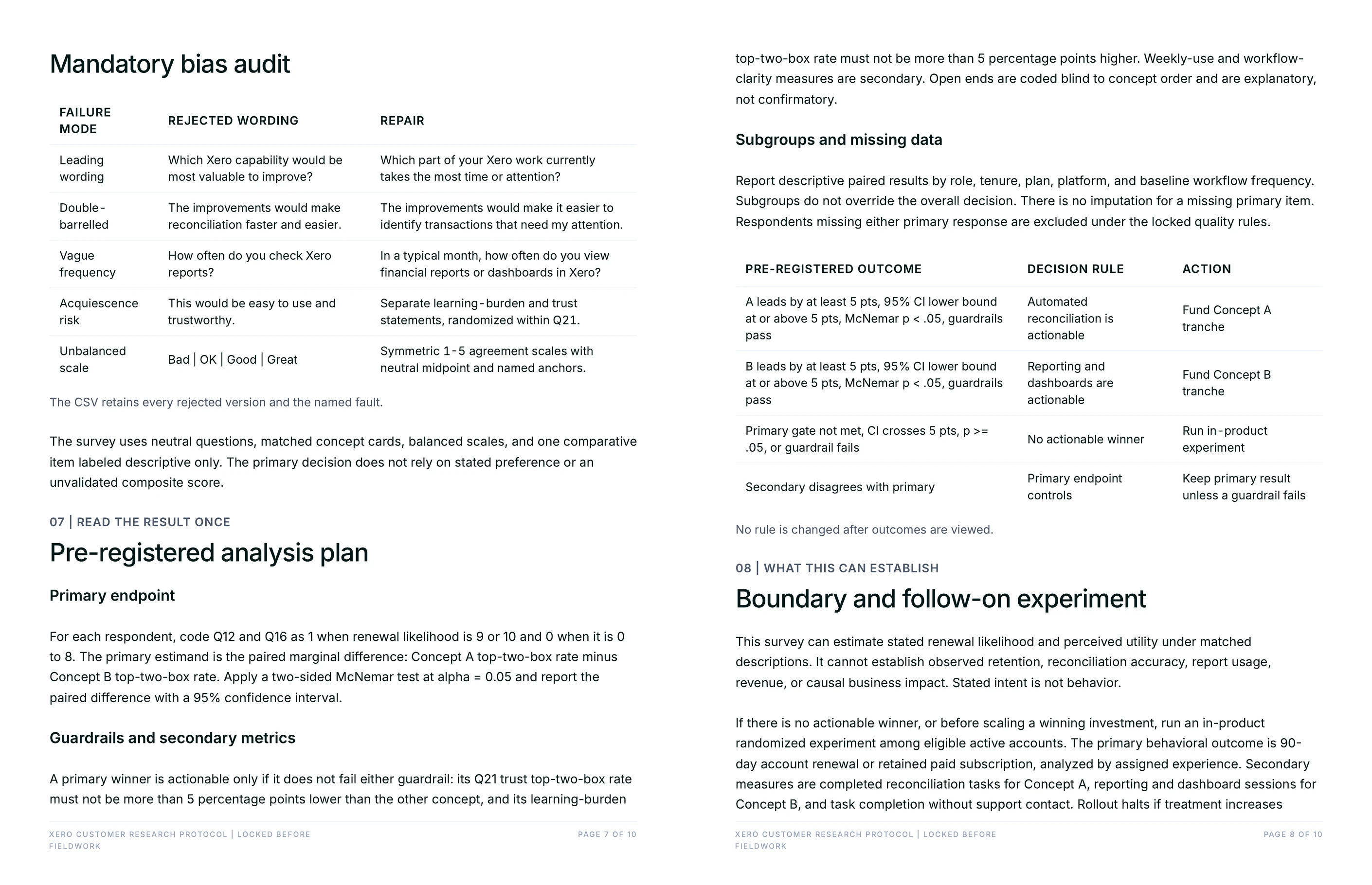
Yes. Ask for the bias audit and the Flow goes item by item against named failure modes: leading questions, double-barrelled items, unbalanced scales, acquiescence risk, and vague frequency wording. Each rejected version is printed next to its repair with the fault named.
The rejected wording stays in the CSV in its own column. A researcher reviewing the instrument can see what was caught and disagree with any of it, which is the point. Human review on every output.
How does this compare to writing the survey ourselves?
The gain is in the parts that normally get skipped under deadline. Teams write good questions. What slips is the sample-size arithmetic, the bias pass, and the analysis plan written before the data lands, because each one takes an afternoon and none of them feel urgent until the readout goes wrong.
Juma augments the team, it doesn't replace it. The researcher still chooses the decision to test, sets the threshold that counts as a win, and signs off on the wording. What changes is that the unglamorous rigour arrives in the first draft instead of never.
Does this work for B2B research, not just consumer apps?
Yes. The structure holds for any decision with two or more defensible options and a population that can be sampled: pricing-tier preference, positioning, feature prioritisation, or churn-driver research. What changes is the sample arithmetic, because B2B populations are smaller and the Flow applies a finite-population correction rather than pretending the base is infinite.
Small eligible populations sometimes cannot support the difference a team wants to detect. The protocol says so directly instead of producing a number that looks authoritative and is not.