Strategy & Planning
Research & Briefing
Web analysis
Web Icon
Web analysis
PDF
PDF Icon
PDF
Excel
Excel Icon
Excel
Web analysis
Web Icon
PDF
PDF Icon
Excel
Excel Icon

Build a brand messaging framework with AI: Positioning statement, message pillars & audience messaging matrix

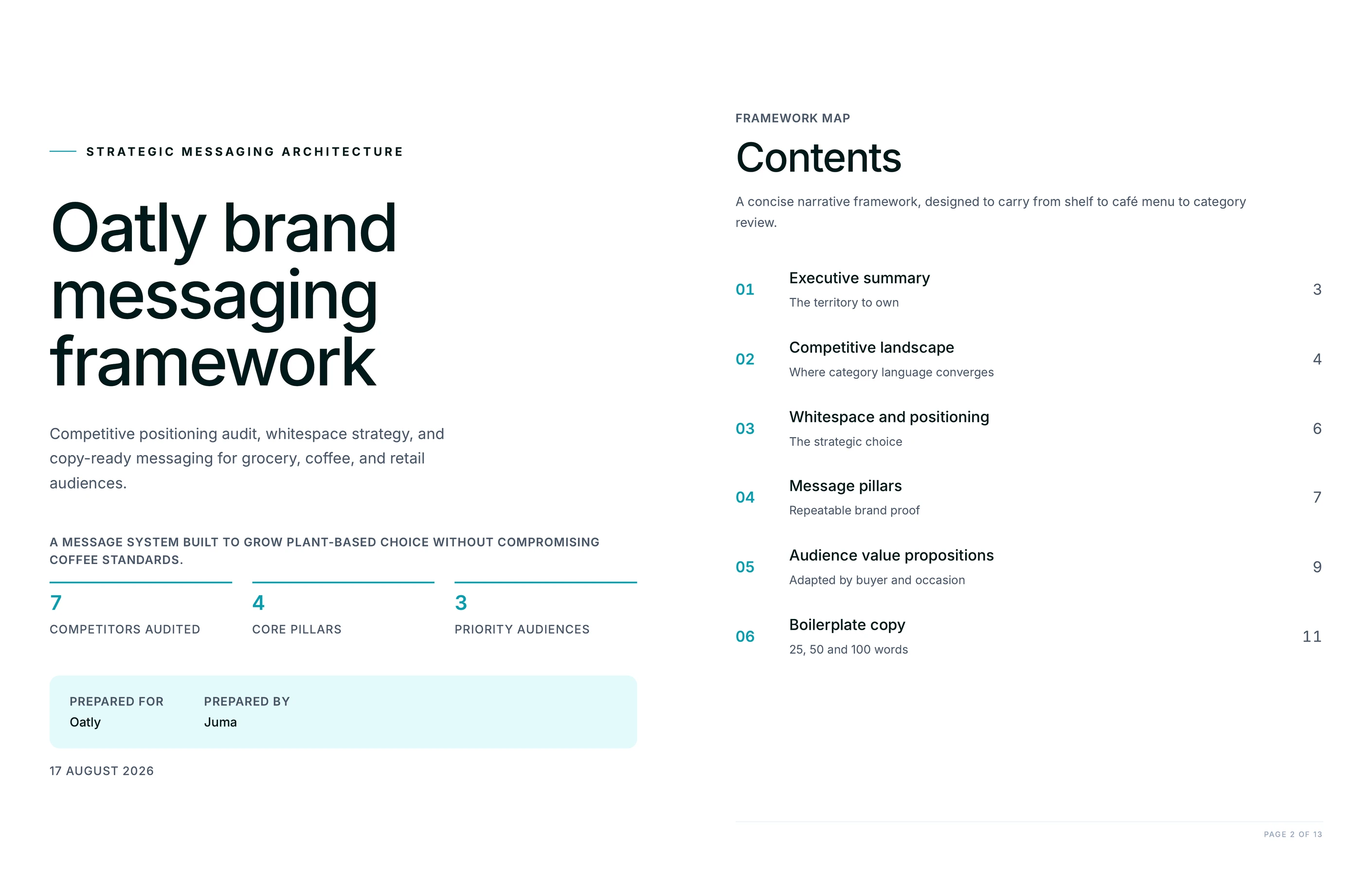
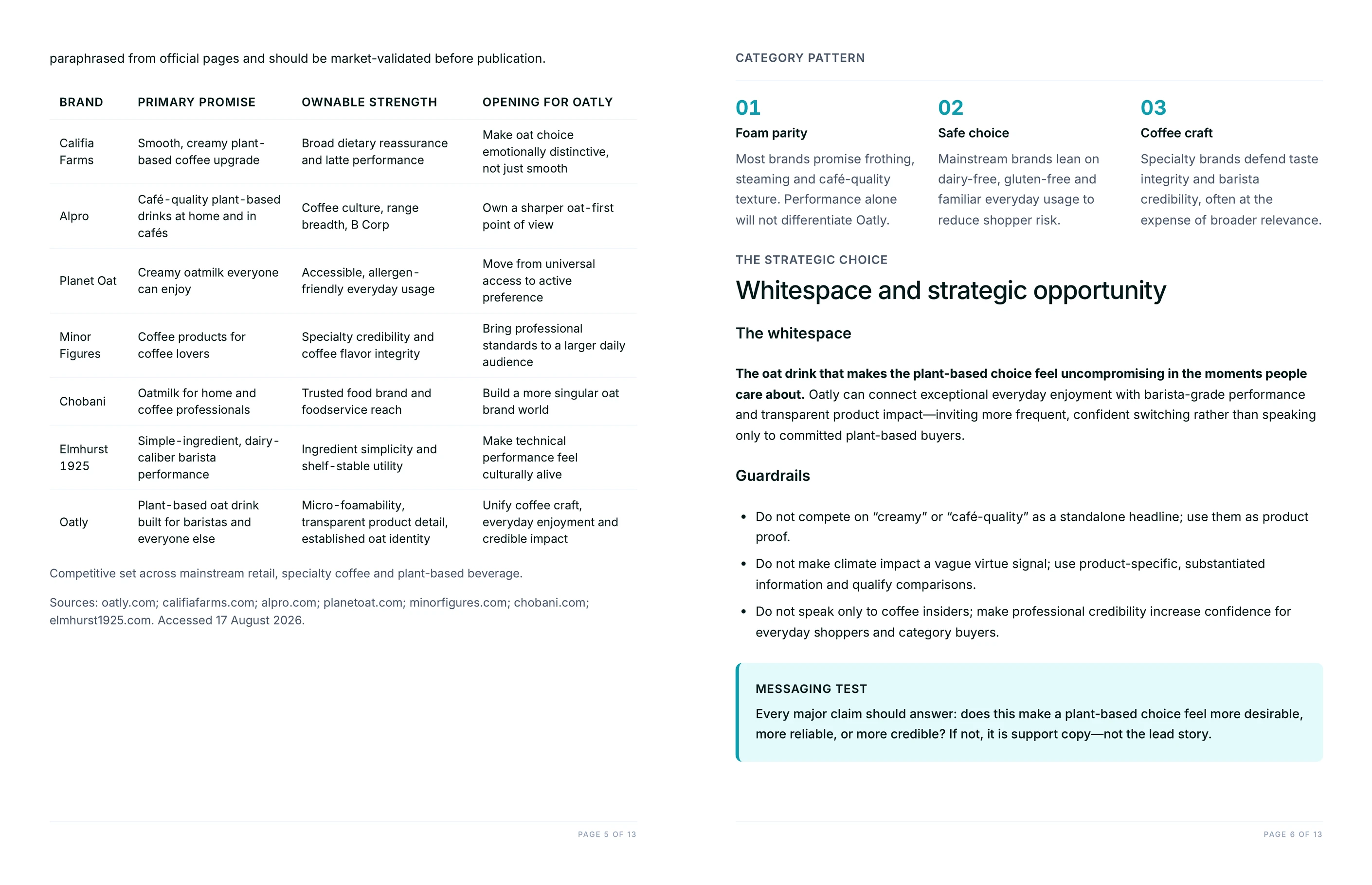
Name the client. Juma audits how competitors position themselves, finds the whitespace, and delivers the full messaging framework as a branded PDF plus an editable messaging matrix.

Give Juma the client and their URL. Before writing a line of messaging, it maps what the closest competitors actually claim on their live sites: the category language, the promises, the proof they offer. The framework gets built from that whitespace, so the positioning is differentiated by evidence, not by assertion.

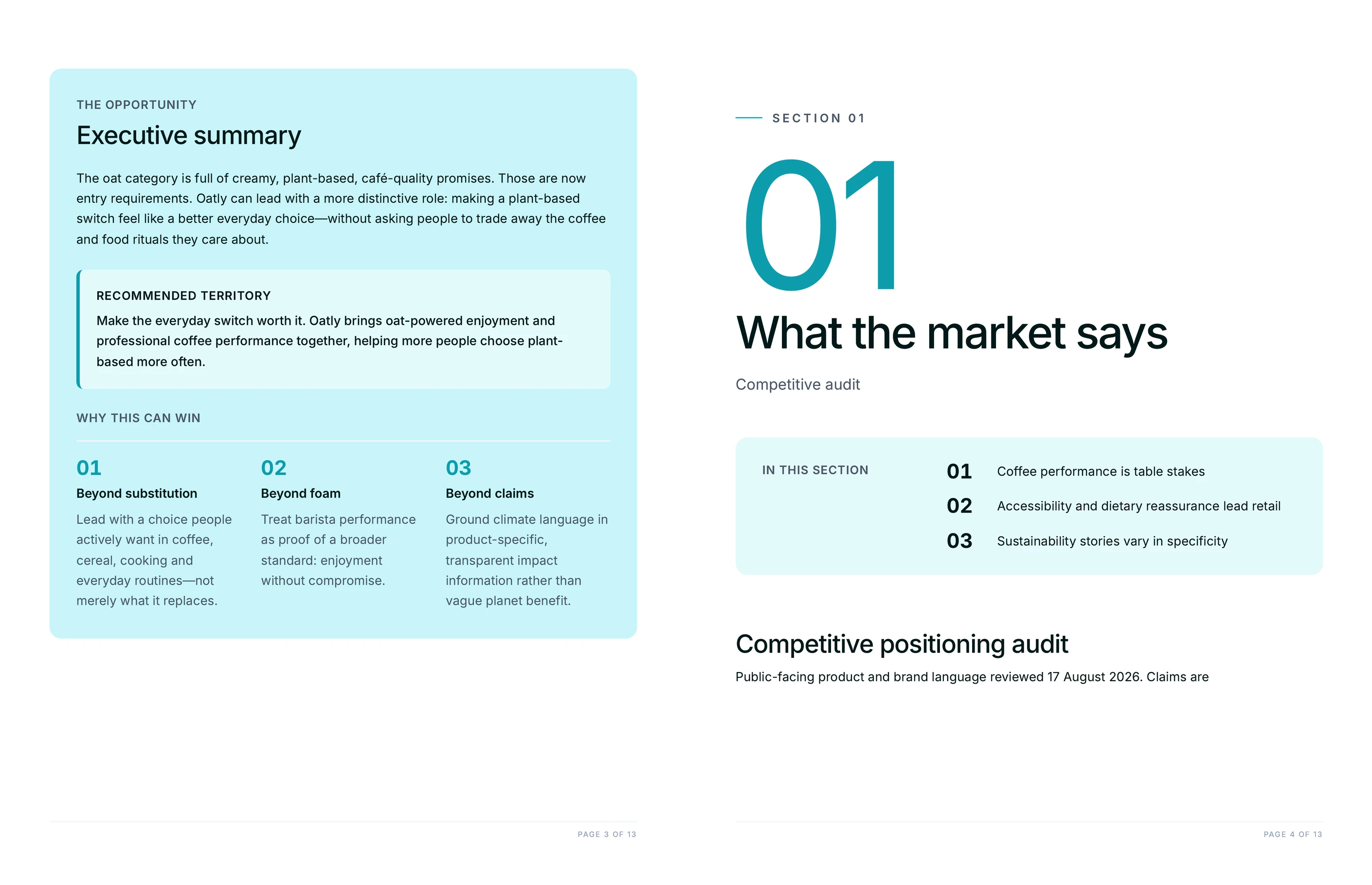
The deliverable is the document a strategist would take weeks to assemble: positioning statement, message pillars with sourced proof points, value propositions per audience, 25/50/100-word boilerplate, and do-and-do-not language rules, packaged as a branded PDF for alignment plus an editable messaging matrix your content team works from. It is one of the Juma Flows that 400+ marketing teams use to replace slideware debates with a single source of truth.

1

Build a messaging framework from the competitive whitespace

Thank you! Your submission has been received!
Oops! Something went wrong while submitting the form.
Try This Flow

Example Flow result

Hide details
  • Name the competitor set when it matters. Juma picks the closest rivals from research by default. If your client competes in a specific lane, list the three or four names that keep coming up in sales calls and the audit starts there.
  • Add existing positioning docs to the project. A current messaging doc, a strategy deck, or founder notes turn the framework from a fresh take into a sharpened version of what the team already believes.
  • Feed it real customer quotes. Win notes, reviews, and testimonials in the project give the pillars voice-of-customer proof instead of product-page paraphrase.
  • Run it before a website rewrite. The framework is the brief the web copy should be written against. Teams that write the homepage first and the framework second end up doing both twice.
  • Trust only sourced proof points. Every claim in the framework traces to a live page or a document you provided. If a proof point is missing, the framework flags the gap instead of inventing one.
  • Work from the matrix, not the PDF. The PDF aligns stakeholders. The editable matrix is the working file: one row per audience, one column per pillar, ready for the content team to pull from.
2

How do you check if your homepage matches your messaging framework?

Audit the copy you already have against the framework you just built. Juma reads the client's homepage and key landing pages, scores each section against the positioning statement and pillars, and returns a gap table: which messages the site leads with, which pillars never appear, and where the copy contradicts the framework outright. Each gap comes with a suggested rewrite in the framework's language, so the table doubles as the revision brief. It is the fastest way to see how much of the new positioning is already live and how much is aspiration.

Prompt
Copy

Audit the client's homepage and main landing pages against this messaging framework. Score each page section against the positioning and pillars, list the gaps and contradictions in a table, and suggest a rewrite for each gap in the framework's language.

Try This Flow
3

How do you turn a messaging framework into a sales talk track?

Translate the framework into the words a seller actually says. Juma converts each pillar into a discovery question, a value statement, and an objection-response pair, then assembles them into a one-page talk track ordered the way a first call runs: opening positioning line, qualifying questions, pillar-by-pillar value statements, and the responses to the three objections the competitive audit predicts. Sales gets language that matches what marketing publishes, which is the whole point of a framework: one story, told the same way in every channel.

Prompt
Copy

Turn this messaging framework into a one-page sales talk track: an opening positioning line, discovery questions per pillar, value statements in the framework's language, and responses to the three most likely competitive objections.

Try This Flow
4

How do you adapt the messaging for a new audience or segment?

Extend the framework instead of rebuilding it. Name the new audience, a vertical you are entering, a buyer role sales keeps meeting, or a market segment the client wants to win, and Juma researches what that audience cares about, then adds a full column to the messaging matrix: their pains in their words, the value proposition per pillar, and the proof points that land with them. The positioning statement stays fixed; only the expression flexes. That is what keeps a brand coherent while the go-to-market widens.

Prompt
Copy

Add a new audience to the messaging matrix: mid-market IT leaders evaluating us for security and governance. Research what this audience cares about, write their value proposition per pillar, and keep the positioning statement unchanged.

Try This Flow
5

How do you keep the framework current when competitors reposition?

Messaging whitespace moves. When a competitor rebrands, launches an AI story, or claims the category language your framework was built on, re-run the audit and diff it. Juma re-reads the competitor sites, compares their current claims to the ones recorded in the framework's audit, and reports what changed: which of your pillars are now contested, which whitespace closed, and which new gaps opened. Each contested pillar comes with options, defend it with sharper proof or rotate to fresher ground. Quarterly is the natural cadence; before any major campaign is the smart one.

Prompt
Copy

Re-run the competitor messaging audit and diff it against the framework's original audit. Report which claims changed, which of our pillars are now contested, and whether any new whitespace opened, with a recommendation per contested pillar.

Try This Flow

Set up your client project: positioning docs, customer proof, and voice

A Juma Project is a shared space where the team stores everything Juma needs to know about a client. Create one project per client, add context as you go, and Juma uses what is relevant every time the team runs a flow. For messaging work, the project is what separates a framework built from public signals from one built on everything the team knows.

What to add

Current Positioning & Strategy Docs

The existing messaging doc, brand strategy deck, or founder narrative. Juma treats these as the starting hypothesis: the framework sharpens what holds up against the competitive audit and flags what does not.

Customer Proof

Win-loss notes, reviews, testimonials, and case studies. These give the pillars voice-of-customer proof points, the difference between "we believe" and "our customers say."

Brand Voice Guide

Tone, vocabulary, and phrases to avoid. The framework defines what to say; the voice guide defines how it sounds. With both in the project, the boilerplate arrives ready to publish.

ICP & Persona Docs

Audience definitions, segment priorities, and buying-committee notes. These set the rows of the messaging matrix, so value propositions map to the audiences the client actually sells to.

Guide Juma with project info

Add a short description to each knowledge item in the project's info field so Juma knows what each file contains and when to use it. For example:

  • Positioning Doc: "Current messaging, last revised January. Treat as the baseline to improve, not the final answer."
  • Win-Loss Notes: "Q2 interview notes. Source of truth for why customers choose us and where we lose."
  • Voice Guide: "Tone and vocabulary rules. Apply to all boilerplate and customer-facing language."
Juma Logo
Give every team the same story to tell

Frequently Asked Questions

How much time does this Flow save compared to a traditional messaging project?

An agency messaging engagement typically runs three to six weeks of workshops, interviews, and revision rounds. This Flow delivers the competitive audit, the framework, and the editable matrix in one working session, so the team's time goes into pressure-testing the strategy instead of assembling the document.

The manual version is slow because the inputs are scattered: competitor claims live on twelve websites, customer proof lives in call notes, and the current positioning lives in three slightly different decks. Juma collects and structures all of it in one pass. The strategic debate still happens, it just happens over a complete, evidence-backed draft.

What does the messaging framework include?

A positioning statement, a competitor messaging audit with the whitespace it revealed, three to five message pillars with sourced proof points, value propositions per audience, 25/50/100-word boilerplate, and do-and-do-not language rules. It arrives as a branded PDF plus an editable messaging-matrix file.

The two files split the work the way teams actually use it. The PDF is the alignment document that goes to leadership and agencies. The matrix is the working file: one row per audience, one column per pillar, the thing a content writer opens on Monday morning.

How does Juma find the messaging whitespace?

Juma reads the live sites of the client's closest competitors and maps what each one claims: category language, headline promises, target audiences, and the proof they offer. The whitespace is what remains: credible territory no competitor owns, matched against what the client can actually prove.

That last clause is the discipline. Whitespace a brand cannot substantiate is not positioning, it is fiction. The framework only recommends territory the client's product evidence and customer proof can hold, which is why adding win-loss notes and reviews to the project makes the output sharper.

Can it work from our existing positioning instead of starting over?

Yes. Add the current positioning doc to the Juma project and the Flow treats it as the baseline: the audit tests it against competitor claims, keeps what is differentiated, and rebuilds only the parts the evidence contradicts. Strategy, taste, and judgment stay human; the team decides what ships.

This is usually the better mode for established brands. A framework that ignores two years of accumulated positioning creates an internal adoption fight. One that visibly improves it gets adopted, because the team can see what changed and why.

What is the difference between a messaging framework and a brand voice guide?

The messaging framework defines what the brand says: positioning, pillars, value propositions, and proof. A brand voice guide defines how it sounds: tone, vocabulary, and style rules. They are companion documents, and strong brands maintain both.

In practice the framework comes first, because voice without message is style with nothing to say. Juma has a separate Flow for the voice guide, and the two share project knowledge, so building one makes the other faster.

Don't take our word for it

Ask AI about us

400+ marketing teams trust Juma. ChatGPT, Claude, and Perplexity know why. Ask them.

Ready when you are

What's on your plate today?

Start typing a task and Juma will figure out the rest.

Thank you! Your submission has been received!
Oops! Something went wrong while submitting the form.