Set up your client project: competitor list, outreach templates, and a won-links log
Teams build one Juma Project per client and add context over time. Every flow the team runs for that client pulls from the same project, so a backlink gap analysis starts from the client's real competitor set and outreach history instead of a blank slate. Add these once and every future run gets sharper.
What to add
Competitor Watchlist
The client's real link-building competitors with their URLs. Add this and the Flow compares against the right set every time, instead of asking who to track on each run.
Outreach Templates & Voice
The agency's outreach email structures and the client's tone. With these in the project, drafted emails match how the team actually pitches, not a generic template.
Won & Contacted Log
Domains already pitched, replied to, or won. The Flow reads this and keeps them out of the gap table, so outreach never doubles up on the same site.
Client Brief
Who the client is, what they sell, and the topics they are credible on. This sharpens the relevance notes and outreach angles so the list fits the client, not just the niche.
Guide Juma with project info
Add a short description to each knowledge item in the project's info field so Juma knows what each file holds and when to use it. For example:
- Competitor Watchlist: "The link-building competitors we track. Always start the backlink gap analysis from this list."
- Won & Contacted Log: "Domains already contacted or won. Exclude these from every new gap table."
- Outreach Templates & Voice: "How we pitch and how the client sounds. Use when drafting outreach emails."
Find the links your competitors have and you don't
Frequently Asked Questions
How much time does a backlink gap analysis with Juma save compared to doing it manually?
A manual backlink gap analysis takes an SEO most of a day: exporting referring domains for the client and each competitor, deduping them in a spreadsheet, filtering out junk, and researching an angle for each target. Juma runs the comparison and returns a ranked, angle-per-row outreach list in minutes.
For an agency running link building across a client roster, that time recovers fast. Each client's competitor list, outreach history, and voice live in their Juma Project, so the analysis scales across the book without a proportional jump in analyst hours. The Flow does the pulling, matching, and first-draft work; the team keeps the relationships and the judgment on what to send.
What data does Juma need to run the backlink gap analysis?
Juma needs the client's domain, the competitor domains, and access to referring-domain data. The simplest setup is connecting your Ahrefs account, which pulls live referring domains and Domain Ratings for every site automatically. No exports, no manual matching. Name the client and competitors, and the Flow starts from live data.
You can also scope the run at the prompt. Name one competitor for a fast, deep pass, or list several for a full-category sweep. Adding a Domain Rating floor (for example, DR 30+) tells the Flow to skip the low-value domains, so the gap table comes back focused on sites actually worth an outreach email.
What does the outreach plan include?
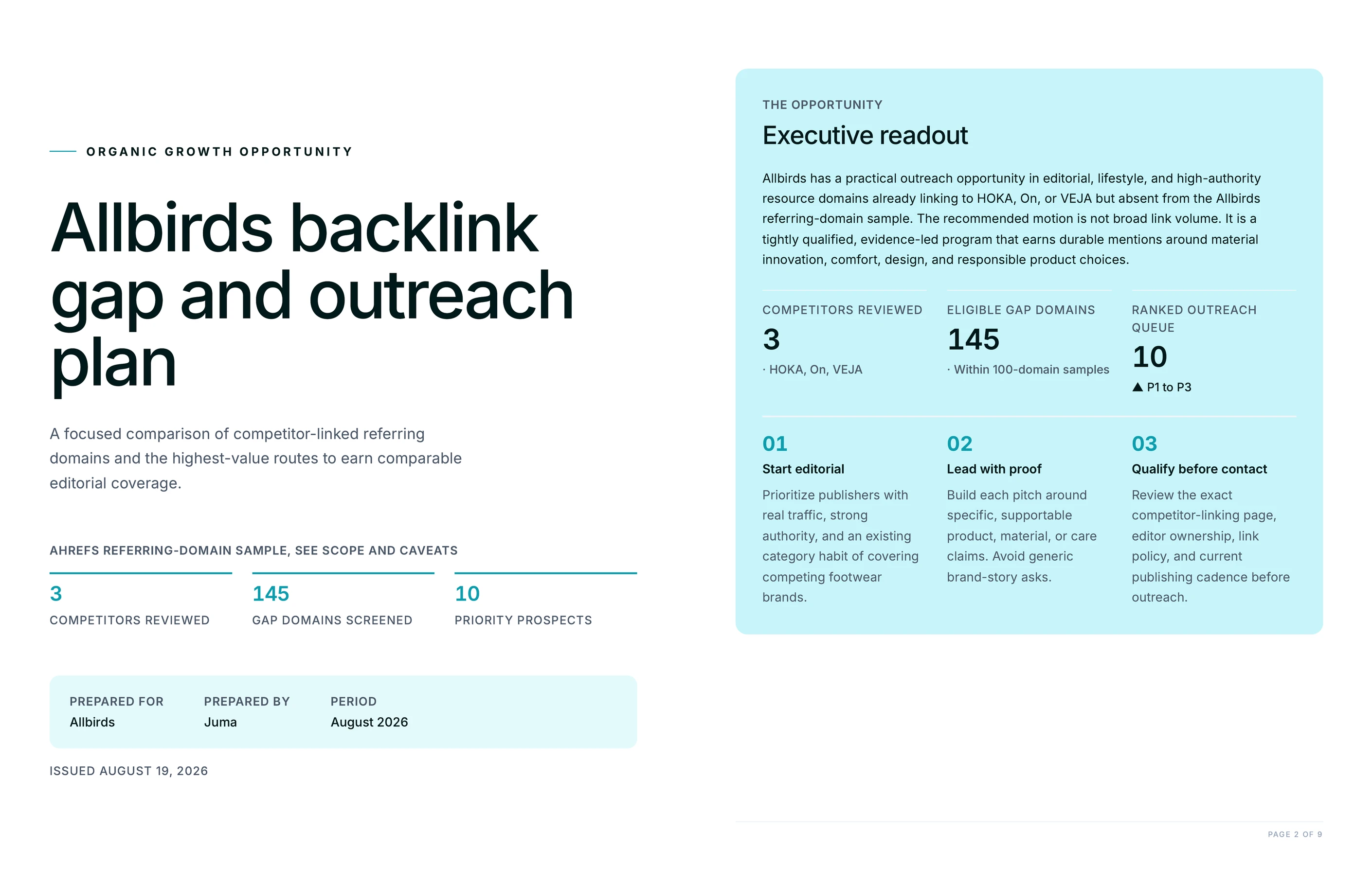
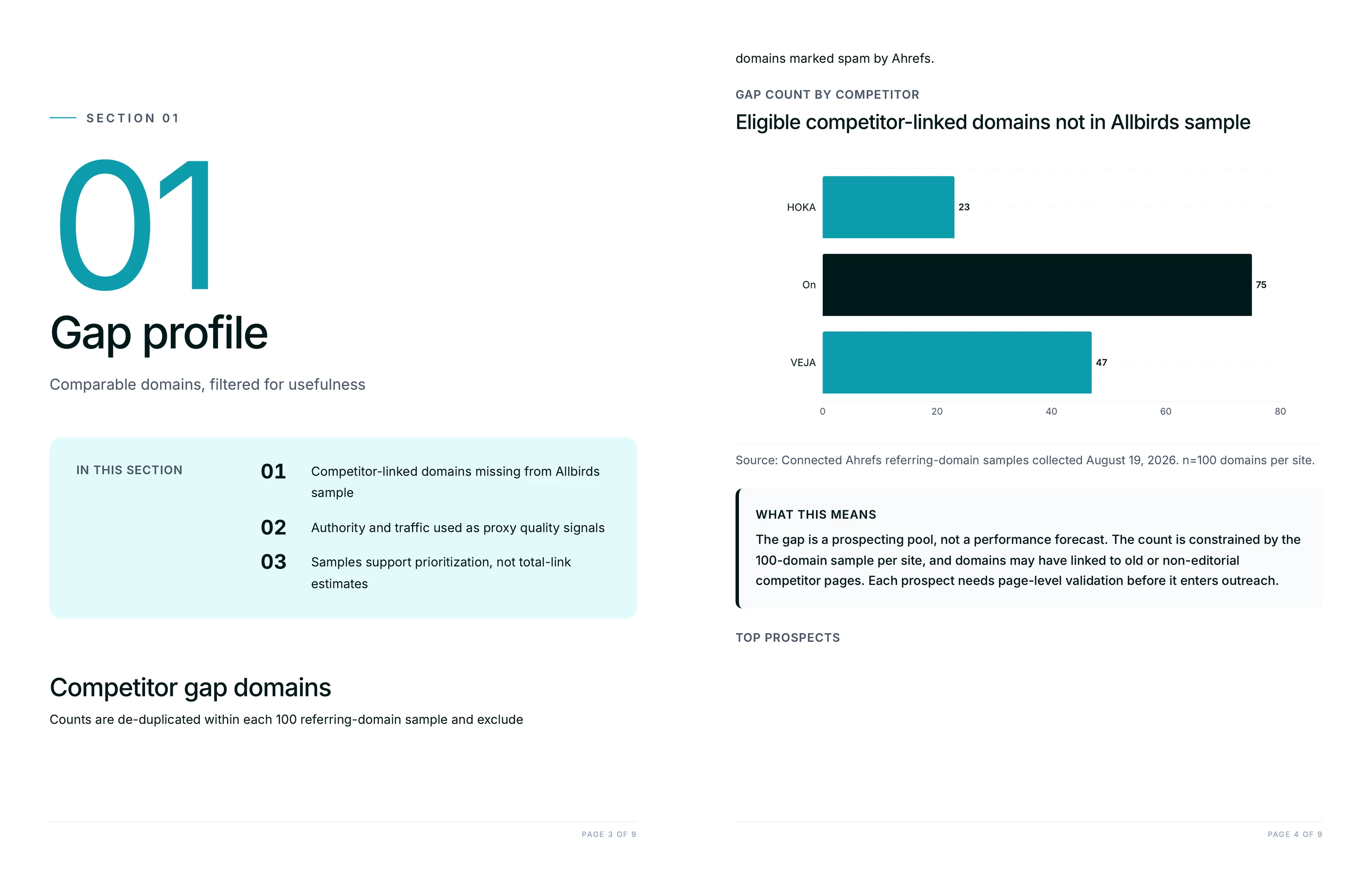
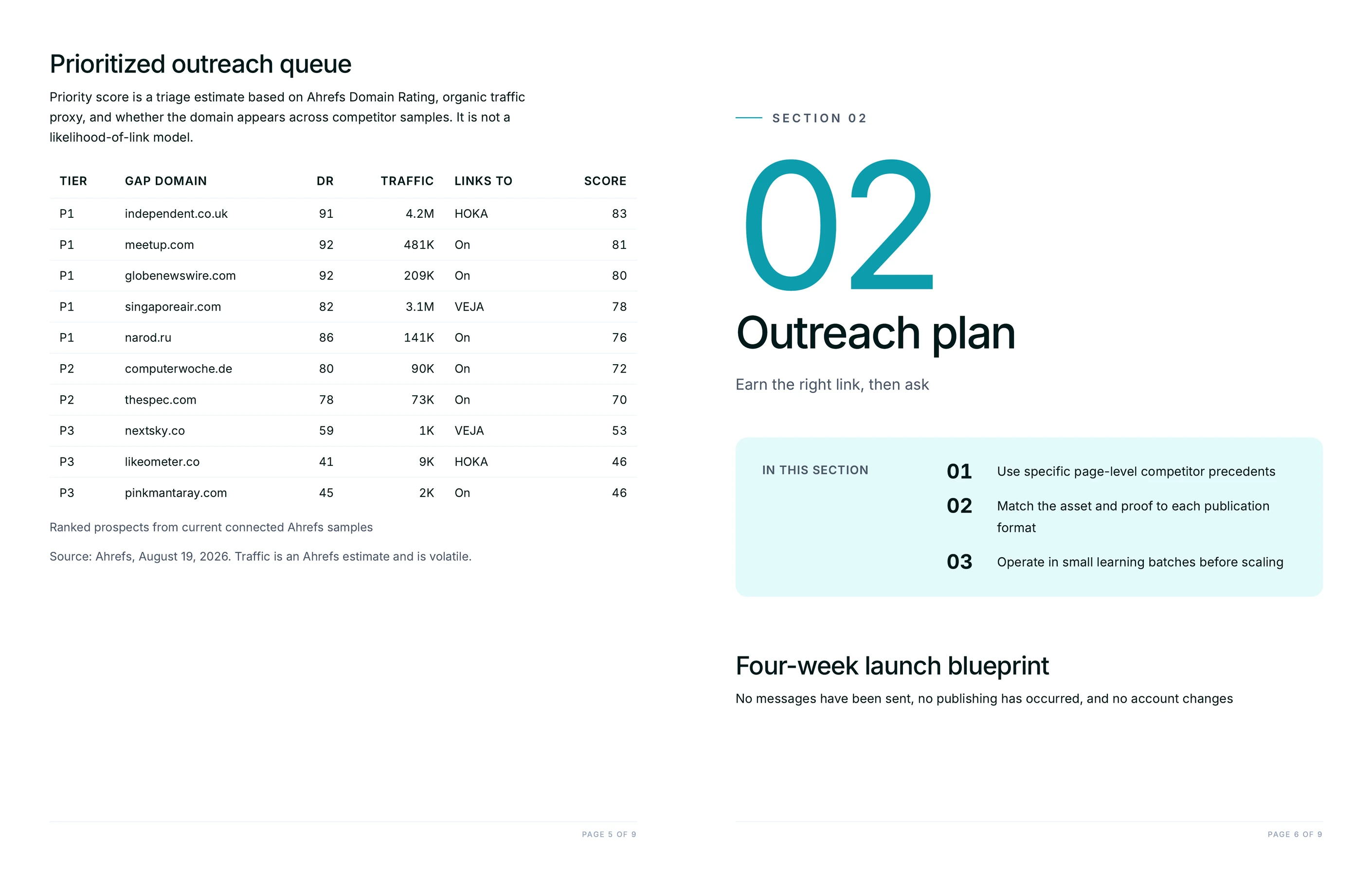
The plan is a ranked table of the referring domains that link to a competitor but not the client. Each row shows the domain's Domain Rating, a one-line relevance note, and a specific outreach angle for that site. A short summary recommends which handful to pitch first and why.
From there, the team can take the list further in the same chat: ask the Flow to find the likely contact for each domain and draft a tailored outreach email per target, built around the angle already surfaced and written in the client's project brand voice. The plan goes from a target list to ready-to-review drafts without a separate briefing step.
Does naming one competitor really change the result?
Yes. The Flow pulls a large amount of referring-domain data, so aiming it at one named competitor returns a faster, deeper result than "all competitors." With a single target, more domains get checked for relevance and each row carries more detail. Use it when you already know the rival to close in on.
A good pattern is to run the broad sweep first to see the whole competitive set, then drill into the one competitor whose links look most winnable. The broad run tells you where the biggest gaps are; the scoped run gives you the depth to act on one of them this week.
How is this different from exporting a link gap report from Ahrefs?
Ahrefs's Link Intersect shows which domains link to competitors but not you. This Flow starts there, then does the parts a raw export doesn't: it filters out irrelevant and low-value domains, writes a relevance note and a tailored outreach angle for each keeper, and hands back a prioritized plan the team can act on.
The raw list is data. The plan is what a strategist would build from it, and the Flow gets you to that draft in minutes. Strategy, taste, and judgment stay human: the team reviews the angles, adjusts priorities to the client's real relationships, and decides what gets sent.




.webp)

