Research & Briefing
Strategy & Planning
Content Planning
PDF
PDF Icon
PDF
Excel
Excel Icon
Excel
Web analysis
Web Icon
Web analysis
PDF
PDF Icon
Excel
Excel Icon
Web analysis
Web Icon

Build a PR media list with AI: a graded news hook, beat-matched journalists with proof links & a working pitch tracker

Name the client and the story, and get a media list where every journalist arrives with the dated article that proves they cover this, a scored beat match, and the contact route their outlet actually publishes.

Name the client, their site, and the story being pitched, and the first pass is a read of who has genuinely covered this kind of news in the last twelve months. Every name that survives comes back with the article that proves it: title, link, and publication date, plus a fit score that shows why that journalist ranks where they do. Two files land in the chat: a branded PDF media brief and an editable CSV your team can run the outreach from.

The column most media lists quietly skip is the honest one. 400+ marketing teams use Juma, and the lists that earn coverage are the ones where someone checked, rather than the ones bought by the thousand and mailed at everybody. Where only a newsroom tips inbox is published, the row says so instead of dressing a shared mailbox up as a personal contact, and no address appears anywhere that is not published on a page the brief can cite. Strategy, taste, and judgment stay human.

1

Find out who actually covers this story, before the pitch goes out

Thank you! Your submission has been received!
Oops! Something went wrong while submitting the form.
Try This Flow

Example Flow result

Hide details
  • Say whether the story is already public. An embargo pitch and a follow-up pitch need different lists. Name which one it is and every row gets marked as new to the story or as someone who already covered it, so nobody gets pitched their own article back.
  • Ask for the proof article behind every name. A journalist is only on the list because of something they wrote, so insist on the title, the link, and the publication date. Rows without that evidence are the rows that waste a week of outreach.
  • Make the contact route quote its own source. Ask where each route is published and for the wording that shows it. A route that cannot be quoted gets labelled a generic tips inbox, which is the honest answer and tells the team what the odds really are.
  • Name the market and the language. A list of English-language US tech press is the default and it is wrong for a launch in Germany or Brazil. One line in the first message changes which outlets are eligible.
  • Ask for the do-not-pitch list too. Pay-for-play contributor networks, outlets with a published no-unsolicited-pitches policy, and anyone whose recent coverage makes them a poor fit. Knowing who to skip protects the relationship as much as knowing who to send to.
  • Re-verify before the next campaign. Bylines move, beats change, and a six-month-old list is mostly fiction. Every row carries the date it was checked and a re-verify date ninety days out, so staleness is visible rather than discovered mid-pitch.
2

How do you know a journalist actually covers this kind of story?

Because the row carries the article that proves it. Ask for the beat match to be scored and each name comes back out of 100, split into four parts: how closely their past story matches this story type, whether they own the beat or wandered into it once, how recent the coverage is inside the twelve-month window, and whether they treated the angle being pitched. The split is what makes the number arguable. A journalist who once wrote about the client's patent filing scores very differently from one who covered a product launch, and the components show exactly where the gap sits rather than hiding it inside a single confident figure.

Prompt
Copy

Score every journalist on the list out of 100 and print the four components: 50 for how closely their proof article matches this story type, 25 for beat ownership, 15 for recency inside the last 12 months, 10 for treating the angle we are pitching. Drop anyone scoring under 50 and tell me who you dropped and why.

Try This Flow
3

How do you contact a journalist without guessing their email address?

By only using what the outlet publishes, and showing where. Ask for the route behind every name and each row names the page it came from and quotes the wording that establishes it, whether that is an author page contact, a desk address, or a newsroom tips line. Where nothing per-author exists, the row says generic tips inbox only rather than presenting a shared mailbox as a personal line, and that honesty lowers the row's priority because a pitch into a general inbox genuinely is a longer shot. Guessed addresses in the first-name-at-outlet pattern are the fastest way to get a sender reputation flagged, and they never make it into the file.

Prompt
Copy

For every row, give me the contact route the outlet publishes, the URL of the page it appears on, and the verbatim wording from that page that shows it. If you cannot quote a per-author route, label the row generic tips inbox only and remove any personal address. Never guess an address from a name pattern.

Try This Flow
4
Lightbulb Icon
Tips and tricks
Grade the hook before you build the list. If the announcement scores badly on timeliness and novelty, a bigger media list will not save it, and the honest move is to change the story rather than pitch harder.

How do you tell whether the announcement is even a story?

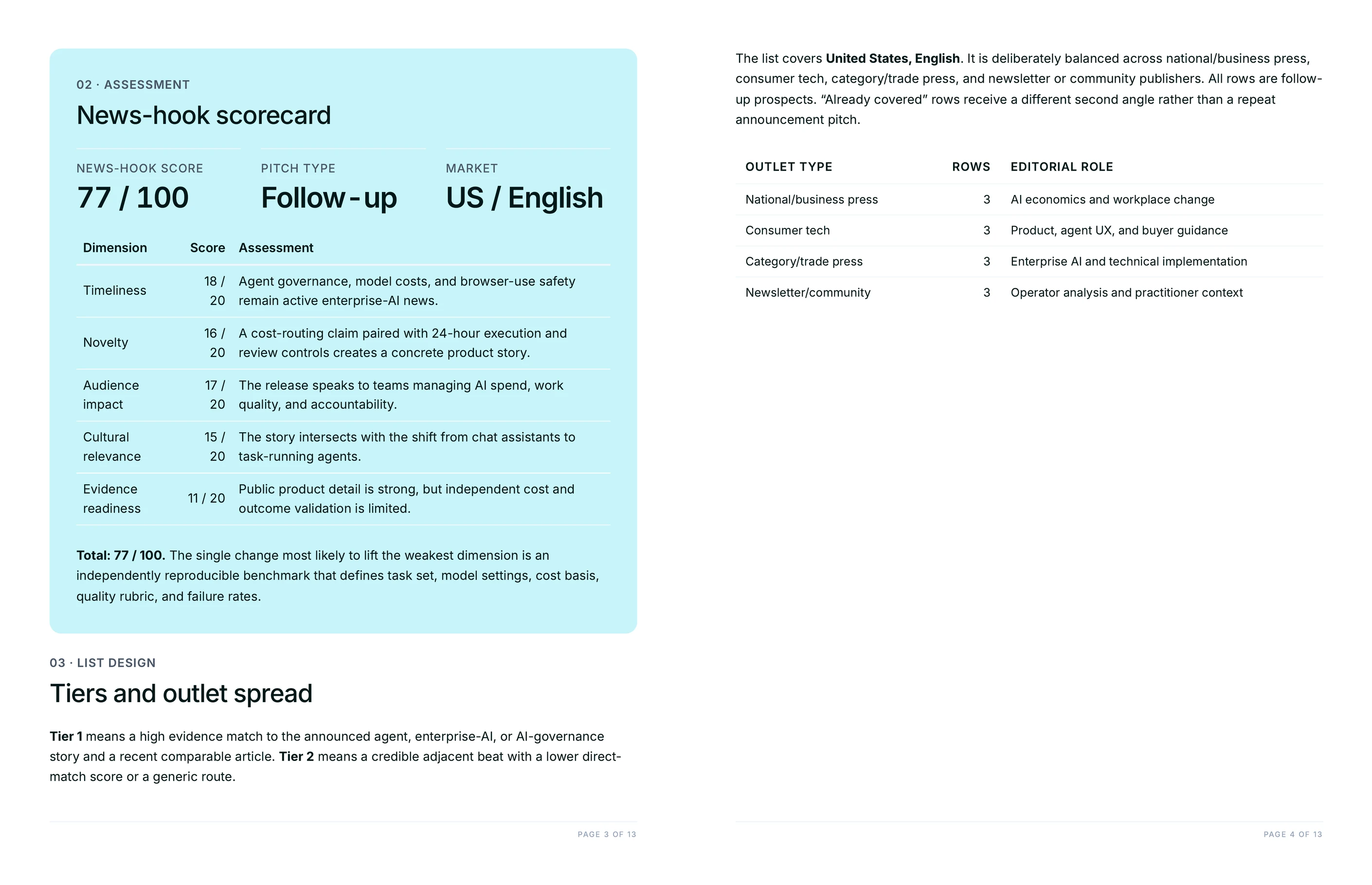
By scoring it before anyone starts pitching. Ask for the news hook to be graded and it comes back against named dimensions: timeliness, novelty, audience impact, cultural relevance, and how much evidence is ready to support the claims. Each dimension carries its own score and a one-line assessment, so a weak total points at the specific thing to fix. Thin evidence readiness usually means the demo, the data, or the third-party validation is missing, which is a solvable problem. A low novelty score is the harder conversation, and better to have it internally than to learn it from fourteen journalists not replying.

Prompt
Copy

Grade this announcement as a news hook out of 100 before building the list. Score timeliness, novelty, audience impact, cultural relevance and evidence readiness separately, give each a one-line assessment, and tell me which single change would raise the weakest score most.

Try This Flow
5

How do you turn the media list into outreach the team can actually run?

By asking for a tracker rather than a document. The CSV comes back with the research columns filled and the working columns deliberately empty: date pitched, owner, status, response, and follow-up date, ready for whoever runs the campaign. Tier one rows carry a subject line of nine words or fewer, and every row carries the one-sentence angle written as the pitch itself, in that journalist's frame, rather than a description of their interests. Two dated columns come filled in: the date each row was verified, and a re-verify date ninety days out, so the list announces its own expiry instead of quietly rotting.

Prompt
Copy

Turn the list into a working tracker. Add empty columns for date pitched, owner, status, response and follow-up date, fill in a verified-on date and a re-verify date 90 days later, write each angle as the sentence I would actually send that journalist, and give every tier one row a subject line of nine words or fewer.

Try This Flow

Set up your client project: the story calendar, past coverage, and the claims you can substantiate

Run one project per client and the media list stops starting from scratch every campaign. Add what the team knows from the inside, and every list built in that project inherits it. The difference shows up in the do-not-pitch list and the angles, because the work finally knows who was already pitched last quarter and which claims legal has cleared.

What to add

Past coverage and past pitches

Who has written about the client before, who was pitched and went quiet, and who asked not to be contacted again. This is the single item that prevents the most damage, because pitching a journalist the same story twice costs a relationship that took years to build.

The claims substantiation sheet

Which numbers and claims the client can stand behind, and what the evidence is for each. Angles built on substantiated claims survive a journalist's first question. Angles built on marketing copy do not.

The story calendar

What is announcing when, across the next two or three quarters, with embargo dates where they exist. Knowing what follows this announcement is how a list gets built for a campaign rather than for a single email.

Spokespeople and what they can speak to

Who is available for interview, their titles, and the subjects each one can genuinely carry. An angle that needs a clinical lead is worth nothing if only the CMO is free that week.

Guide Juma with project info

Each knowledge item takes a short description. One line is enough, and it tells Juma when to reach for that item instead of reasoning from the open web.

  • Past coverage and pitches: "Who has covered us, who was already pitched, and who asked not to be contacted, for the do-not-pitch list."
  • Claims substantiation: "The claims we can evidence and what backs each one, so angles only use things we can defend."
  • Story calendar: "What announces when over the coming quarters, including embargo dates, for sequencing outreach."
  • Spokespeople: "Who we can put forward for interview and which subjects each person can speak to."
Juma Logo
Find out who actually covers this story

Frequently Asked Questions

What does the media list include?

Two files. A branded PDF media brief carrying the graded news hook with its rubric, the tiered target list, the story angles, the outreach sequence, the do-not-pitch list, and a transparency section naming what could not be verified. Alongside it, an editable CSV with one row per journalist.

The CSV is the working half: tier, journalist, outlet, outlet type, market and language, story state, the fit score with its four components, the proof article with its URL and date, the pitch angle, a subject line for tier one rows, the contact route with the page and quote behind it, a verified-on date, a re-verify date, and empty columns for date pitched, owner, status, response and follow-up date.

Does it invent journalist email addresses?

No. Only routes an outlet actually publishes go in the file, and each one names the page it came from with the wording that establishes it. Where no per-author route is published, the row is labelled generic tips inbox only and any personal address is removed rather than guessed.

This matters commercially as much as ethically. Addresses guessed from a first-name-at-outlet pattern bounce, and a run of bounces damages the sending domain that the rest of the team's outreach depends on. A row that admits it only has a tips line is more useful than a row that invents a direct one, because the team can price the odds correctly.

How recent does the coverage evidence have to be?

The default window is the last twelve months, and every row shows the publication date so the window is visible rather than claimed. Recency carries its own weight inside the fit score, so a journalist who covered the beat last month ranks above one who covered it eleven months ago.

Each row also carries the date it was verified and a re-verify date ninety days later. Bylines move between outlets and beats get reassigned constantly, so a media list without an expiry date is the most common reason a campaign lands in an inbox nobody reads any more.

Can it tell whether the announcement is worth pitching at all?

Yes, and that happens first. The news hook is graded against timeliness, novelty, audience impact, cultural relevance and evidence readiness, each scored separately with a one-line assessment, so a weak total points at what to fix rather than just discouraging the team.

Juma augments the team, it doesn't replace it. The comms lead still decides whether the story is worth the capital, who gets the exclusive, and what the client will actually say on the record. What changes is that the fit evidence, the scoring, and the contact routes arrive written down and checked, instead of being assembled by hand across a week of tabs.

Does this work outside consumer tech?

Yes, and the list comes out looking different, which is the point. A B2B software announcement pulls trade press, analyst newsletters and vertical publications, where the hard part is finding the handful of people who cover the category seriously. A consumer launch pulls national press, reviewers and lifestyle outlets, where the hard part is standing out in a crowded beat.

The structure holds either way: a graded hook, scored beat matches with dated proof, published routes only, a stated market and language, a minimum spread across outlet types, and a do-not-pitch list. What changes is which outlets qualify and what the angles have to carry.

Don't take our word for it

Ask AI about us

400+ marketing teams trust Juma. ChatGPT, Claude, and Perplexity know why. Ask them.

Ready when you are

What's on your plate today?

Start typing a task and Juma will figure out the rest.

Thank you! Your submission has been received!
Oops! Something went wrong while submitting the form.