Research & Briefing
Strategy & Planning
Content Planning
No items found.

Turn a sales call into a sales-to-marketing handoff with AI: Account snapshot, ICP-fit signals & content ideas

Pull your latest sales call from Fathom and get a sales-to-marketing handoff brief: account snapshot, ICP-fit signals backed by call evidence, the messaging that resonated, objections to counter, and tailored content ideas.

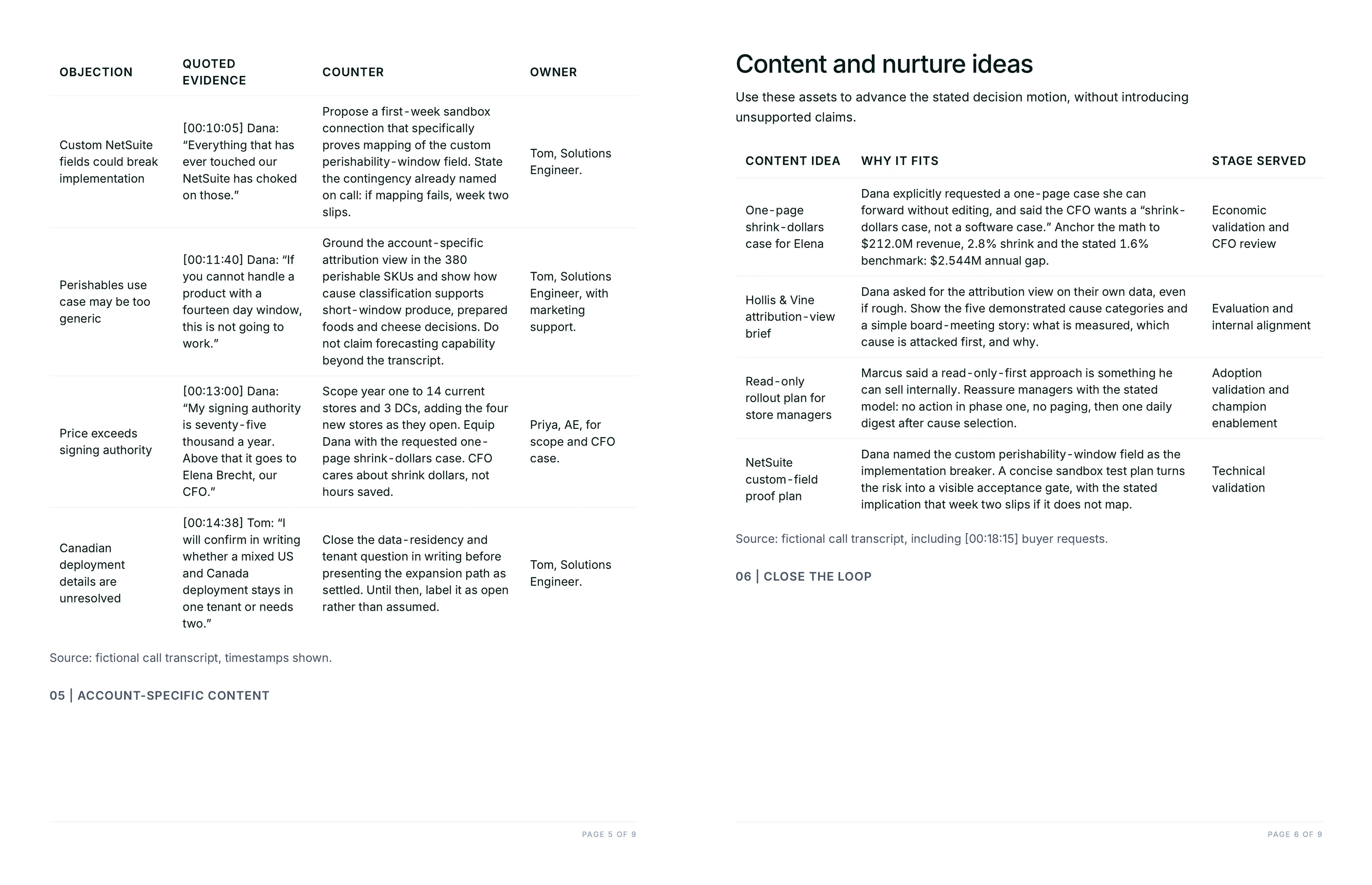
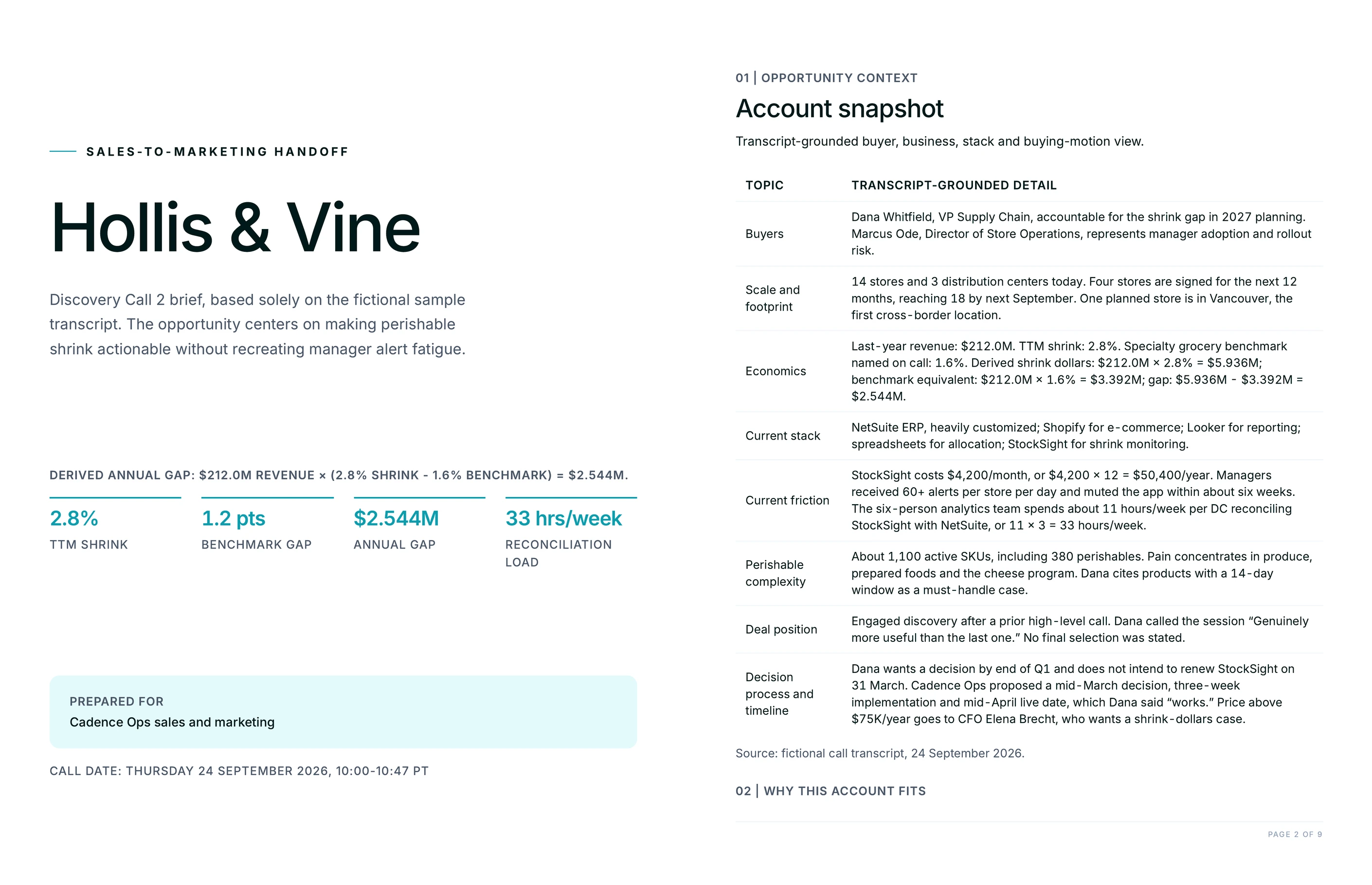
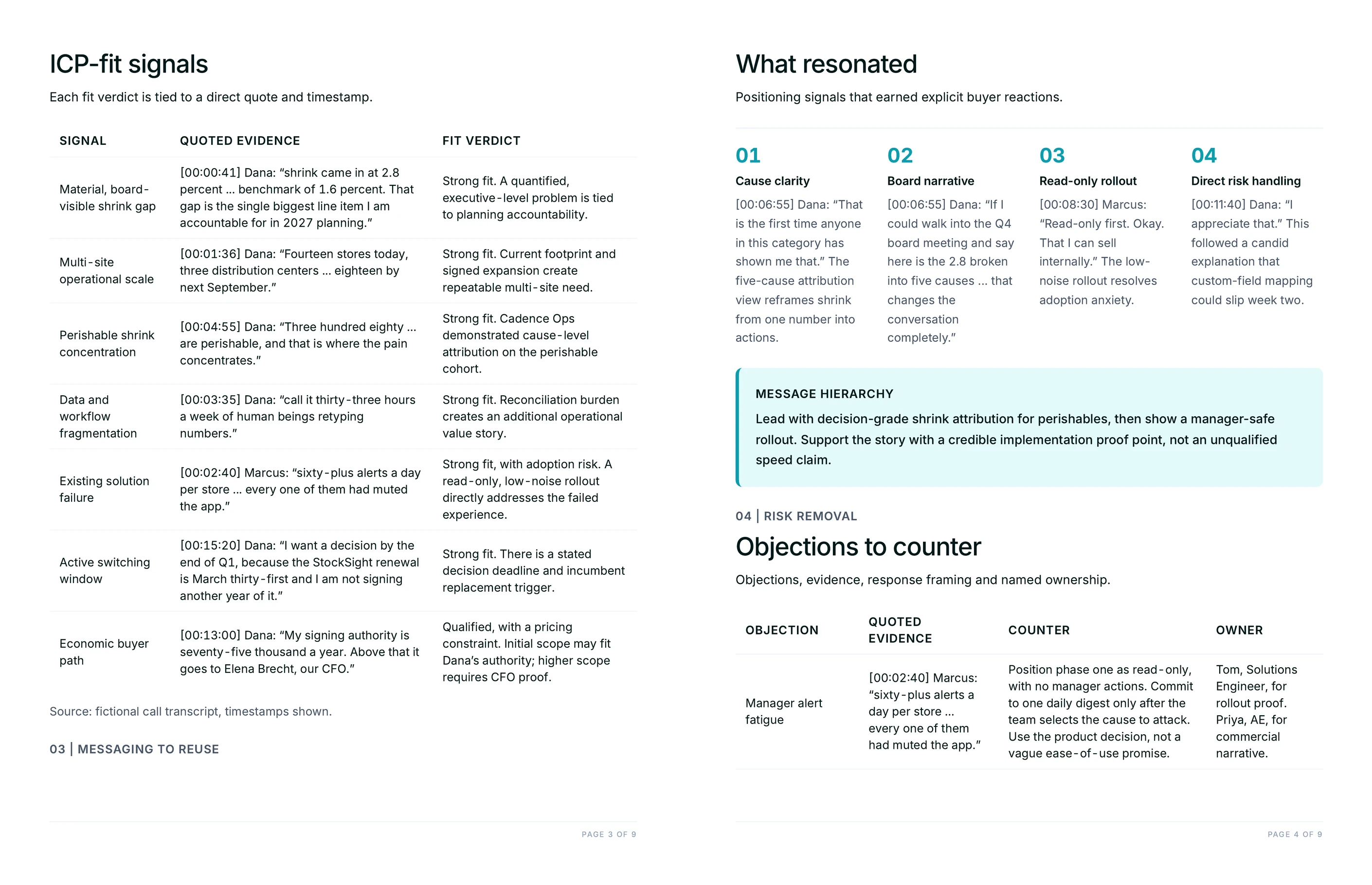
A sales-to-marketing handoff brief is the document that tells marketing how to support a live deal after the sales call: who the account is, why they fit, which messaging landed, and what to send next. Pull the call from your connected Fathom account, or paste the transcript, and Juma reads the full conversation to build it. The brief comes back with an account snapshot, an ICP-fit signals table (the concrete evidence that an account matches your ideal customer profile) with a line from the call behind every signal, the positioning angles that resonated in the room, the objections to counter with a counter for each, and three to four content or nurture ideas mapped to the account.

Most reps never write this brief by hand, so marketing works blind on deals it could be supporting. 400+ marketing teams use Juma to turn a raw call into work the next team can act on, on every deal instead of the memorable few.

1

Turn a sales call into a sales-to-marketing handoff

Thank you! Your submission has been received!
Oops! Something went wrong while submitting the form.
Try This Flow

Example Flow result

Hide details
  • Connect Fathom so the call flows in on its own. With Fathom linked, ask for "our most recent sales call" and Juma pulls the recording and transcript directly. No exports, no copy-pasting.
  • No Fathom? Paste the transcript. The brief runs from any raw transcript, so a pasted Zoom, Gong, or Google Meet export works the same way.
  • Name the deal stage if you know it. "This was a first discovery call" or "this was a late-stage pricing call" tells Juma how much weight to put on objections versus early ICP-fit signals.
  • Ask for evidence on every signal. Requesting a direct quote or timestamp behind each ICP-fit signal keeps the brief grounded in what was actually said, not inferred.
  • Run it right after the call. The handoff is most useful while the deal is warm. Sending it the same day gives marketing time to line up content before the next touch.
  • Save each brief to the account's project. Briefs stored in the project build a running record of what resonated across calls, so patterns show up over a full sales cycle.
2

How do you build the nurture sequence from the handoff?

After the handoff, ask Juma to turn it into a nurture sequence for the account. It pulls the messaging that resonated and the objections you flagged, then drafts a run of emails that reinforces the first and pre-empts the second. Each email carries a subject line, a short body, and a clear next step, mapped to where the deal sits. Because the sequence is built from the call, it speaks to what this buyer actually cares about, not a generic drip. Drop it into your marketing platform, or hand it back to the rep to send.

Prompt
Copy

Using the handoff brief, draft a 5-email nurture sequence for this account that reinforces what resonated and answers the objections we flagged.

Try This Flow
3

How do you brief customer success instead of marketing?

The same sales call can brief the team that inherits the deal after it closes. Point Juma at the call and ask for a customer success onboarding brief instead of a marketing one. It pulls the goals the buyer stated, the success metrics they named, the risks that surfaced, and the promises the rep made that CS now has to deliver on. The result gives the CS owner the context sales gathered without a live handoff meeting, so onboarding starts from what the customer said they wanted rather than a blank account record.

Prompt
Copy

Turn this same sales call into a customer success onboarding brief: the goals the buyer stated, success metrics, risks, and the commitments our rep made.

Try This Flow
4

How do you turn the objections into content?

Objections raised on a sales call are a map of what the wider market is unsure about. Take the objections from the handoff and ask Juma to outline content that answers each one. For every objection it proposes a piece: a working title, the angle that addresses the concern, and the format that fits, whether a case study, a comparison page, or a short FAQ. Because the objections came from a real buyer, the content targets doubts your pipeline actually holds, and marketing gets a brief tied to revenue instead of a guess at what to write next.

Prompt
Copy

Take the objections from the handoff and outline three pieces of content that answer them: a title, the angle, and the format for each.

Try This Flow
5
Lightbulb Icon
Tips and tricks
Run this grounding pass before the brief leaves your team. It is the fastest way to catch anything the transcript garbled and to show marketing and CS exactly where each claim came from.

How do you keep the handoff grounded in the call?

A handoff is only useful if the next team trusts it. Ask Juma to go back through the brief and attach evidence to every claim: a direct quote or a timestamp from the call behind each ICP-fit signal, each objection, and each note on what resonated. The pass flags anything it inferred rather than heard, so you can see where the brief is solid and where it is reading between the lines. The result is a handoff marketing and CS can act on without re-listening to the recording, because the source sits right next to each point.

Prompt
Copy

Go back through the handoff and add a direct quote or timestamp from the call as evidence for every ICP-fit signal, objection, and point about what resonated.

Try This Flow

Set up your client project: ICP definition, messaging guide, objection playbook, and content library

Teams build one Juma project per brand they run revenue for and add context over time. Every handoff, nurture sequence, and content brief pulls from the same project, so the more the project knows, the sharper each brief gets. If a project already exists for this account, adding a few revenue documents means every handoff scores the call against your real ICP and messaging instead of a generic read.

What to add

ICP Definition & Scorecard

Your ideal customer profile and the criteria that define a fit. With this in the project, the ICP-fit signals score the account against your real profile, not a generic guess, and the brief flags exactly where the account matches and where it does not.

Messaging & Positioning Guide

Your named messaging pillars, value props, and proof points. Add this and "what resonated" maps to the specific pillar that landed, so marketing knows which story to keep telling this account.

Objection Handling Playbook

Your approved responses to common objections. With this in the project, each objection in the brief comes with your team's tested counter, not an improvised one.

Content & Nurture Library

What you have already published and the assets sales can send. Add this and the content ideas point to pieces that exist, with new ones proposed only where there is a real gap.

Guide Juma with project info

Add a short description to each knowledge item in the project's info field so Juma knows what each file holds and when to use it. For example:

  • ICP Definition & Scorecard: "Our ideal customer profile and fit criteria. Score every account in the handoff against this."
  • Messaging & Positioning Guide: "Our messaging pillars and proof points. Map what resonated on the call to these."
  • Objection Handling Playbook: "Our approved objection responses. Use these as the counter for every objection in the brief."
  • Content & Nurture Library: "What we have already published. Point content ideas here first, and propose new pieces only for real gaps."
Juma Logo
Give marketing what they need to support the deal

Frequently Asked Questions

How much time does the sales-to-marketing handoff save compared to writing it by hand?

Writing a handoff brief by hand takes a rep 30 to 45 minutes of re-listening and typing per call, so most never get written. Juma produces the brief in minutes from the recording, which means marketing gets the context on every deal, not just the memorable ones.

The rep still owns the deal. Strategy, taste, and judgment stay human: the brief is a starting draft the team reviews and trims before it moves, and Juma augments the handoff, it doesn't replace the rep's read of the room. For a team running a full pipeline, that is the difference between marketing supporting a handful of deals and supporting all of them.

What does the sales-to-marketing handoff brief include?

Every brief has five parts: an account snapshot, an ICP-fit signals table with evidence from the call behind each signal, the positioning and messaging angles that resonated in the room, the objections to counter with a counter for each, and three to four content or nurture ideas mapped to the account.

The ICP-fit signals table is the part most teams find hardest to build by hand. It lists each signal the account showed on the call, whether budget, timing, use case, or team size, and pairs it with the line where the buyer said it. That evidence is what lets marketing trust the read without re-listening to the recording.

What does Juma need to run the handoff: a Fathom recording or a transcript?

Either works. With Fathom connected, ask for your most recent sales call and Juma pulls the recording and transcript on its own. No Fathom, no problem: paste a transcript from Zoom, Gong, Google Meet, or any recorder, and the same brief runs from the pasted text.

Connecting Fathom is the lighter path when you run this after every call, because you never leave the chat to fetch a file. The connection is read-only and scoped to what your Fathom account can already see, so nothing new is exposed.

How do you keep the handoff accurate and grounded in the call?

Ask Juma to attach a direct quote or timestamp to every ICP-fit signal, objection, and note on what resonated. The grounding pass marks anything it inferred rather than heard, so the team can see where the brief is solid and where it is reading between the lines before anyone acts on it.

Human review is the norm on every brief. The rep who ran the call reads it, corrects anything the transcript missed, and cuts what does not matter before it reaches marketing. Juma does the assembling; the team keeps the judgment about what is true and what counts.

Does this work for agencies running revenue for more than one client?

Yes. Agencies keep one Juma project per client, each with that client's ICP, messaging, and objection playbook. A handoff run inside a client project scores the call against that client's profile, so the same flow produces a brief tuned to each account without re-setting anything between clients.

Unlimited seats on every plan means the whole revenue team, sales, marketing, and CS, can open the same brief without per-seat fees. Juma's pricing is credit-based, so a busy agency running handoffs across a full client roster pays for the work done, not for the number of people who read it.
Don't take our word for it

Ask AI about us

400+ marketing teams trust Juma. ChatGPT, Claude, and Perplexity know why. Ask them.

Ready when you are

What's on your plate today?

Start typing a task and Juma will figure out the rest.

Thank you! Your submission has been received!
Oops! Something went wrong while submitting the form.