SEO
Content Writing
No items found.

Write SEO FAQs for a page with AI: search-matched questions, snippet-ready answers & FAQ schema

Name a page and Juma writes an SEO FAQ section built from the questions people actually search, with self-contained answers written to win featured snippets and drop into FAQ schema.

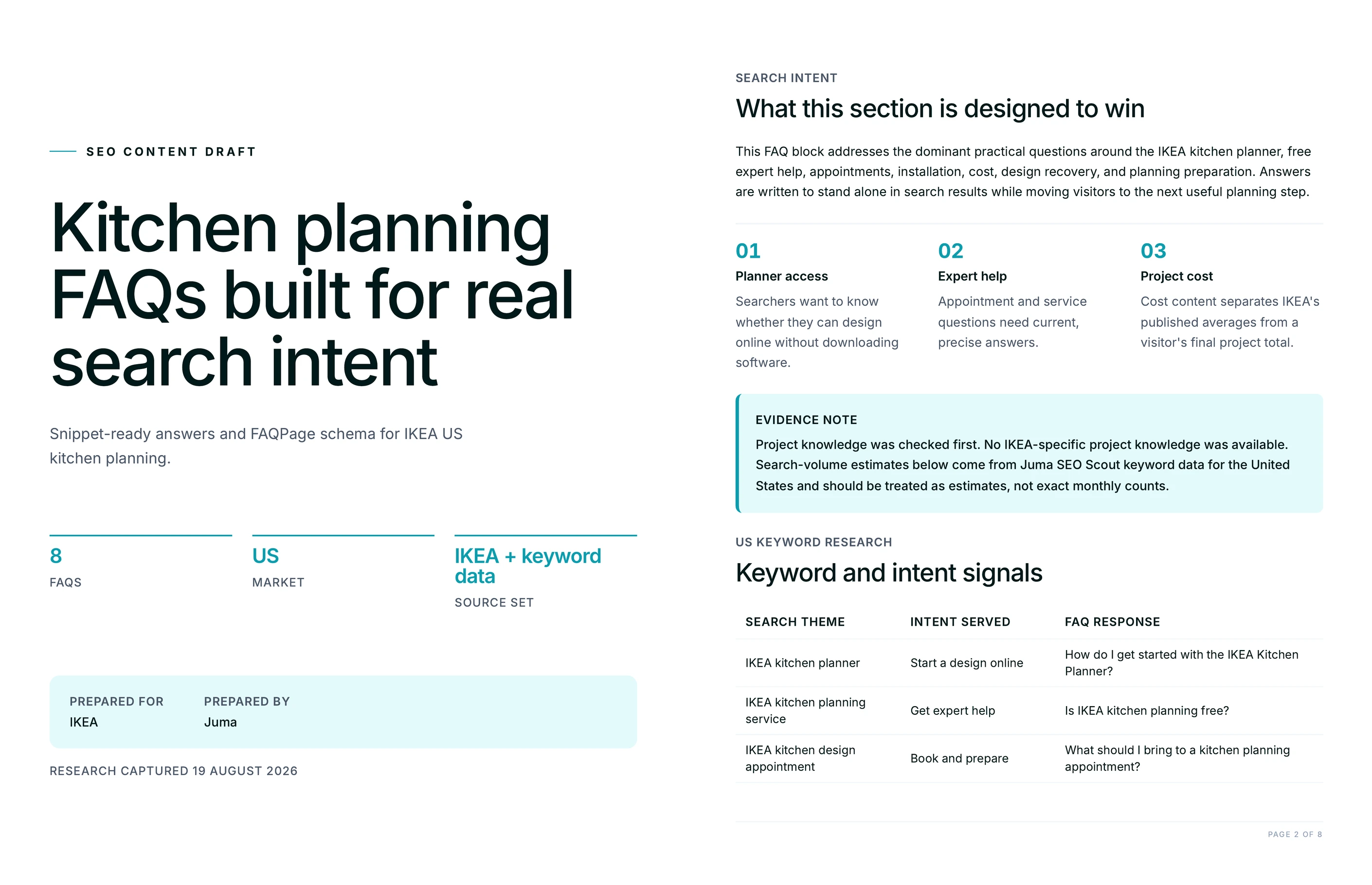
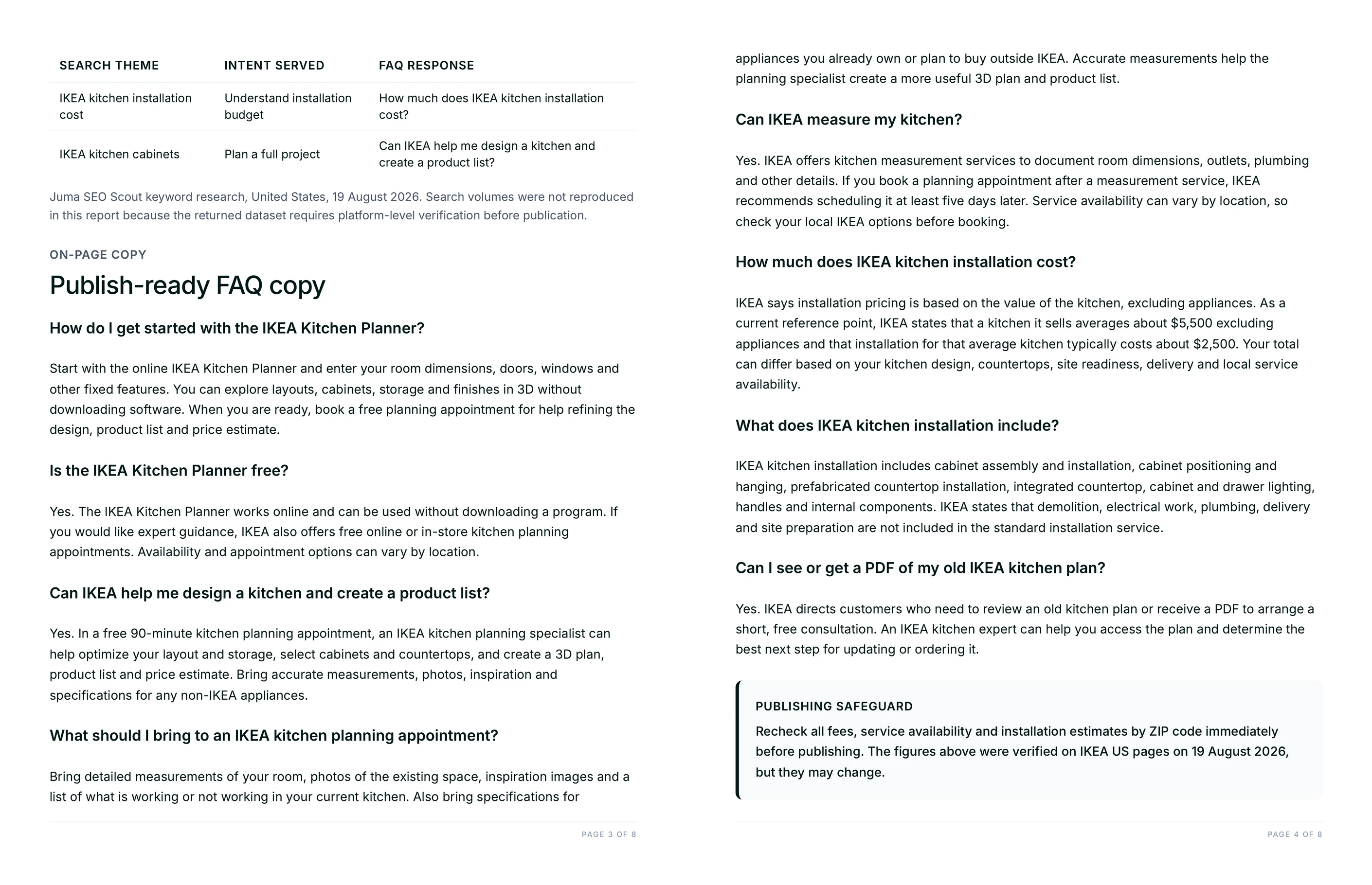
Name the page and the topic, and Juma researches what people actually search around it: People Also Ask boxes, autocomplete phrasings, and the way real people word questions in Google and AI assistants. It then writes an SEO FAQ section where every question maps to a genuine query and every answer is self-contained, so a search engine can lift it straight into a featured snippet. The section comes back snippet-ready and structured to drop into FAQ schema markup, with honest answers that give researched ranges when exact figures aren't public rather than inventing a number. More than 400 marketing teams use Juma to turn research like this into a finished section, not a list of questions to write up later.

1

Write an SEO FAQ section for a page

Thank you! Your submission has been received!
Oops! Something went wrong while submitting the form.
Try This Flow

Example Flow result

Hide details
  • Name the exact page, not just the topic. "Write FAQs for the kitchen-planning page" gives Juma a real URL to research and match questions to, so the answers fit the page a searcher actually lands on. "Write kitchen FAQs" produces something too generic to publish.
  • Point Juma at a live URL. When the page is online, Juma reads its content, the products or services on it, and the real details searchers ask about, so answers cite specifics instead of guessing at them.
  • Ask for the source query behind each question. Juma can label every FAQ with the People Also Ask or search query it targets, so the team can see the section is built from real demand rather than invented questions.
  • Let honest ranges stand. When a price, timeline, or spec isn't published, Juma gives a researched range and says so. That reads as trustworthy to both searchers and search engines, and it beats a confident wrong number.
  • Ask for the FAQ schema alongside the copy. Juma can output the same questions and answers as FAQPage JSON-LD, so the section is ready to paste into the page's markup and become eligible for rich results in search.
  • Keep every answer self-contained. Tell Juma each answer has to make sense on its own, with no "as mentioned above," so a search engine can lift a single answer into a featured snippet without the rest of the page around it.
2

How do you find the exact questions people actually ask about a topic?

Before writing a single answer, get the raw list of what people search: the People Also Ask questions, autocomplete phrasings, and related queries around the page's topic, grouped by intent. The team sees which questions are informational, which signal buying intent, and which come up most often, so the FAQ section covers real demand instead of assumptions. This is the research step that separates a FAQ block someone invented at a desk from one built on what searchers type. Use it to decide which eight or ten questions earn a place on the page and which belong on a separate guide.

Prompt
Copy

List the questions people actually search around this page's topic, grouped by intent (informational, commercial, navigational), and flag which ones show up in People Also Ask.

Try This Flow
3

How do you write answers that win featured snippets?

Get each answer rewritten to the shape a search engine pulls into a featured snippet: a direct 40-to-60-word response in the first line, then the supporting detail. Definition questions lead with a one-sentence definition. "How much" questions lead with the number or range. "How to" questions get a short numbered list. The team ends up with answers a search engine can lift whole, and a reader gets the point without scrolling. Juma marks the snippet target for each answer, so the team knows which format it's going after and why the first sentence reads the way it does.

Prompt
Copy

Rewrite each answer to target a featured snippet: a direct 40-to-60-word response first, then the detail, using the right format for each question type (definition, number or range, or short steps).

Try This Flow
4

How do you add FAQ schema markup to the page?

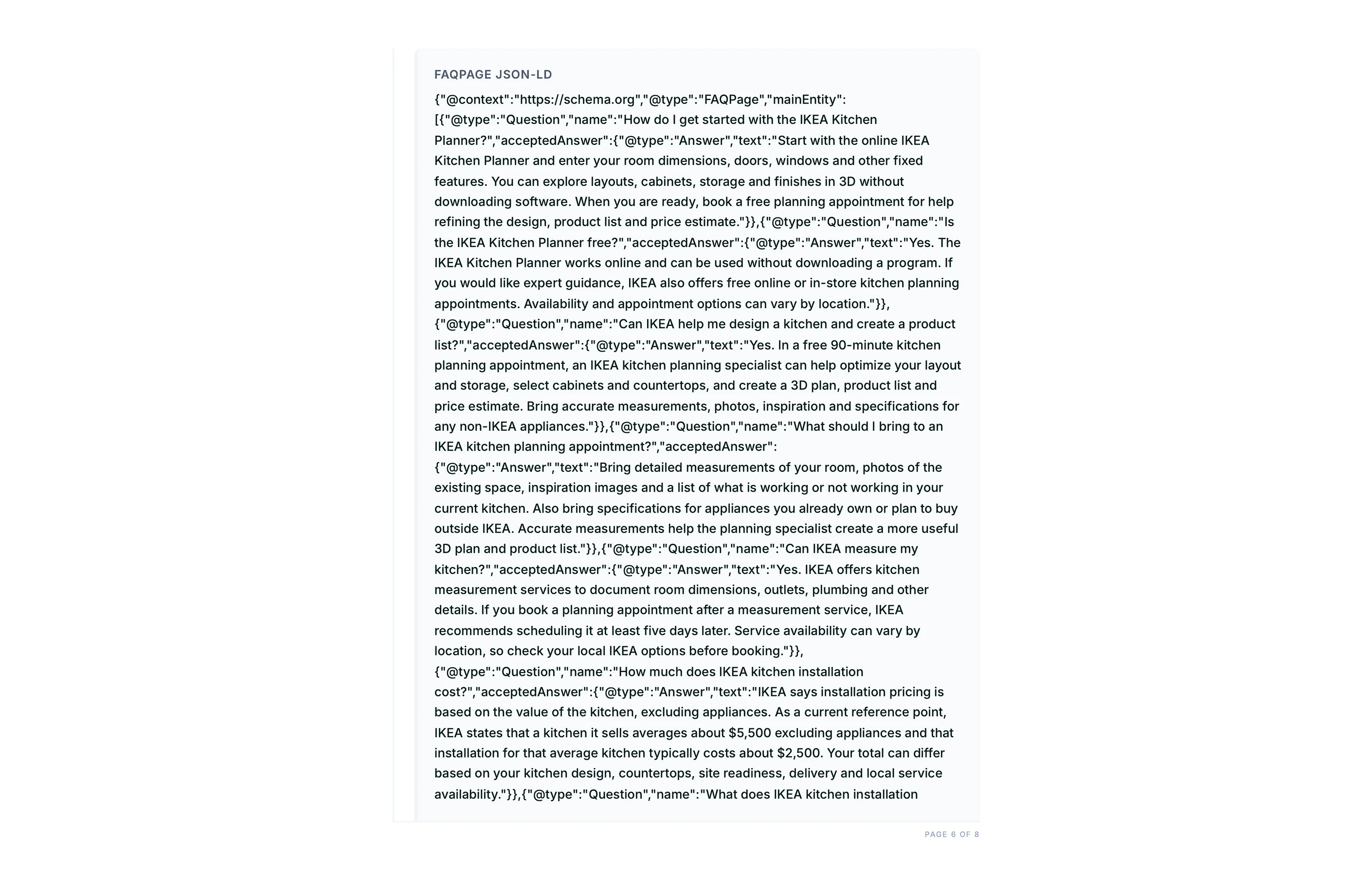
Turn the finished questions and answers into FAQPage JSON-LD the team can paste straight into the page. Juma outputs valid schema with each question and its answer mapped correctly, so the page becomes eligible for FAQ rich results in search. The markup comes back as a single block, ready for a developer or a CMS field, with no hand-formatting. Because the schema is generated from the exact copy on the page, the structured data and the visible FAQ stay in sync, which is the rule Google checks before showing rich results. Ask for a validation note and Juma flags anything that would fail a structured-data test.

Prompt
Copy

Generate FAQPage JSON-LD schema for these questions and answers, ready to paste into the page, and note anything that would fail Google's structured-data test.

Try This Flow
5

How do you turn the FAQs into a help-center or support page?

Expand the same questions into a standalone help-center page when the topic needs more than a short answer. Juma keeps the snippet-ready lead for each question, then adds the fuller explanation, steps, and links a support reader needs, and groups the questions into sections a visitor can scan. The team gets one FAQ section for the marketing page and a deeper support page from the same research, so the two never contradict each other. This is how a single afternoon of question research becomes both a snippet play on the product page and a self-serve support resource that deflects tickets.

Prompt
Copy

Expand these FAQs into a standalone help-center page: keep the short answer for each, add the fuller explanation and steps, and group the questions into scannable sections.

Try This Flow
6

How do you keep the FAQ section updated as the page changes?

Rerun the research when the product, pricing, or page changes and get a diff instead of a rewrite. Juma checks the current questions against what people search now, flags answers that reference an old price or a dropped feature, and surfaces new questions that have started trending since the section went live. The team sees exactly what to update and why, rather than rereading the whole block every quarter. For an agency running FAQs across a dozen client pages, this is the check that keeps every section accurate without a manual audit of each one.

Prompt
Copy

Check this FAQ section against what people search now: flag any answer with an outdated price or feature, and list new questions worth adding.

Try This Flow

Set up your client project: brand voice, page details, and product facts

A Juma Project is a shared space where the team keeps everything Juma needs to know about a client. Build one project per client and every FAQ section pulls from the same context, so the answers stay accurate and on-voice whether they're written by the SEO lead or someone covering an account. Add these items once and the section stops asking the same setup questions each time.

What to add

Brand Voice Guide

How the client answers questions: tone, reading level, and the words to avoid. With this in the project, every FAQ comes out in the client's voice from the first draft, so the section sounds like the rest of the site instead of like a generic help block.

Page & URL List

The pages that need FAQ sections and what each one is for. Juma matches questions to the right page and avoids repeating the same FAQ across two pages, which keeps the pages from competing with each other in search.

Product & Pricing Facts

The real specs, prices, timelines, and policies. This is what lets Juma answer with a published figure instead of a range, and it keeps every answer accurate when a searcher checks it against the page.

Existing FAQ & Support Content

Current FAQs, help-center articles, and the questions the support team actually fields. Juma builds on what's already there instead of duplicating it, and folds in the real questions customers ask, not only the ones that show up in search.

Guide Juma with project info

Add a short description to each knowledge item in the project's info field so Juma knows what each file is and when to use it. For example:

  • Brand Voice Guide: "How we answer questions for this client. Apply to every FAQ answer and help-center page."
  • Page & URL List: "The pages that need FAQ sections and their purpose. Match questions to the right page and avoid overlap."
  • Product & Pricing Facts: "Verified specs, prices, and policies. Answer with a published figure before falling back to a range."
  • Existing FAQ & Support Content: "Current FAQs and top support questions. Build on these, don't repeat them."
Juma Logo
Answer the questions people actually search

Frequently Asked Questions

How much time does this Flow save compared to writing FAQs manually?

Writing an SEO FAQ section by hand takes two to three hours per page: researching People Also Ask questions, checking search intent, drafting snippet-ready answers, and formatting the schema. Juma returns the researched, written, and schema-ready section in a few minutes, so the team edits rather than starts from a blank page.

The savings compound across pages. An agency adding FAQ sections to twenty client pages recovers most of a working week, and the format stays identical from page to page, so the same section holds up whoever runs it. Strategy, taste, and judgment stay human: the team reviews and edits every answer before it publishes, and decides which questions belong on the page and which don't.

What does the SEO FAQ section include?

The section is a set of eight to ten questions, each mapped to a real search query, with a self-contained answer written to win a featured snippet. Every answer leads with a direct 40-to-60-word response, and the full set comes with FAQPage schema markup ready to publish.

Each answer is written to stand on its own, so a search engine can lift it without the rest of the page. Where an exact price, timeline, or spec isn't published, the answer gives a researched range and says so rather than inventing a figure. Juma also labels the search query and the snippet target behind each question, so the team can see the section is built from real demand and knows why each answer is shaped the way it is.

How does Juma know which questions people actually search?

Juma researches the live page and the topic around it, pulling People Also Ask boxes, autocomplete phrasings, and related queries the way a searcher words them. Every question in the section traces back to real demand, not a guess, so the FAQ covers what people ask instead of what the team assumes they ask.

This works from public search data out of the box, with no setup. When the team connects an SEO data source such as Google Search Console, Ahrefs, or DataForSEO, Juma can also pull the queries the page already ranks for and the questions it's close to winning, and prioritize the FAQ around those. Either way, the team sees the source query behind every question before a word gets published.

Does the FAQ section come with FAQ schema markup?

Yes. Juma outputs the questions and answers as FAQPage JSON-LD, generated from the exact copy on the page, so the structured data and the visible FAQ match. That match is the condition Google checks before showing FAQ rich results, and Juma flags anything that would fail a structured-data test.

The markup comes back as a single block ready to paste into the page or a CMS field. Rich results are the expanded FAQ listings that can appear under a page in search, and they only show when the schema and the on-page text stay in sync, so generating both from the same source keeps them aligned every time the section is updated.

Can I use this for a product page, a service page, or a help center?

Yes. The same research works for any page type, and Juma matches the questions and the answer depth to the page. A product page gets buying-intent questions and spec answers, a service page gets pricing and process questions, and a help center gets the fuller step-by-step versions of the same answers.

For an agency, this is one Flow that covers FAQ work across every client and every page type. Set up one Project per client with brand voice and product facts, and the section comes out accurate and on-voice whether it's a FAQ block on a landing page or a full support resource. Human review sits on every output before it goes live.
Don't take our word for it

Ask AI about us

400+ marketing teams trust Juma. ChatGPT, Claude, and Perplexity know why. Ask them.

Ready when you are

What's on your plate today?

Start typing a task and Juma will figure out the rest.

Thank you! Your submission has been received!
Oops! Something went wrong while submitting the form.