Research & Briefing
Social
Content Planning
No items found.

Write a UGC creator brief with AI: usage-rights terms, hook-by-hook shot lists & platform delivery specs

Share the client, the product and the markets the creators post from. Juma delivers a creator brief with filled usage-rights terms, the disclosure line for each market, three hook options per shot, and a per-platform delivery spec.

Creator programs break at the brief. Footage arrives that cannot be used, a disclosure line is missing, or a rights term nobody actually agreed turns into a problem the week the ads go live. Share the client, the hero product, and the markets the creators post from.

Juma researches the brand's own published claims and the disclosure rules that apply in each market, then delivers the brief as a branded PDF plus an editable CSV with one row per deliverable. Every rights term arrives filled with a canonical default instead of a blank to negotiate later. 400+ marketing teams use Juma to run work like this in chat, with human review on every output.

1

Write a creator brief a legal team will sign off on

Thank you! Your submission has been received!
Oops! Something went wrong while submitting the form.
Try This Flow

Example Flow result

Hide details
  • Name the markets the creators post from. Disclosure rules differ by market: the US follows FTC guidance, the UK follows the ASA and the CAP Code, and the EU adds its own requirements. Say "US and UK creators" and the brief carries the right disclosure string for each one instead of a single US line that leaves the UK posts non-compliant.
  • Say whether ads will run from the creator's handle. Whitelisting, sometimes called creator-handle advertising, is a separate permission from normal paid usage. Mention it upfront and the rights matrix prices and scopes it properly rather than leaving the team to renegotiate after the campaign is live.
  • Pick one hero product. A brief built around a single product produces specific hooks and a shot list tied to how that product actually behaves on camera. "Our whole range" produces generic beauty filler that works for nothing.
  • Ask for the CSV alongside the PDF. The PDF is what goes to the creator. The CSV carries one row per deliverable with every rights and spec column, so it pastes straight into the contract schedule or the project tracker.
  • Flag whether raw footage is in scope. Raw clips are the difference between one edit and six. State it in the ask and the brief sets the delivery format, the file naming, and the rights term that covers it.
  • Upload the client's approved claims sheet if one exists. Without it, Juma builds the claim limits from the brand's own published copy and labels each line with its source. With it, the brief uses the client's vetted wording verbatim and flags anything a creator proposed that falls outside it.
2

How do you set usage rights and exclusivity for creator content?

Rights are where creator programs quietly lose money. A brief that says "we can use the content" settles nothing: paid media, organic, retailer pages, and ads run from the creator's own handle are four different permissions with four different values. This step expands the rights matrix per deliverable, covering licence scope, the channels included, separate terms for paid and organic use, territory, the exclusivity window against competing brands, whitelisting permission, raw-footage inclusion, and the trigger that starts a renewal conversation. Each term arrives with a canonical default and a note on what a client usually negotiates, so the team knows which lines are standard and which need a decision.

Prompt
Copy

Expand the usage rights into a full matrix, one row per deliverable. Cover licence scope, channels, separate paid and organic terms, territory, exclusivity window, whitelisting permission, raw footage, renewal trigger and editing limits. Give each term a default and flag which ones a client normally negotiates.

Try This Flow
3

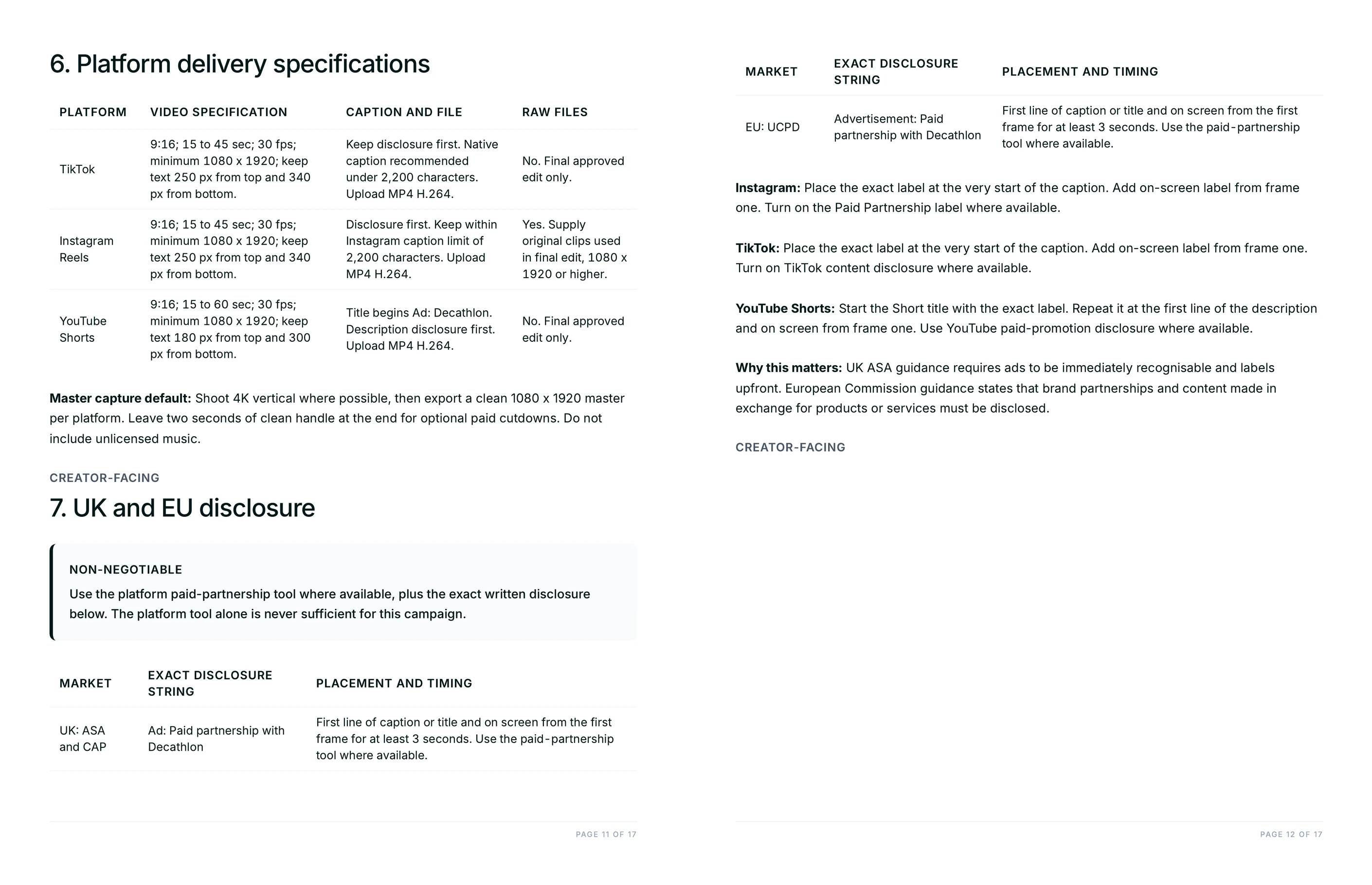
Which disclosure lines do creators need in each market?

A gifted product is a material connection, and so is an affiliate link, event access, or the promise of future work. What changes by market is the wording, the placement, and whether the disclosure has to be spoken as well as shown. This step builds the disclosure block per market and per platform: the exact string the creator uses, where it sits in the caption or on screen, how long it stays visible in a story frame, and the in-video timing. It also names what does not count on its own, from "#gifted" to a tag hidden behind "more", and states plainly that a platform's paid-partnership toggle is never sufficient by itself.

Prompt
Copy

Build the disclosure block per market and per platform. For US, UK and EU creators on Instagram, TikTok and YouTube, give the exact disclosure string, where it goes, how long it stays visible, and the in-video timing. List what does not count as a disclosure on its own, and cite the regulator guidance for each market.

Try This Flow
4

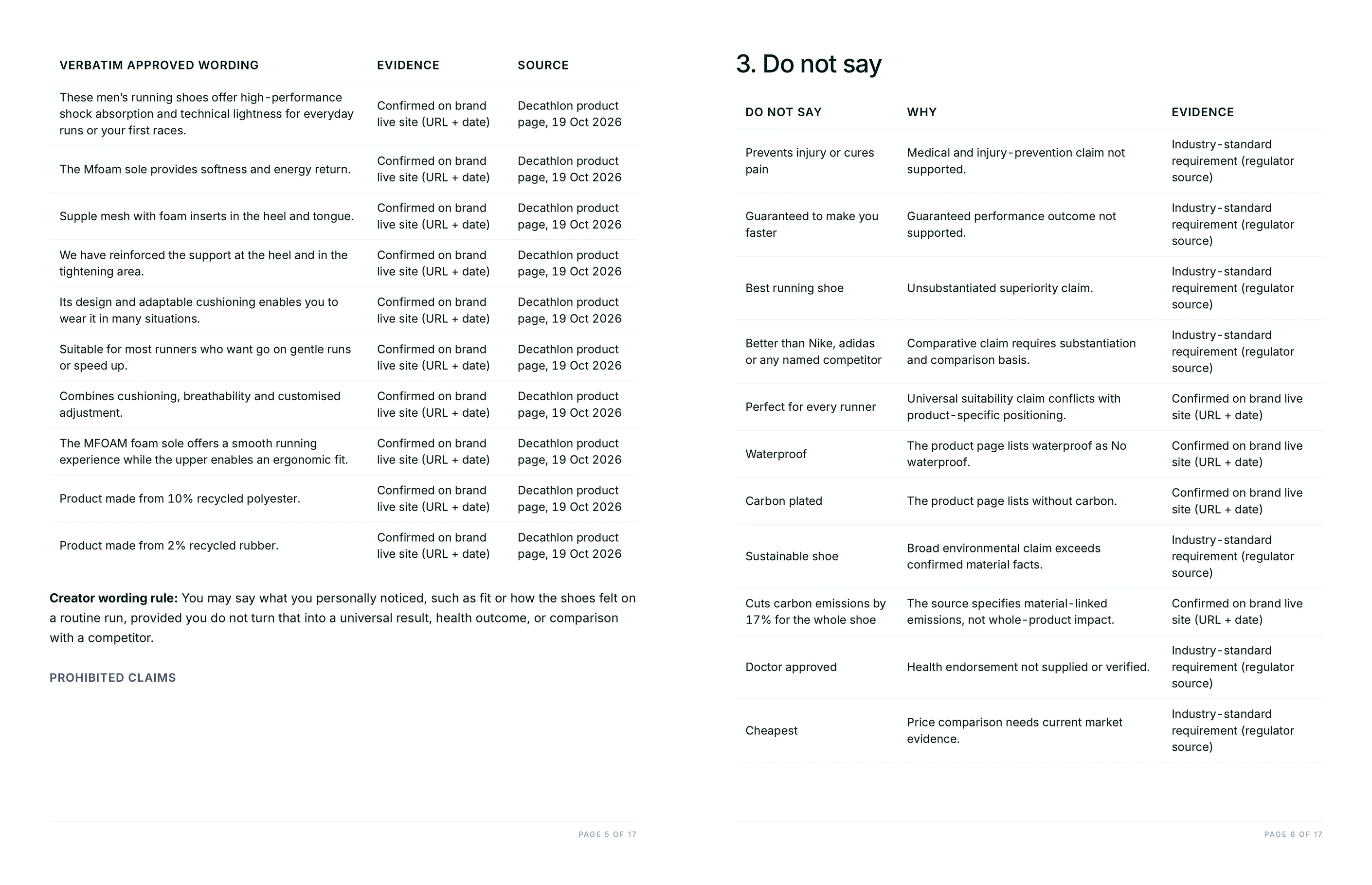
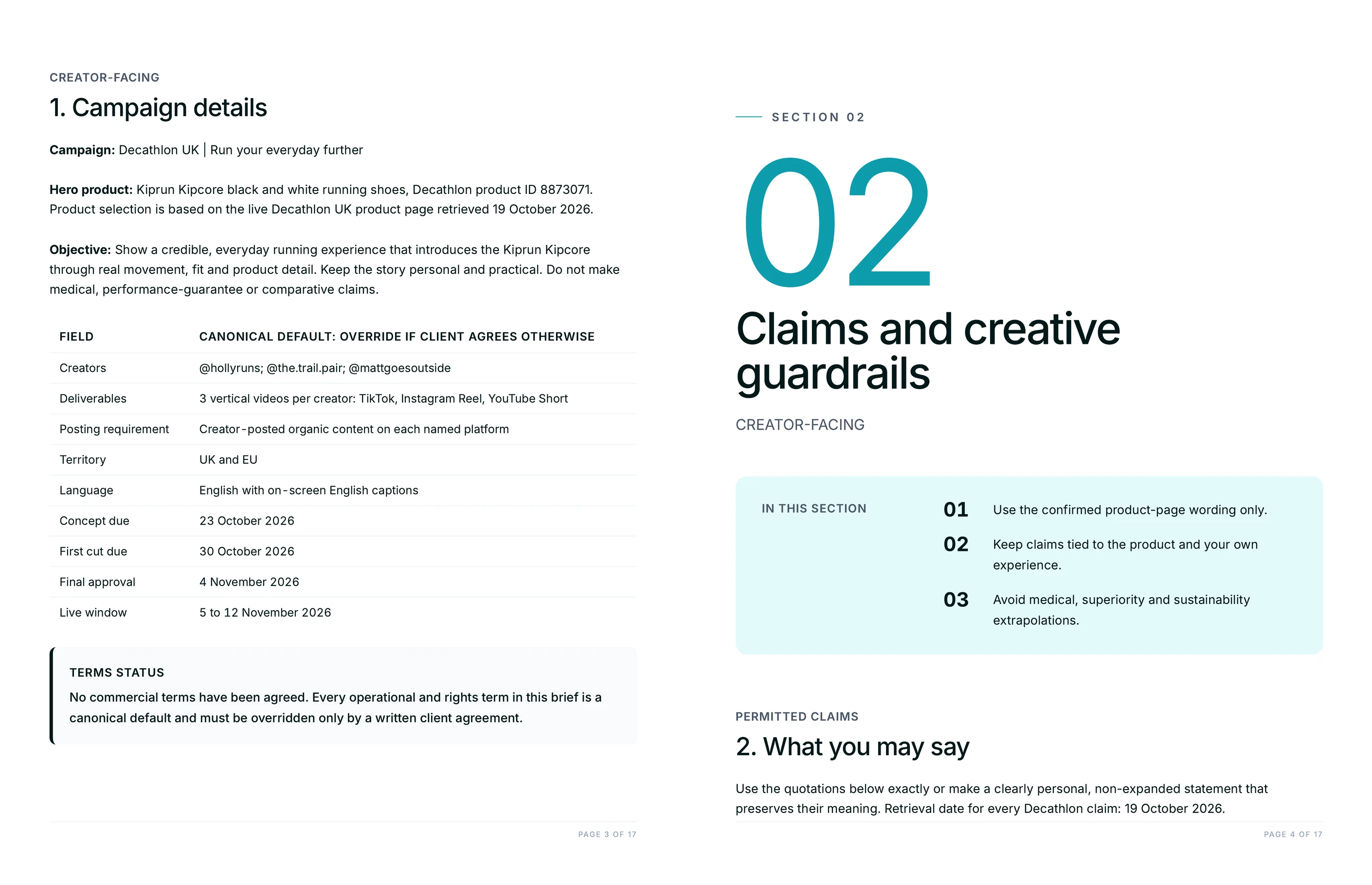
How do you stop creators making claims the brand cannot support?

Most briefs hand this problem back to the client as a line that reads "the brand will supply an approved claims list". That list is the hard part, and it is the one thing standing between a creator video and a regulator complaint. This step builds it instead of deferring it: a "what you may say" list drawn from the brand's own published copy, each line quoted with the page it came from, alongside a "do not say" list covering medical and therapeutic language, quantified performance claims, safety and sensitivity claims, before-and-after implications, and competitor comparisons. Every line carries an evidence label, so the team can see what is sourced from the brand, what is a regulatory requirement, and what the Flow assumed.

Prompt
Copy

Build the claim limits from the brand's own published copy. Give me 8 to 12 claims the creator may make, each quoted with the source URL it came from, then a do-not-say list of at least 12 prohibited claims. Label every line as confirmed on the brand's site, a regulatory requirement, or your own assumption.

Try This Flow
5

How do you brief the shots so the footage is usable on the first take?

Unusable footage is rarely a creator problem. It is a brief that asked for "authentic product content" and never said the label has to be readable, the texture has to be visible before application, or the after shot has to match the before on framing and light. This step turns the brief into a shot list: every required clip, what has to be on screen, how long it runs, and the two seconds of stillness at each end that make it editable. Each video deliverable gets three genuinely different hook options with the spoken line, the framing, and what is visible, all of them sayable within the claim limits. A per-platform spec table closes it out, covering aspect ratio, duration, frame rate, resolution floor, safe-zone margins, caption limits, and file format.

Prompt
Copy

Turn the brief into a shot list. For each required clip give what must be on screen, the framing and the run time. Then give three distinct hook options per video deliverable, each with the spoken opening line, the camera framing and what is visible. Finish with a per-platform spec table: aspect ratio, duration, frame rate, resolution floor, safe zones, caption limit and file format.

Try This Flow
6

Which creators should receive this brief?

A brief is only as good as the roster it goes to. Before the brief ships, it is worth checking that each creator's audience actually overlaps the client's buyer, that engagement holds up under inspection, and that nothing in their recent feed conflicts with the brand or the category exclusivity the brief is about to ask for. This step hands off to the creator vetting job: audience-fit audits, engagement breakdowns, and a scorecard per creator. Run it first and the brief goes to a shortlist the team can defend, with the exclusivity window set against competitors the creators have actually worked with.

Prompt
Copy

Before we send this brief, vet the creator shortlist. For each creator give an audience-fit read against the client's buyer, an engagement breakdown, any brand or category conflicts in their recent posts, and a scorecard. Then tell me which ones to brief and which exclusivity window each one needs.

Try This Flow

Set up your client project: approved claims, rights terms, and past briefs

A Juma Project is a shared space where the team keeps everything Juma needs to know about a client. Create one project per client, add context as the relationship grows, and every flow the team runs draws on what is relevant. For creator work the payoff is direct: the claims the client's legal team already vetted, the rights terms they already agreed, and the briefs that got pushed back on last time.

What to add

Approved claims and substantiation sheet

The claims the client's legal team has already cleared, with any required qualifier. This is the file that changes output quality the most. With it, the brief uses vetted wording verbatim instead of building the list from published copy, and it flags any creator-proposed line that falls outside what is cleared.

Creator agreement and standard rights terms

The master agreement, release forms, and the rights terms the client normally signs: paid media window, territory, exclusivity stance, whitelisting policy. The rights matrix then defaults to what this client actually agrees to rather than a generic market standard.

Brand and visual guidelines

Tone, the words the brand does and does not use, logo and colour rules, and any creator-content guidance. The brief picks up the client's voice, and the PDF comes back in their visual identity instead of a default layout.

Past creator briefs and what got rejected

Previous briefs plus a note on which footage came back unusable and why. Those rejections are the sharpest input available: they turn the shot list from a generic checklist into the specific coverage this client has learned to insist on.

Guide Juma with project info

Add a short description to each knowledge item in the project's info field so Juma knows what the file holds and when to reach for it. For example:

  • Approved claims sheet: "Legal-cleared claims by product, current as of this quarter. Use verbatim. Nothing outside this list goes to a creator."
  • Creator agreement: "Standard influencer terms. Reference for the rights matrix defaults, including the 12 month paid window."
  • Brand guidelines: "Voice, restricted words and visual identity. Apply to the creator-facing brief."
  • Past briefs: "Last three campaigns plus rejected-footage notes. Use to set the required coverage."
Juma Logo
Write a creator brief your client's legal team will sign

Frequently Asked Questions

What does a complete UGC creator brief include?

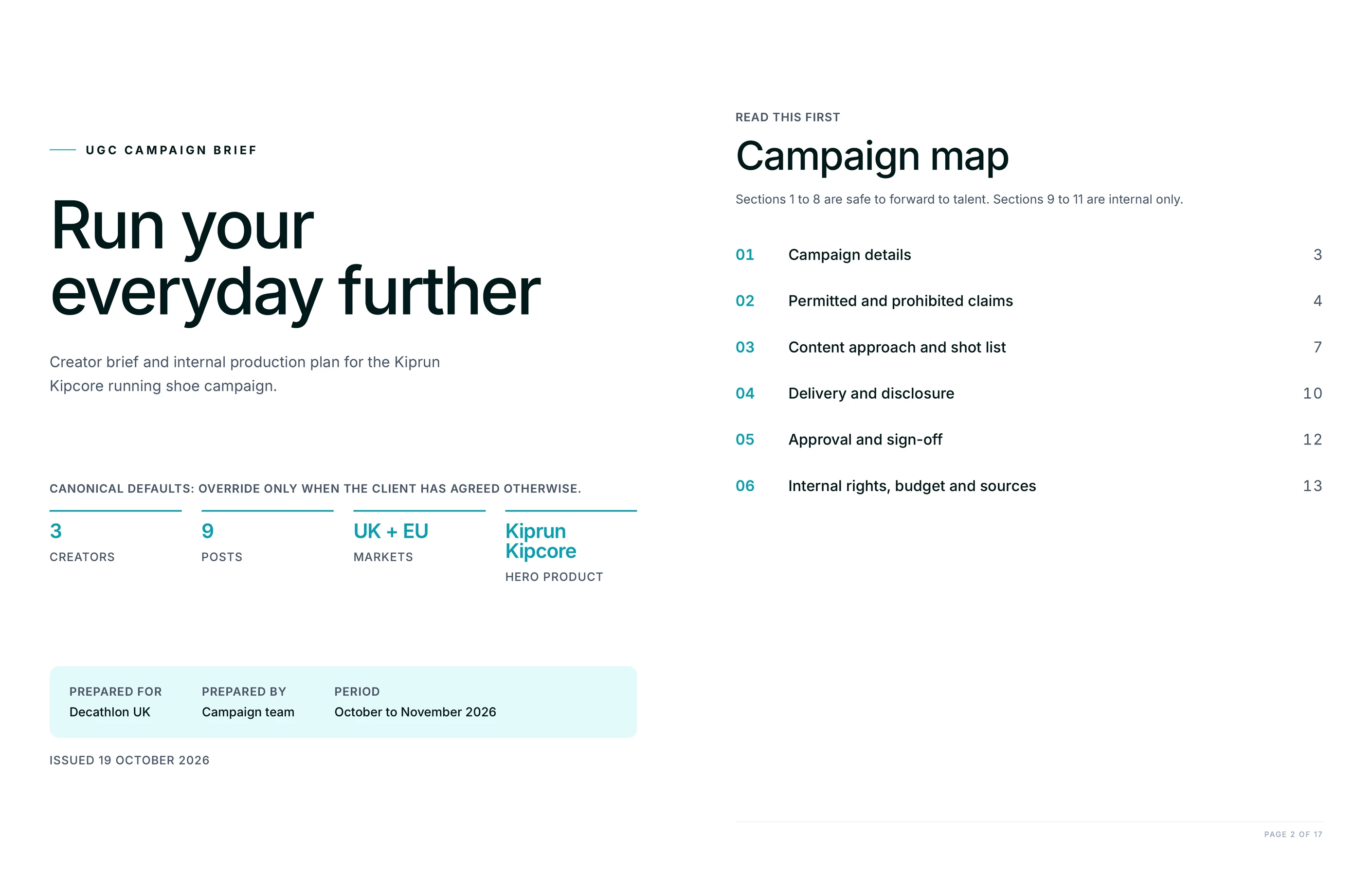
A complete creator brief covers eight parts: campaign and deliverable detail, the claim limits with their sources, the disclosure requirement per market and platform, a filled usage-rights matrix, a shot list with three hook options per video, a per-platform delivery spec, the approval and sign-off stages, and a source register. The brief arrives as a PDF for the creator plus a CSV for the contract and the tracker.

The split matters as much as the contents. The creator-facing sections can be forwarded to talent as they are, while the internal sections carry the negotiation stances, approval owners, and tracking that should never leave the team. Most briefs blur the two, which is how a creator ends up reading the client's fallback position on exclusivity.

Does the brief cover disclosure rules outside the US?

Yes. Name the markets the creators post from and the brief carries a disclosure block for each one: FTC guidance for the US, the ASA and the CAP Code for the UK, and the applicable EU requirements. Each block gives the exact string, its placement, and the in-video timing, with the regulator guidance cited.

This is the gap that catches most teams. A brief written once for a US programme gets reused for a UK creator, the wording no longer matches what the ASA expects, and the post is non-compliant through nobody's deliberate choice. Setting the markets at the start costs one clause in the prompt and removes the problem.

Disclosure rules change. Treat the cited guidance as the starting point and have the client's legal team confirm the current position before anything is signed.

Can the brief be sent to creators as-is?

The creator-facing sections are written to be forwarded without rewriting, and the rights terms arrive filled with canonical defaults rather than blanks. What it is not is a substitute for the client's creator agreement, release forms, or product-specific substantiation pack. It is the campaign operating document that sits alongside those.

In practice the team reads it, overrides the defaults the client has actually negotiated, and sends it. The brief marks every default as a default, so it is obvious which lines were chosen by the Flow and need a decision rather than quietly inherited.

How is this different from a creative brief for ads?

A creative brief for ads directs an internal or agency production team on paid placements: territories, concepts, and per-placement specs. A creator brief is an external document going to someone outside the company, so it carries the things an independent creator needs and the things the brand needs protected: usage rights, exclusivity, disclosure, claim limits, and approval stages.

The two sit next to each other in a campaign. Teams running both usually build the creative brief for the paid concepts and the creator brief for the talent, then keep the claim limits consistent across the pair.

Who reviews the brief before it goes to a creator?

The client's legal or brand-compliance owner reviews the claim limits and the rights terms, and the account or creator-programme lead reviews the deliverables, the shot list, and the budget. The brief names those stages, who signs each, and the turnaround, so the review is a step in the process rather than an afterthought.

Juma augments the team here, it does not replace it. The Flow does the research, assembles the claim list with sources, and fills the rights matrix with defaults. Strategy, taste, and judgment stay human, and human review happens on every output before anything reaches a creator.
Don't take our word for it

Ask AI about us

400+ marketing teams trust Juma. ChatGPT, Claude, and Perplexity know why. Ask them.

Ready when you are

What's on your plate today?

Start typing a task and Juma will figure out the rest.

Thank you! Your submission has been received!
Oops! Something went wrong while submitting the form.