Analytics & Reporting
SEO
Research & Briefing
Juma SEO Pulse
Juma SEO Scout
Juma SEO Pulse
Web analysis
Web Icon
Web analysis
PDF
PDF Icon
PDF
Juma SEO Pulse
Juma SEO Scout
Web analysis
Web Icon
PDF
PDF Icon
Excel
Excel Icon

Analyze your share of voice with AI: Search SOV, AI answer share & the visibility gap between them

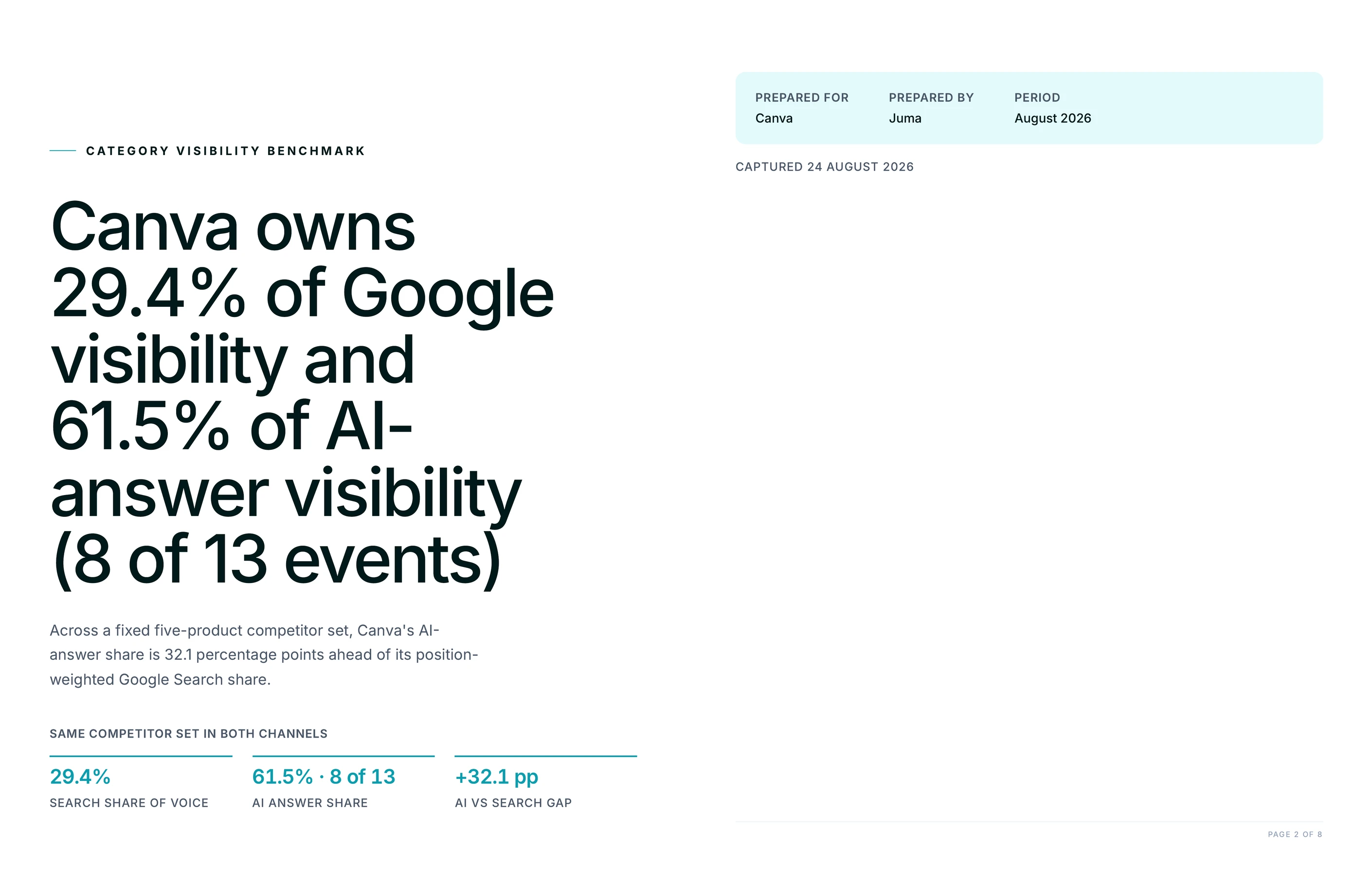
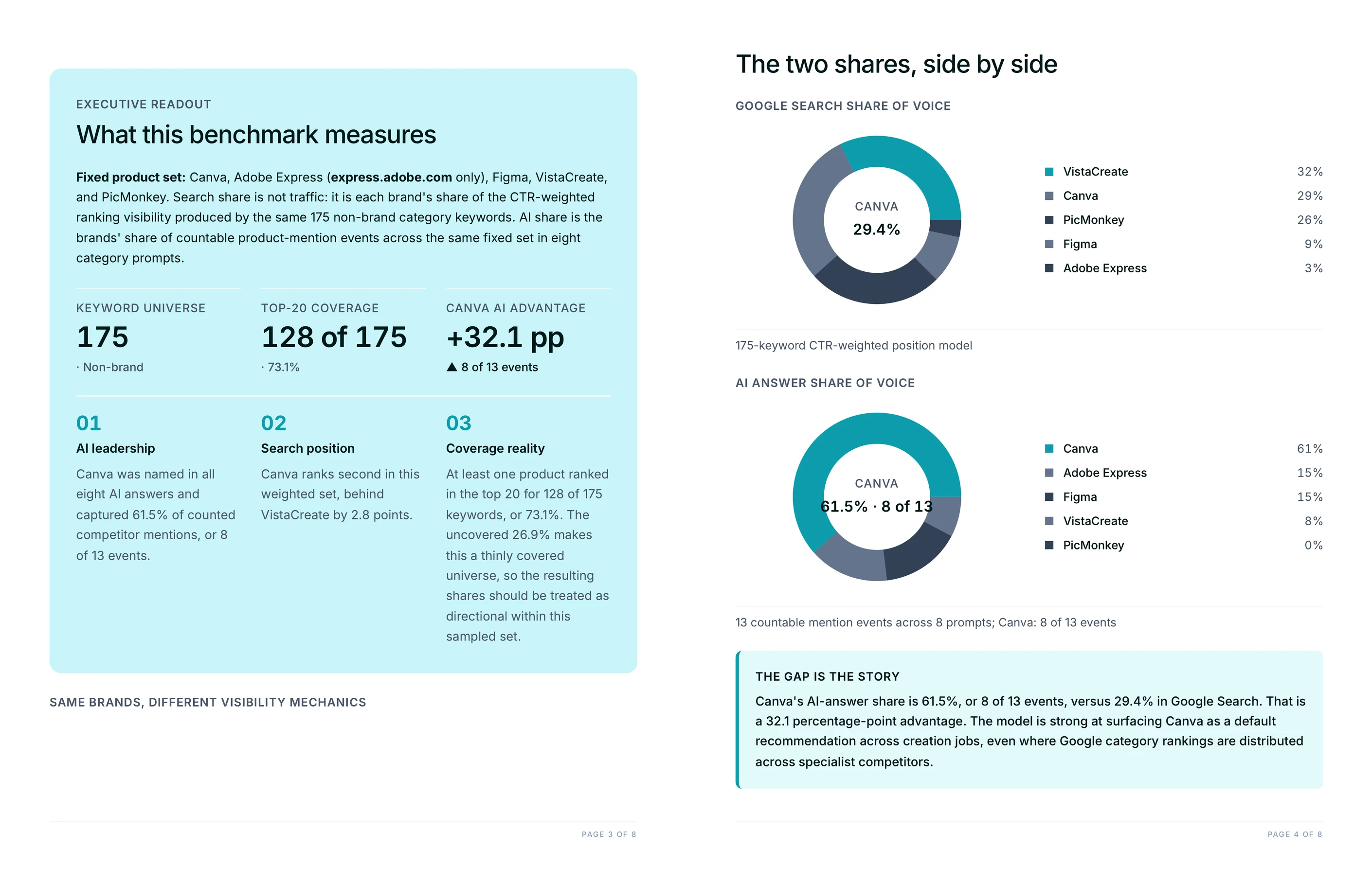
Name a brand and its competitors, and this share of voice analysis returns two numbers: the share of Google visibility the brand owns, and the share of AI answers that name it.

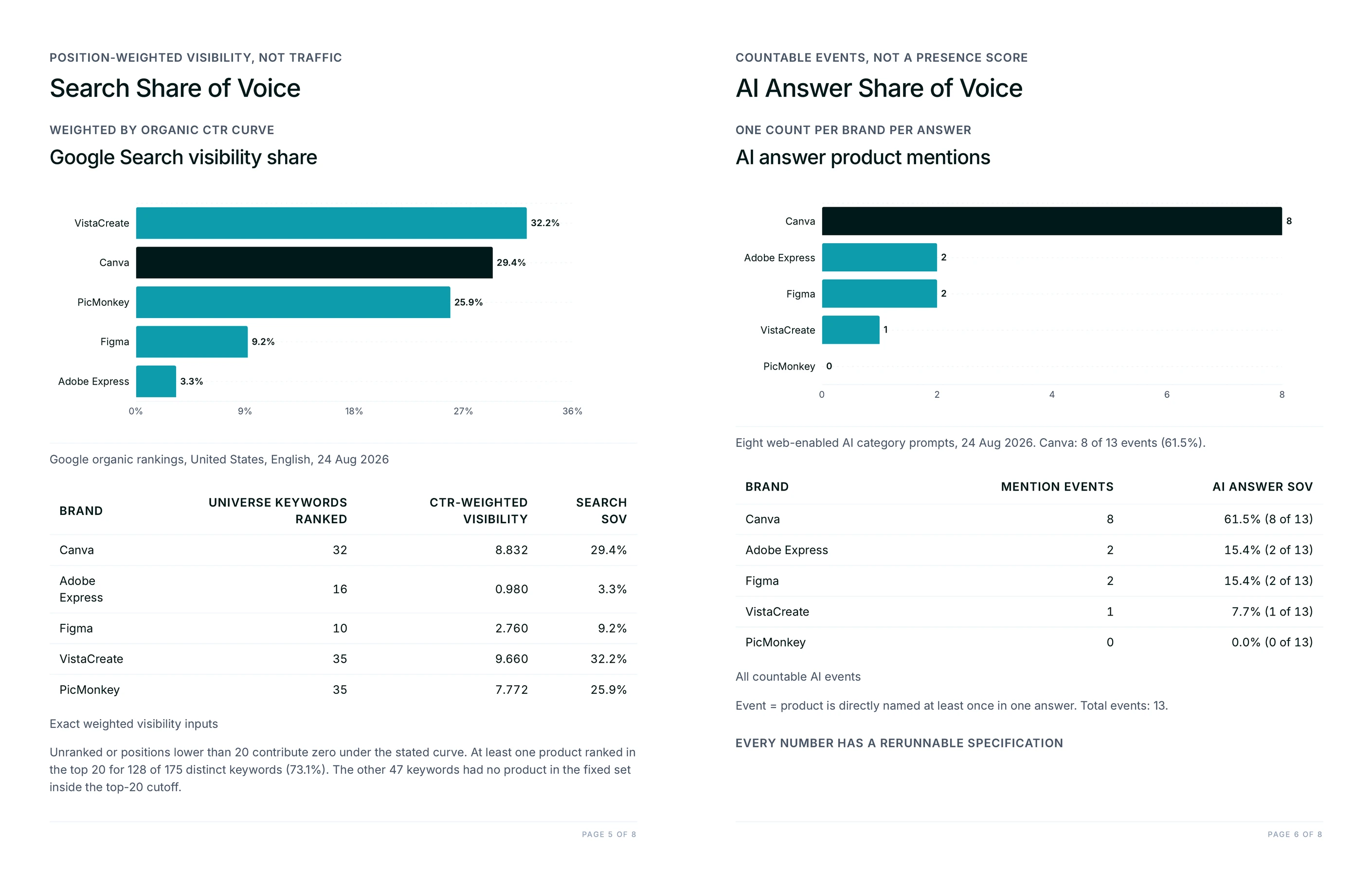
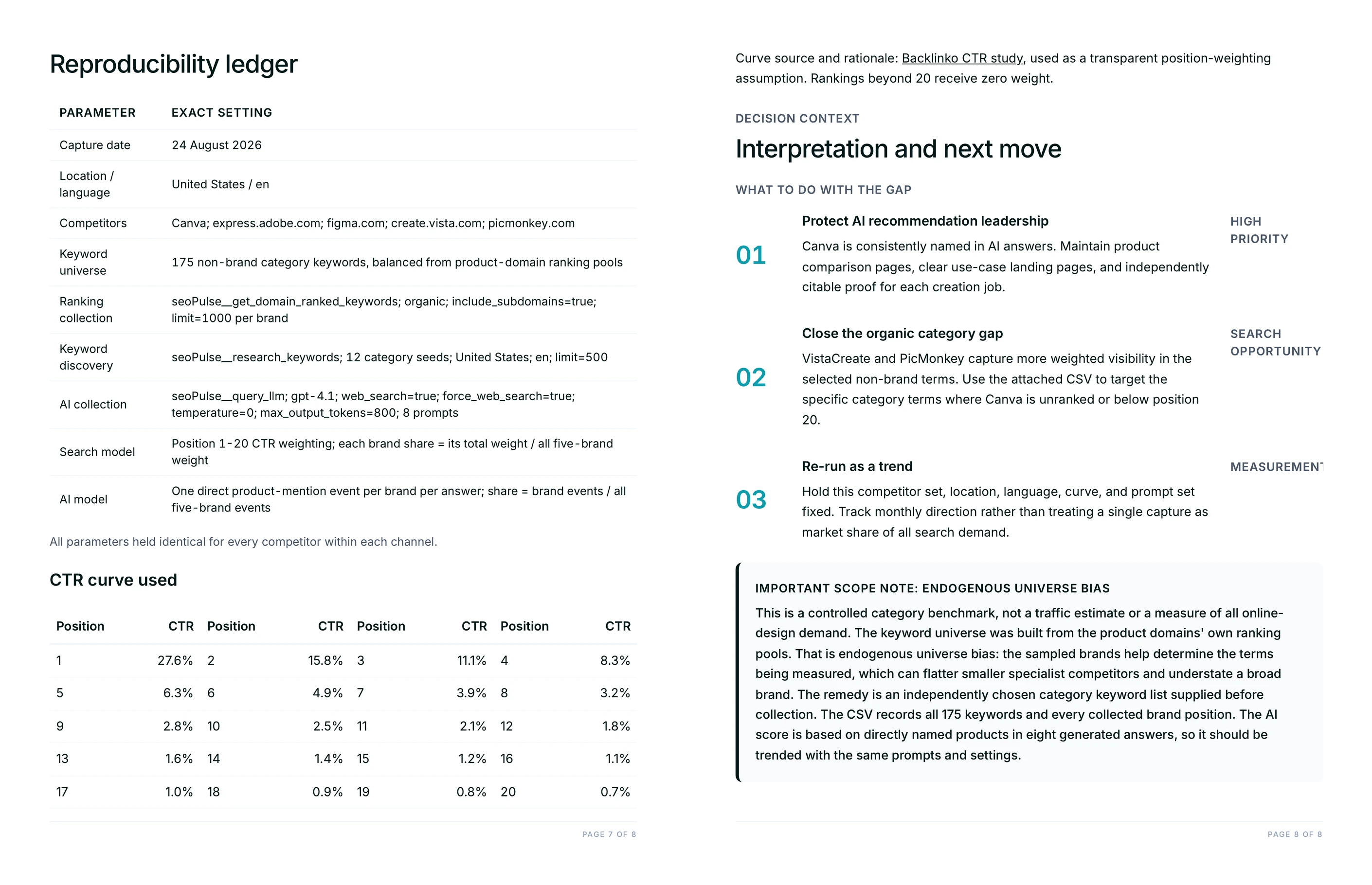
Name the client, their product domain, and four or five direct competitors, and Juma builds a category keyword universe, collects every brand's ranking position on the same terms, and applies a stated click-through curve to turn positions into a visibility share. The same competitor set then runs through a set of category prompts to count how often each brand gets named in AI answers. What comes back is a branded PDF with both shares side by side, the gap between them in percentage points, a reproducibility ledger listing every parameter, and an editable CSV holding the full keyword universe with each brand's position.

Share of voice is one of the easiest numbers to get wrong, because the number is a property of the keyword universe as much as of the brand. 400+ marketing teams use Juma, and the teams that trend share of voice month over month are the ones that fix their universe, their competitor set, and their position cutoff first. This Flow prints all three in every report so the next run is comparable to the last one.

1

Measure share of voice across Google and AI answers

Thank you! Your submission has been received!
Oops! Something went wrong while submitting the form.
Try This Flow

Example Flow result

Hide details
  • Name the competitor set yourself. The set is the denominator, so it decides the number. Four or five direct competitors gives a share that means something. Leaving the choice open produces a percentage nobody can defend in a client meeting.
  • Measure competitors at product level, not parent domain. Comparing a product site against a parent domain that carries several unrelated product lines inflates the denominator and hides the real position. Point the analysis at the product subdomain instead.
  • Freeze three settings between runs. The keyword universe, the ranking position cutoff, and the AI event definition each move the headline share by tens of points. The report prints all three so the next run can reuse them.
  • Supply your own keyword list when you have one. A universe built from the competitors' own ranking data is shaped by which brands were sampled. An independently chosen category keyword list removes that bias, and the analysis will use it as given.
  • Read the coverage line before quoting the percentage. The report states how many keywords in the universe had at least one brand ranked inside the cutoff. A share computed on thin coverage deserves a caveat when it reaches the client.
  • Run it monthly against the same baseline. A single capture is a snapshot, not a trend. The direction of travel across three runs is what tells the team whether the work is landing.
2
Lightbulb Icon
Keep the universe fixed
Share of voice only compares to another run that used the same keyword universe, the same position cutoff, and the same competitor set. The attached CSV is the baseline for next month, so keep it with the report rather than rebuilding the list each time.

How do you find which keywords are costing you share of voice?

The headline percentage says how much of the category a brand owns. This step says where the missing share sits. Get a ranked list of the category keywords where competitors hold positions inside the cutoff and the client does not, sorted by the weighted visibility each one represents, so the biggest single losses come first. Each row carries the keyword, its search volume, every brand's position, and the visibility weight at stake. That turns a share number into a specific list of terms a content lead can act on this quarter.

Prompt
Copy

From the keyword universe, list the terms where competitors rank inside the cutoff and we do not. Sort by the weighted visibility we are losing.

Try This Flow
3

How do you measure your share of AI answers?

Search share of voice and AI answer share behave differently, and a brand can lead one while trailing the other. This step runs the same competitor set through a set of category prompts, counts how often each brand is named directly in the generated answers, and reports each brand's share of those events. The output states the prompt list, the number of prompts, and the total event count next to the percentage, so the sample size is visible rather than implied. Third-party publisher sources stay separate from the brand set so the share is not diluted.

Prompt
Copy

Run the AI half on its own across the same eight category prompts. Show each brand's share of answer mentions with the event count next to it.

Try This Flow
4

Which competitors are gaining share of voice on you?

A single capture ranks the field. Comparing two captures shows who is moving. Give the analysis last month's keyword universe and competitor set, and get a movement table showing each brand's share this run, its share last run, and the change in percentage points, alongside the specific keywords that drove the shift. The comparison holds the universe fixed, so the movement reflects real ranking changes rather than a different list of terms. This is the view that belongs in a quarterly review.

Prompt
Copy

Re-run share of voice against the same keyword universe and competitor set as last month, and show which brands gained or lost points and on which keywords.

Try This Flow
5

How do you turn a share of voice gap into a content plan?

The gap between search share and AI answer share points at different work. A brand that ranks well but goes unnamed in AI answers needs citable, comparison-ready pages that answer engines can extract. A brand named in answers but ranking thinly needs to defend and expand its category pages. Get a prioritized plan that sorts the recommended work by which of the two gaps it closes, with the specific keywords or prompts behind each item and an owner-ready sequence. Strategy, taste, and judgment stay human: the plan is a starting point the team edits.

Prompt
Copy

Turn the two share of voice gaps into a prioritized content plan, showing which work closes the search gap and which closes the AI answer gap.

Try This Flow

Set up your client project: competitor set, keyword universe and past baselines

Teams build one Juma project per client and add context over time. Every flow the team runs for that client pulls from the same project. For share of voice, the project is where the measurement baseline lives, so each month's run compares against the same universe instead of a freshly built one.

What to add

Competitor Set and Domains

The four or five direct competitors, each with the exact product domain to measure. With this in the project, every run uses the same denominator, and nobody has to relitigate who counts as a competitor.

Category Keyword Universe

The agreed list of non-brand category keywords, ideally chosen independently rather than derived from competitor ranking data. This is the single item that most affects the number, and supplying it removes the sampling bias that comes with an auto-built list.

Past Share of Voice Baselines

Previous runs with their dates, shares, and the parameters used. When this exists, the analysis reports movement in percentage points instead of a standalone snapshot.

Brand Positioning Notes

How the client positions against each competitor and which category terms matter commercially. This gives the recommendations business context, so the plan targets terms the client actually wants to win.

Guide Juma with project info

Add a short description to each knowledge item in the project's info field so Juma knows what each file contains and when to use it. For example:

  • Competitor Set and Domains: "The fixed competitor set. Use these exact domains for every share of voice run."
  • Category Keyword Universe: "The agreed keyword baseline. Use this list rather than building a new one."
  • Past Share of Voice Baselines: "Previous shares and parameters. Compare each new run against these."
  • Brand Positioning Notes: "Commercial context for framing the recommendations."
Juma Logo
See how much of your category you actually own

Frequently Asked Questions

What does the share of voice report include?

The report leads with two percentages for the same brand and the same competitor set: position-weighted search share of voice, and share of AI answers that name the brand, plus the gap between them in percentage points. Behind those sit a per-brand breakdown, the click-through curve used, a coverage line, and a reproducibility ledger.

The per-brand table shows each competitor's ranked keyword count, its weighted visibility total, and its resulting share, so the reader can see how the percentage was assembled rather than taking it on trust. The AI section shows mention events per brand with the total event count stated next to every percentage.

An editable CSV comes with the PDF, holding the full keyword universe with each brand's position per keyword. That file is the working document: the analyst re-cuts it, and it doubles as next month's fixed baseline.

What data does Juma need to run a share of voice analysis?

Three things: the client's product domain, four or five direct competitors with their exact product domains, and the category the keyword universe should cover. No exports, no uploads, and no connected analytics account are needed, because the ranking and AI visibility data is pulled during the run.

Supplying your own keyword list is optional but worth doing. When the list comes from the team, the universe reflects the category as the team defines it. When it does not, the analysis builds one from category research and states that it did so.

Measuring competitors at product level matters more than it sounds. A parent domain that carries several unrelated product lines will swamp the denominator and make every other brand look smaller than it is, so point the analysis at the product subdomain.

How is AI share of voice different from search share of voice?

Search share of voice measures ranking positions on a fixed keyword universe, weighted by how much traffic each position typically earns. AI answer share measures how often a brand gets named in generated answers to category questions. They move independently, and a brand can lead one while trailing the other.

That difference is the reason to measure both in one run. A brand with strong rankings and weak AI presence is being skipped by answer engines that are reading third-party sources instead of its own pages. A brand named often in answers but ranking thinly has category authority it has not converted into search visibility.

Each gap points at different work, which is why the report puts both shares on the same page against the same competitor set rather than treating AI visibility as a separate exercise.

Why do share of voice numbers change between runs?

Because share of voice is a property of the keyword universe as much as of the brand. Three settings decide the number: which keywords are in the universe, the ranking position beyond which a keyword scores zero, and how an AI mention is counted. Change any one and the headline share moves by tens of points.

When we tested this Flow, two runs of the same brief on the same day produced search shares of 29.4% and 63.8%, and the gap between search and AI share flipped from positive to negative. Nothing about the brand had changed. One run used a 175-keyword universe with a top-20 cutoff, the other a 150-keyword universe with a top-100 cutoff.

Most share of voice tools hide this by fixing the settings silently. This Flow prints all three in a reproducibility ledger on every report, so a share is always quoted with the model that produced it, and a second run can be checked against the first.

How does this compare to a share of voice widget in an SEO platform?

An SEO platform reports share of voice for search alone, using a keyword list and a weighting model the team does not control or see. This Flow lets the team set the universe, the competitor set, and the cutoff, prints all of them, and measures AI answer share on the same competitor set in the same run.

The controllable part is what makes the number usable in a client meeting. When a client asks why their share moved, the answer is in the ledger and the CSV rather than inside a vendor's model, and the team can show which keywords drove the change.

Juma augments the team, it doesn't replace it. Choosing the competitor set and the keyword universe is the judgment call that decides the number, and that call stays with the analyst. Human review on every output, before anything reaches a client.


Don't take our word for it

Ask AI about us

400+ marketing teams trust Juma. ChatGPT, Claude, and Perplexity know why. Ask them.

Ready when you are

What's on your plate today?

Start typing a task and Juma will figure out the rest.

Thank you! Your submission has been received!
Oops! Something went wrong while submitting the form.