Set up your client project: target URL list, competitor brands, category queries, and brand voice
A Juma Project is a shared space where the team stores everything Juma needs to know about a client's GEO program. Create one project per client, add context as the program develops, and Juma uses what's relevant every time the team runs a flow. The more the team adds, the sharper every audit, comparison, and rewrite gets.
What to add
Target URL List
The 10 to 20 pages the team most wants to win AI citations on, usually the category landing pages, comparison pages, and feature pages, not the homepage. With this in the project, Juma runs the same audit set every month so the team can track score movement page by page over time.
Competitor Brand List
The two or three brands the team most wants to displace in AI citations, with each brand's main category page URL. Juma uses this list to run side-by-side audits and to scope the competitive citation map so the gap analysis is always against the brands that actually matter.
Category Query List
The 15 to 20 long-tail queries the audience asks ChatGPT, Perplexity, or Claude in the brand's category. These shape the citation mapping flow and the earned-media investment list. Add as the team learns from sales calls, support tickets, and search data.
Brand Voice Guide
How the brand sounds across channels: tone, vocabulary, banned words, and approved phrasings. Juma applies the voice to every rewritten page so the content stays on-brand while the structure changes for AI citability.
Guide Juma with project info
Add a short description to each knowledge item in the project's info field so Juma knows what each file contains and when to use it. For example:
- Target URL List: "10-20 pages we want to win AI citations on. Use as the monthly audit set."
- Competitor Brand List: "Top 2-3 competitors with category page URLs. Use for side-by-side audits and gap analysis."
- Category Query List: "15-20 long-tail buyer queries in our category. Use to scope citation mapping and earned-media prioritization."
- Brand Voice Guide: "Tone and vocabulary rules. Apply to every rewrite so the page stays on-brand."
Score your page against the patterns AI engines cite
Frequently Asked Questions
How does generative engine optimization differ from traditional SEO?
Generative engine optimization focuses on getting a brand cited inside AI-generated answers, while traditional SEO focuses on ranking pages in Google's blue links. SEO helps people find a page; GEO helps AI engines choose that page as part of an answer. Both depend on crawlable content and authoritative signals.
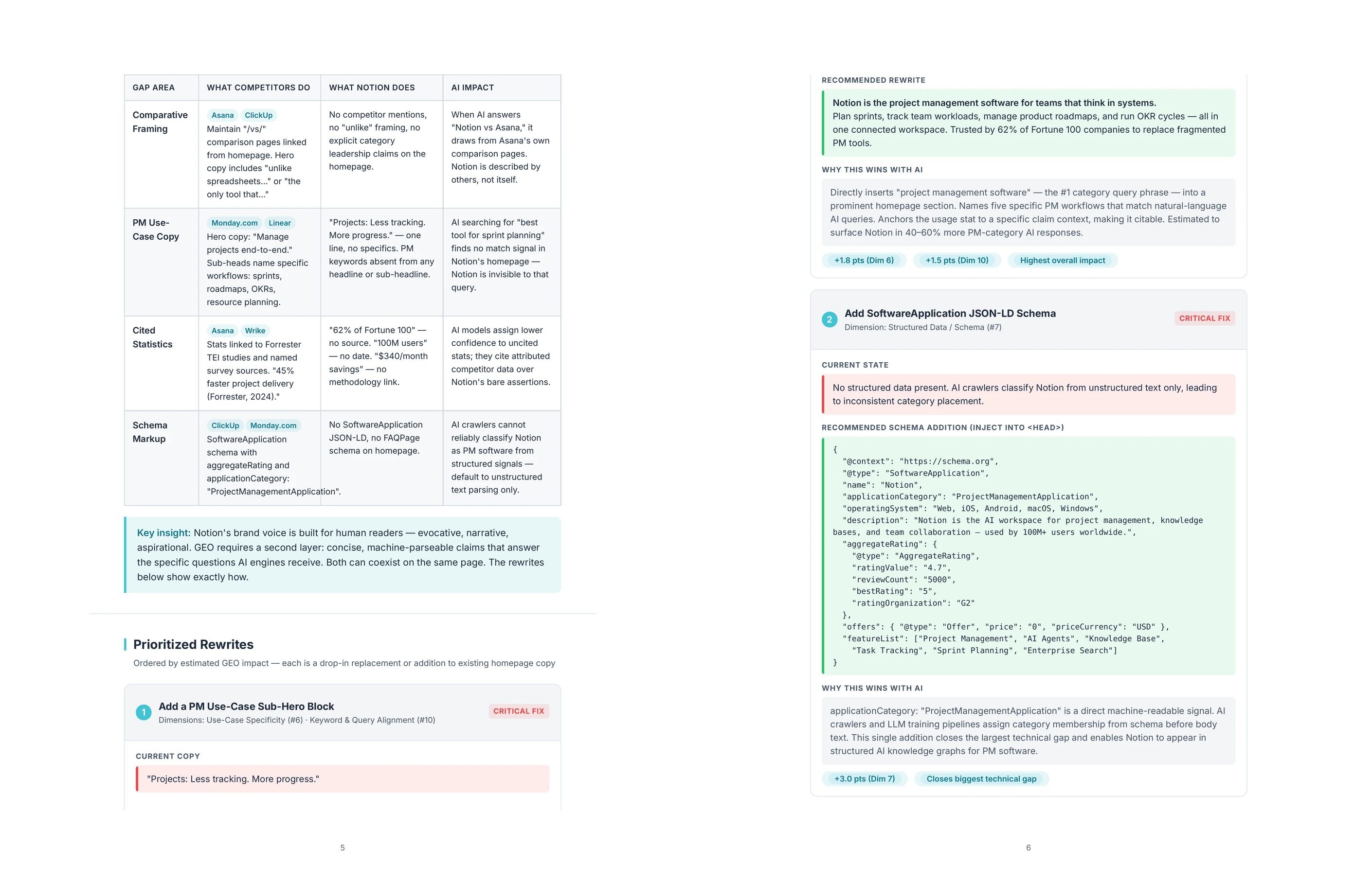
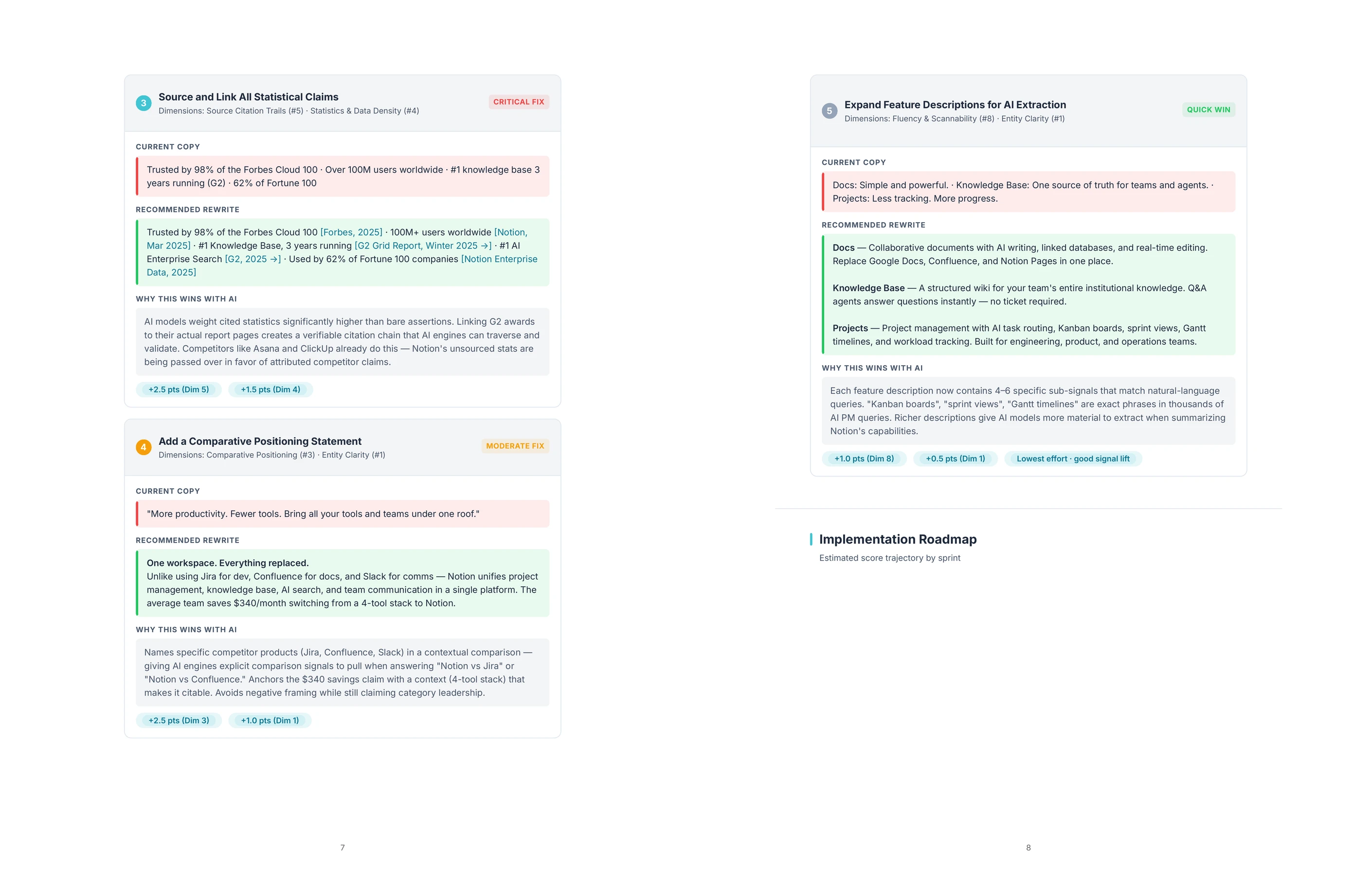
GEO adds structural requirements SEO does not weigh: TL;DR blocks and direct-answer openings in the first 40 to 60 words, citation-worthy stats every 150 to 200 words, FAQ blocks with question-based headings, comparison tables, full JSON-LD schema markup, and entity consistency across schema, social profiles, and Wikipedia. A page can rank in the top three Google results and still never appear in an AI answer if it does not follow these patterns.
What does the 10-dimension GEO score actually measure?
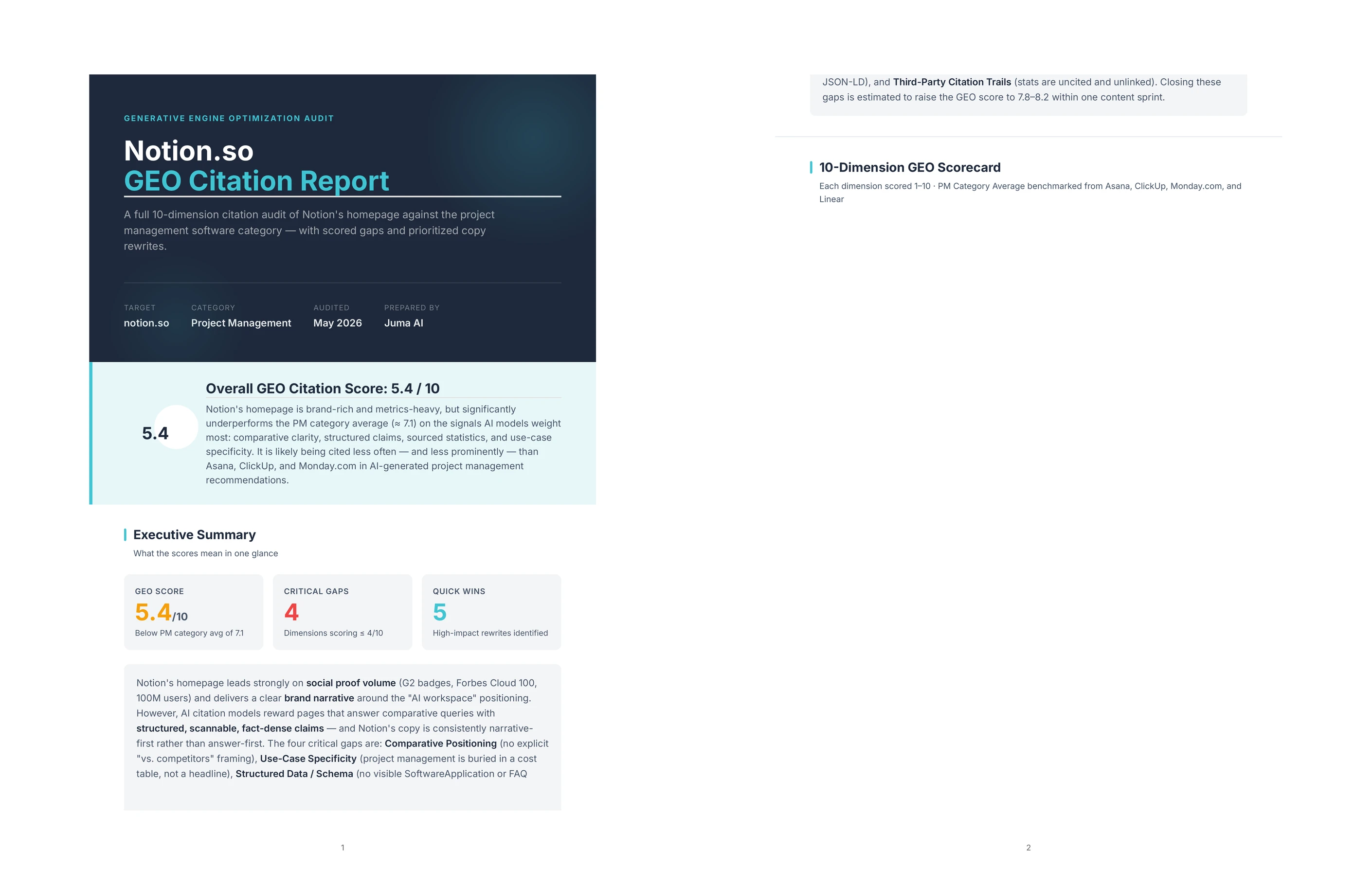
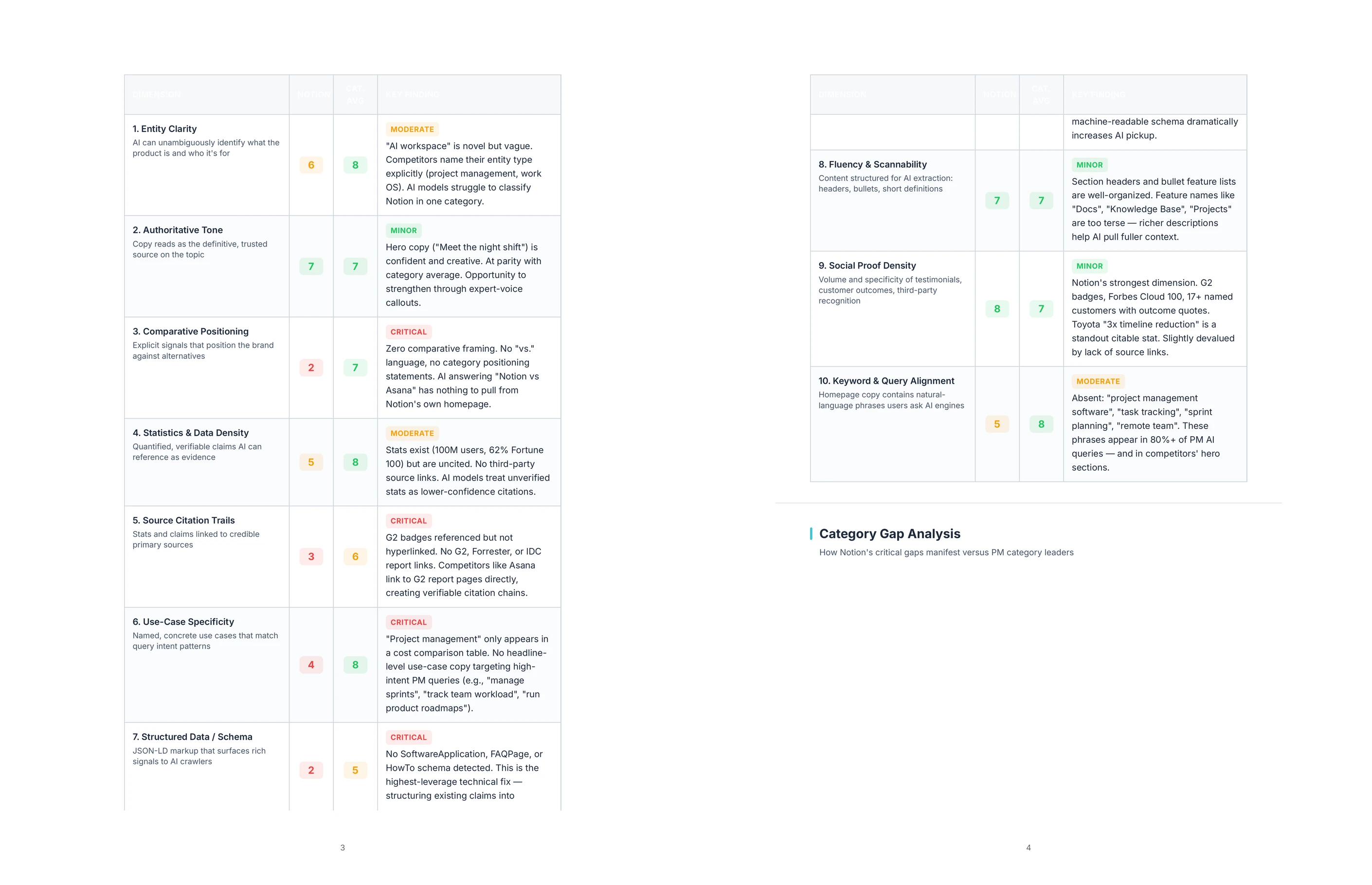
The score is weighted by how strongly each dimension predicts an LLM citation in current research. The four heaviest dimensions are Extractability at 18% (TL;DR blocks, top-third positioning, direct-answer H2 openings), Content Authority at 14% (bylines, original data, hyperlinked citations to authority domains), On-Page Trust at 13% (named customers, G2 ratings, case study metrics, compliance certs), and Schema Markup at 13% (JSON-LD validation for Organization, Article, FAQ, HowTo, Product, and BreadcrumbList).
The remaining six dimensions cover Entity Consistency, Citability, Crawler Access (whether robots.txt allows GPTBot, PerplexityBot, ClaudeBot, and ChatGPT-User), Technical SEO, Freshness, and Brand Presence. Each dimension produces its own sub-score with specific findings, so the report shows not only the overall band but exactly which structural gap is costing the page citations.
How long does it take for rewrites to start earning AI citations?
Most rewrites start showing up in AI answers within four to eight weeks of being published. Perplexity tends to surface new pages fastest because it weighs recency heavily. ChatGPT and Gemini move slower because they re-index web content less frequently than they retrieve from training data.
The timeline depends on the engine, the strength of the rewrite, and how well the page is referenced by third-party sources. Rewrites that fix the heaviest dimensions first, extractability and content authority, outperform rewrites that update copy without changing structure. Pages already mentioned in Reddit threads, G2 reviews, or industry publications surface in AI answers faster because the engines find the consensus signal sooner. Run the audit monthly to track when each rewrite lands and to spot when a competitor pushes the brand back out.
Can the team monitor AI citation share of voice over time?
Yes. Save the target URL list and the category query list to the project, and Juma reruns the audit set every month, producing a comparable scorecard for every page each time. The audit report includes a band ("Excellent / Good / Needs Work / Critical") and the per-dimension scores, so trend tracking is page-level and dimension-level rather than a single rolled-up number.
Monthly audits matter more than single-point-in-time audits because AI engines refresh their content on different cycles, competitors run their own GEO programs in parallel, and earned-media coverage shifts the underlying citation graph. The trend view shows whether the rewrites are landing, whether new third-party sources are feeding the engines, and whether a competitor's recent product launch or press cycle has pushed the brand out of an answer.
Does this Flow work for B2B SaaS, ecommerce, and agency brands?
Yes. The 10 dimensions are universal because AI engines reward the same structural patterns across categories: direct answers, citation-worthy stats, entity consistency, schema markup. What changes by category is the citation map. A B2B SaaS audit weighs G2 and Reddit. An ecommerce audit weighs Amazon, Wirecutter, and TikTok mentions. An agency audit weighs G2, Clutch, and trade publications.
The Flow asks for the category early in the session so every output reflects how the brand's audience actually researches. The audit score is the same methodology; the third-party citation map and the earned-media prioritization are category-specific. Strategy, taste, and the final call on which fix to ship first stay human. Juma handles the scoring, the rewrites, and the report.