Set up your client project: target query list, page set, character standards, and brand voice
A Juma Project is a shared space where the team stores everything Juma needs to know about a client's meta-tag program. Create one project per client, add context as the program develops, and Juma uses what is relevant every time the team runs a flow. The more the team adds, the sharper every variant and every bulk refresh gets.
What to add
Target Query List
The exact SERP queries each page is competing for, written as a per-URL mapping. "https://notion.so/product/projects → project management software" not "project management." With the list in the project, every bulk run uses the correct competitor SERP per page instead of guessing the query from the URL.
Page Set
The 20 to 100 URLs the team most wants to keep fresh. Usually the homepage, the category pages, the comparison pages, and the FAQ pages. Pair each URL with the target query above. Juma reuses the list every refresh, so trend tracking is consistent month over month.
Character Standards
The brand's house standards for title length, description length, and any banned words or required brand-name suffixes. Some brands insist on the pipe character; some prohibit ellipses. With the standards in the project, every generated variant respects them without the team having to flag exceptions.
Brand Voice Guide
Tone, vocabulary, banned words, and approved phrasings. Juma applies the voice to every meta title and description so the team is never publishing on-brand pages with off-brand SERP snippets.
Guide Juma with project info
Add a short description to each knowledge item in the project's info field so Juma knows what each file contains and when to use it. For example:
- Target Query List: "Per-URL query mapping. Use as the competitor-SERP target for every meta-tag run."
- Page Set: "20-100 priority URLs. Use as the monthly refresh set."
- Character Standards: "House rules on title length, description length, banned words, brand-name suffix. Apply to every generated variant."
- Brand Voice Guide: "Tone and vocabulary. Apply to every meta tag so SERP snippets stay on-brand."
Write meta tags that beat what is winning the SERP today
Frequently Asked Questions
What are the ideal character limits for meta titles and descriptions in 2026?
Meta titles should land between 30 and 60 characters, with the strongest performers hitting 50 to 58 characters so the full title displays on both desktop and mobile SERPs without truncation. Meta descriptions should land between 120 and 155 characters, with the strongest performers around 150 to 155 characters so the description fills the snippet box without spilling over the cutoff.
Google occasionally renders longer descriptions on desktop, but the team should not write to that range because mobile and AI Overview snippet boxes still enforce the lower bound. Juma's `analyze_geo_technical` tool validates every generated meta tag against the 30 to 60 / 120 to 155 ranges and flags both over-length and under-length fields. Pixel-width estimators add a second layer for brand suffixes that take more visual space than their character count suggests.
How is Juma different from a typical meta description generator?
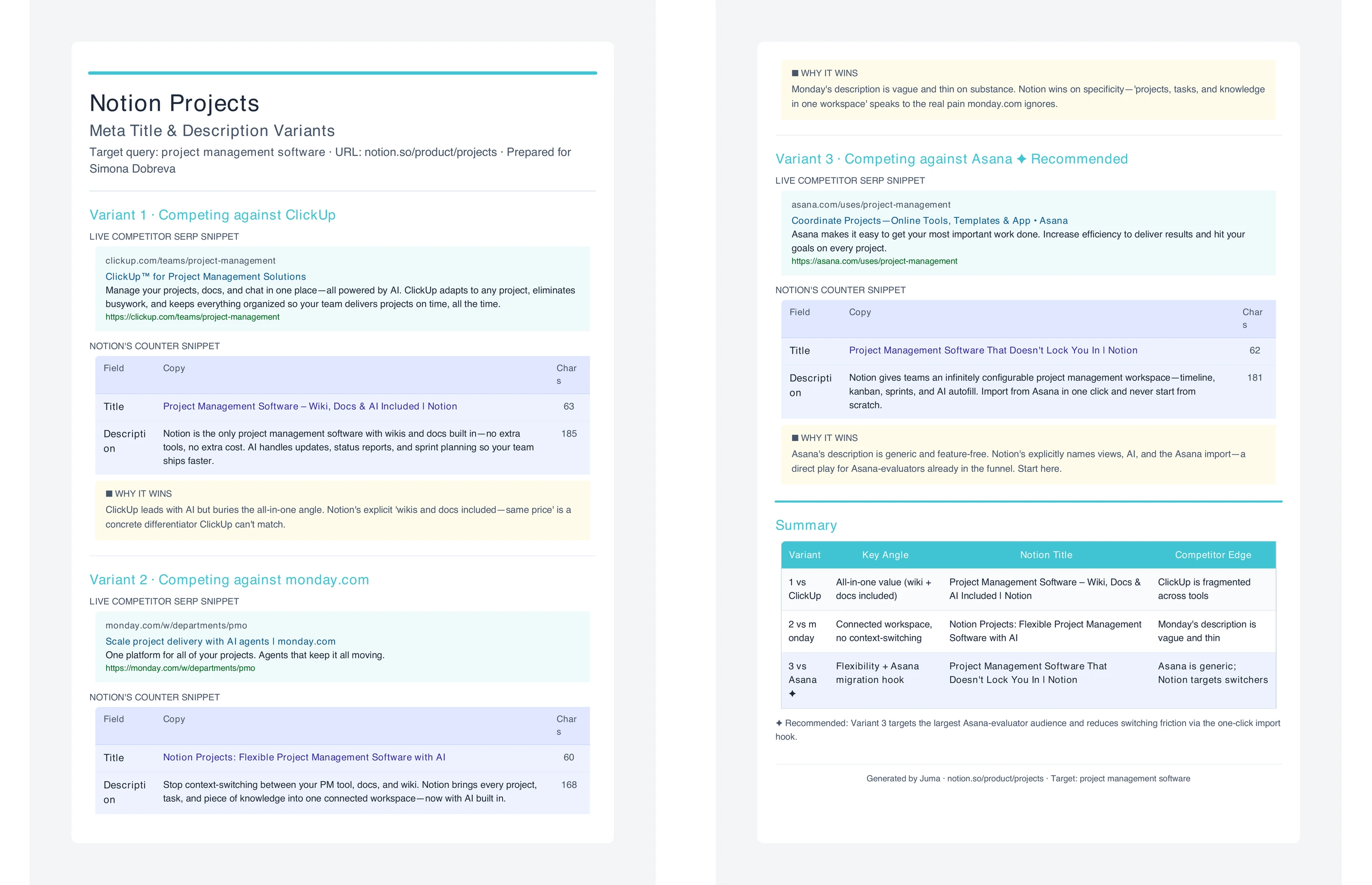
Most meta description generators output a generic summary based on the page title or a paste of body copy. Juma pulls the live SERP for the page's target query, identifies which competitor's snippet is winning, and writes the meta description to compete against that specific snippet. Every variant comes with the competitor snippet shown side-by-side so the team sees what each angle is positioning against.
The bulk version goes further: Juma runs `analyse_google_serp` per URL, extracts the snippet patterns that dominate the category, and writes differentiated descriptions so the brand does not echo the same generic structure 20 pages in a row. The output is an XLSX workbook the CMS team can implement page by page, with character counts and status tracking already wired in.
Does the workbook integrate with our CMS or Search Console?
The workbook is a paste-ready XLSX, not a direct CMS integration. Most CMS tools accept bulk meta-tag uploads via CSV import or a developer-facing API endpoint. The workbook columns map cleanly to the standard fields most platforms expect: URL, current title, current description, proposed title, proposed description, character counts, and a status column for tracking which rows have shipped.
For Search Console specifically, Juma can pull GSC CTR data per URL when the integration is connected on the workspace, then prioritize the bulk refresh by the pages with the lowest CTR despite high impressions. That ordering surfaces the highest-leverage refresh candidates first instead of running a flat sitemap audit.
Can the team track which pages have been refreshed and when?
Yes. The XLSX workbook ships with a status-tracking column that records the date each row was refreshed and the team member who shipped it. Saved to the project, the workbook becomes the source of truth across months: the next refresh inherits the prior status column, so the team can filter to "not refreshed in 90 days" or "refreshed but CTR did not move" cohorts.
The trend view also catches when a competitor's snippet changes mid-cycle. If Asana rewrites its description, the next bulk run will surface the new competitor snippet in the SERP-winner column, and Juma flags the rows where the brand's existing description is now writing against an outdated competitor pattern.
Does this Flow work for B2B SaaS, ecommerce, and agency brands?
Yes. The character math is universal across categories. What changes is the SERP landscape Juma writes against. B2B SaaS pages compete against G2-style review listicles and direct competitor product pages. Ecommerce pages compete against Amazon, Wirecutter, and category-comparison content. Agency brands compete against G2, Clutch, and trade publications.
The Flow asks for the target query early in the session so every variant reflects how the audience actually searches. The character standards and character-length validator are universal. The competitor-snippet research is category-specific. Strategy and the call on which angle to ship stay with a senior content lead. Juma handles the SERP research, the variants, and the workbook.