Set up your client project: ICP, qualification criteria, and win/loss patterns
A Juma Project is a shared space where the team stores everything Juma needs to know about how they sell. Create one project per client or per offer, add context as you go, and Juma applies what is relevant every time the team runs a flow. For lead research the payoff is comparability: with the rubric stored once, every brief scores accounts the same way instead of re-inventing the criteria per run.
What to add
ICP and Fit Criteria
The criteria that define a good-fit account and the weight each one carries: company size, team size, channel activity, retainer potential, and any hard disqualifiers. This is the file that changes output quality the most. With it in the project, the fit score is reproducible and comparable across every lead the team researches.
Qualification Framework
Whether the team runs BANT, MEDDIC, or its own checklist, plus the questions that actually move a deal forward. This shapes the discovery questions in the brief so they match how the team qualifies, rather than arriving as generic openers.
Service and Pricing Overview
What the team sells, at what retainer, and what sits outside scope. Without this, the pain-to-offer mapping stays generic. With it, each observed pain is matched to a service the team can actually deliver at a price that works.
Win/Loss Notes
Which accounts closed, which died, and why. The sharpest disqualification criteria come from losses, not from market research. "Accounts without a named budget owner never closed" turns a vague hesitation into a specific check on the first call.
Outreach That Got Replies
A handful of first-touch emails and messages that earned responses. Juma matches their structure and register when drafting the outreach, so the first touch sounds like the team rather than like a template.
Guide Juma with project info
Add a short description to each knowledge item in the project's info field so Juma knows what each file holds and when to reach for it. For example:
- ICP and Fit Criteria: "Scoring rubric with weights. Use for every fit score so results stay comparable."
- Qualification Framework: "Our MEDDIC checklist. Shape the discovery questions around these."
- Service and Pricing Overview: "Retainer tiers and scope. Map observed pains only to services listed here."
- Win/Loss Notes: "Closed-won and closed-lost reasons from the last four quarters. Ground the disqualifiers in these."
Know what is fact and what is a guess before the call
Frequently Asked Questions
What does a pre-call account brief include?
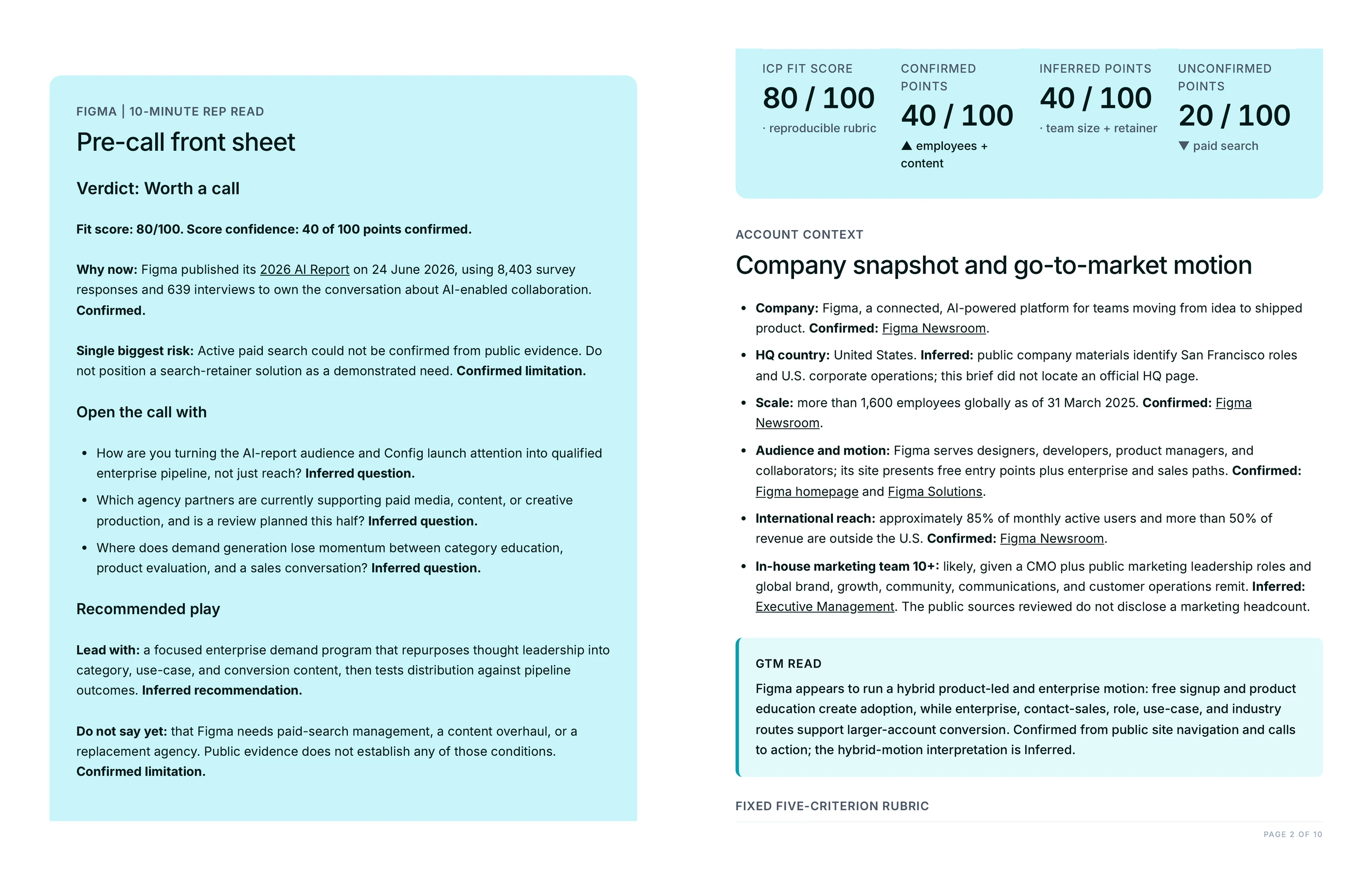
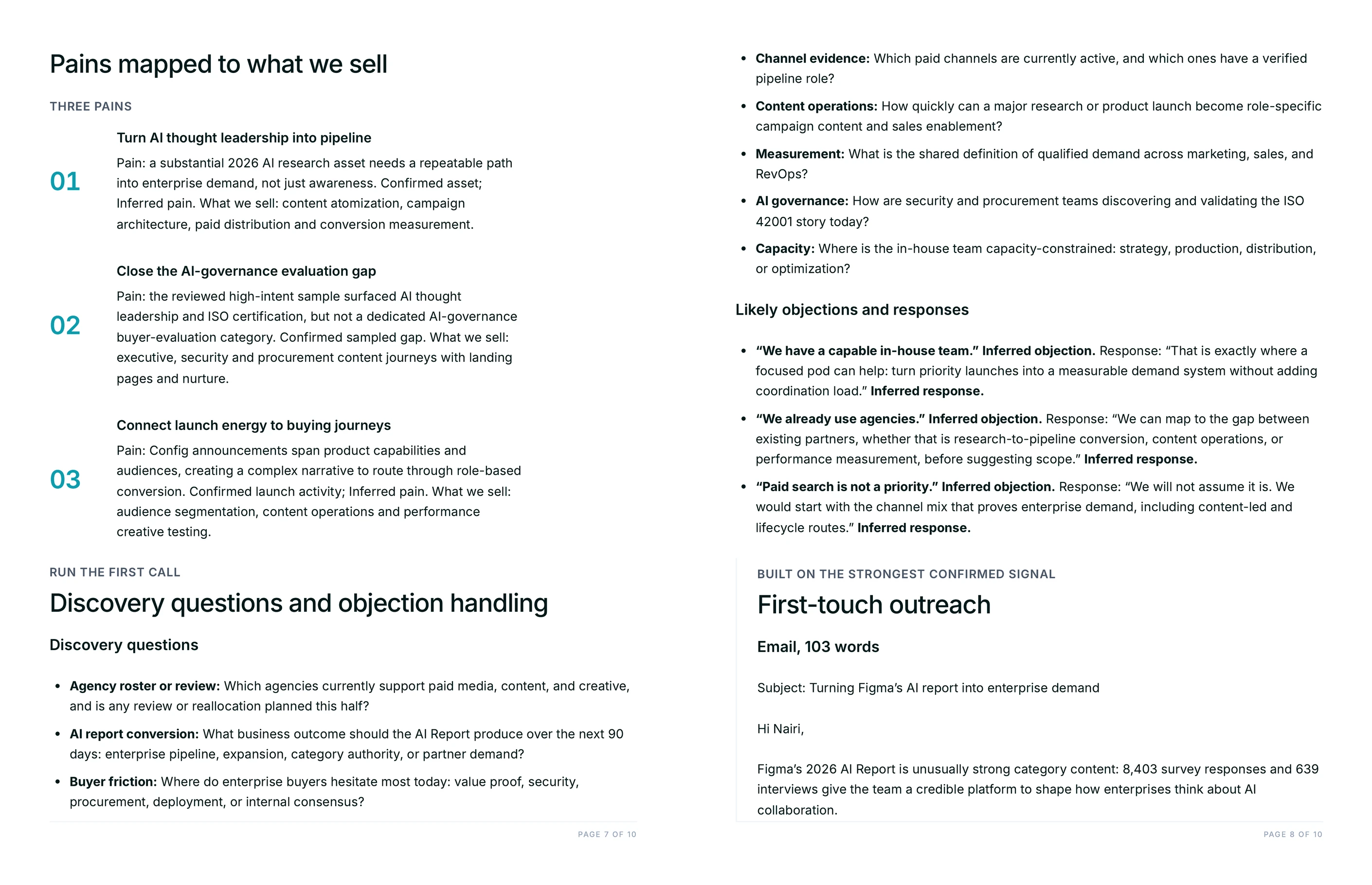
The brief opens with a one-page front sheet: the verdict, the fit score with its confirmed-point split, the why-now trigger in one line, the biggest risk, and three questions to open the call with. Behind it sit the company snapshot, the observable marketing stack, dated buying signals, the buying committee, the score breakdown, objections, and an evidence-gap list.
The structure follows how a call actually runs. A rep reads page one in the ten minutes beforehand and works from the three opening questions. The evidence pages exist for the moment a prospect challenges a claim, which is when a source URL next to the assertion matters. The pain-to-offer section connects each observed problem to a service the team sells, so the conversation moves from research to scope without a separate prep pass.
Alongside the PDF comes a one-row CSV lead record, sized for a CRM rather than for reading.
How does this Flow avoid inventing facts about a lead?
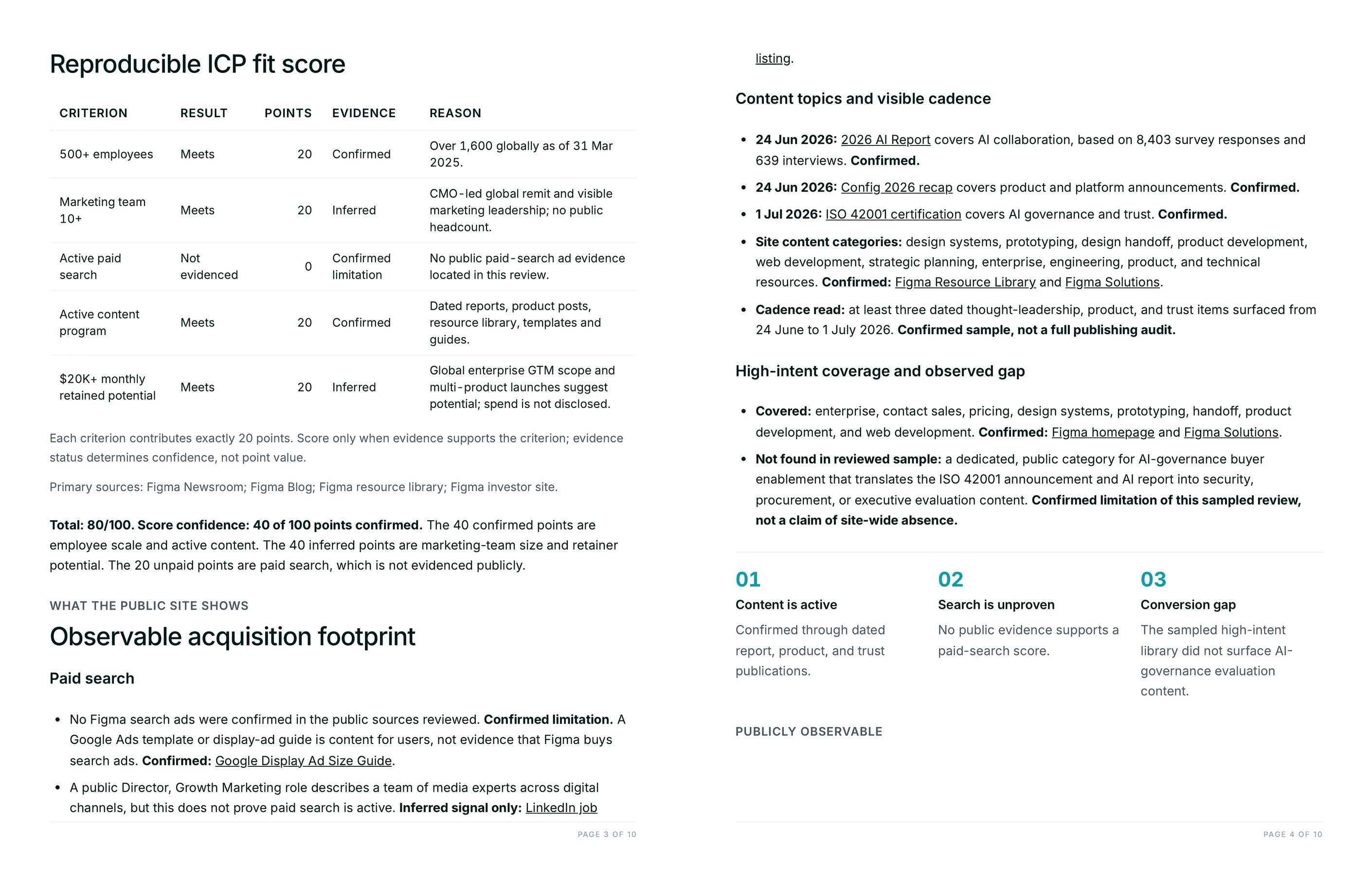
Every assertion carries a label: Confirmed with a source URL and a date, or Inferred. The brief then closes with a list of what the research could not find, so budget, agency roster, and named contacts surface as open questions rather than as confident-sounding guesses a rep might repeat on a call.
The fit score is built the same way. Each of the five criteria scores out of 20, and the brief reports how many of the 100 points rest on confirmed evidence. A 72 with 54 confirmed points and a 72 built mostly on inference are different calls, and collapsing them into one number hides exactly the thing a rep needs to know.
Where a public source names a person, the brief names them and links the source. Where none does, it says so, instead of presenting a job posting as though it were a contact.
How much time does this Flow save compared to researching a lead manually?
Manual pre-call research usually runs 30 to 45 minutes per account: the website, the careers page, pricing, recent news, LinkedIn, then a second pass to write it up and a third to fill the CRM. This Flow returns the brief and the record in a single run. Strategy, taste, and judgment stay human.
400+ marketing teams use Juma, and on average they report 60% faster workflows and 50+ hours saved monthly. The saving here is not only the research: it is the write-up and the CRM entry, the two steps that usually get skipped when a call is 15 minutes away. Human review on every output still applies, and the evidence-gap list is what makes that review quick, because it points straight at the claims worth challenging.
Can the lead record import straight into HubSpot or Salesforce?
Yes. The record arrives as a one-row CSV with atomic typed columns: company, domain, HQ country, industry, employee band, in-house marketing size band, fit score, confirmed points, tier, verdict, evidence confidence, why-now, primary pain, next step, next step due date, and owner suggestion, plus a single notes column holding the prose and source URLs.
Atomic columns are the point. Enrichment exports that pack a paragraph into every field look complete and then fail on import or land as unsearchable text. Here the scored and banded values sit in their own columns so they can drive views, filters, and routing rules, while the reasoning stays in one notes field where it does not interfere.
Teams researching a list rather than a single account can score every row on the same rubric first, then import the whole set in one pass.
Does this Flow work for outbound prospecting as well as inbound leads?
Yes, and the two produce different briefs. An inbound brief leads with why the lead came to the team and what to confirm on the call. An outbound brief leads with the trigger that justifies a first touch at all, and weights the signal timeline and the outreach drafts more heavily than the objection prep.
Naming the situation in the prompt is what shifts it. "A demo request just came in from this account" produces a qualification brief. "We want to open a conversation with this account" produces a trigger-led brief where the dated signal timeline does the heavy lifting and the first-touch drafts come with alternatives to test.
For a whole target list, the same rubric applied across every account keeps the tiers meaningful, and the column naming the one fact that would change a tier turns the list into a short research plan.