Email
Content Writing
Strategy & Planning
Web analysis
Web Icon
Web analysis
PDF
PDF Icon
PDF
Excel
Excel Icon
Excel
Web analysis
Web Icon
PDF
PDF Icon
Excel
Excel Icon

Write a product launch email with AI: Segmented sequence, subject line tests & ESP-ready CSV

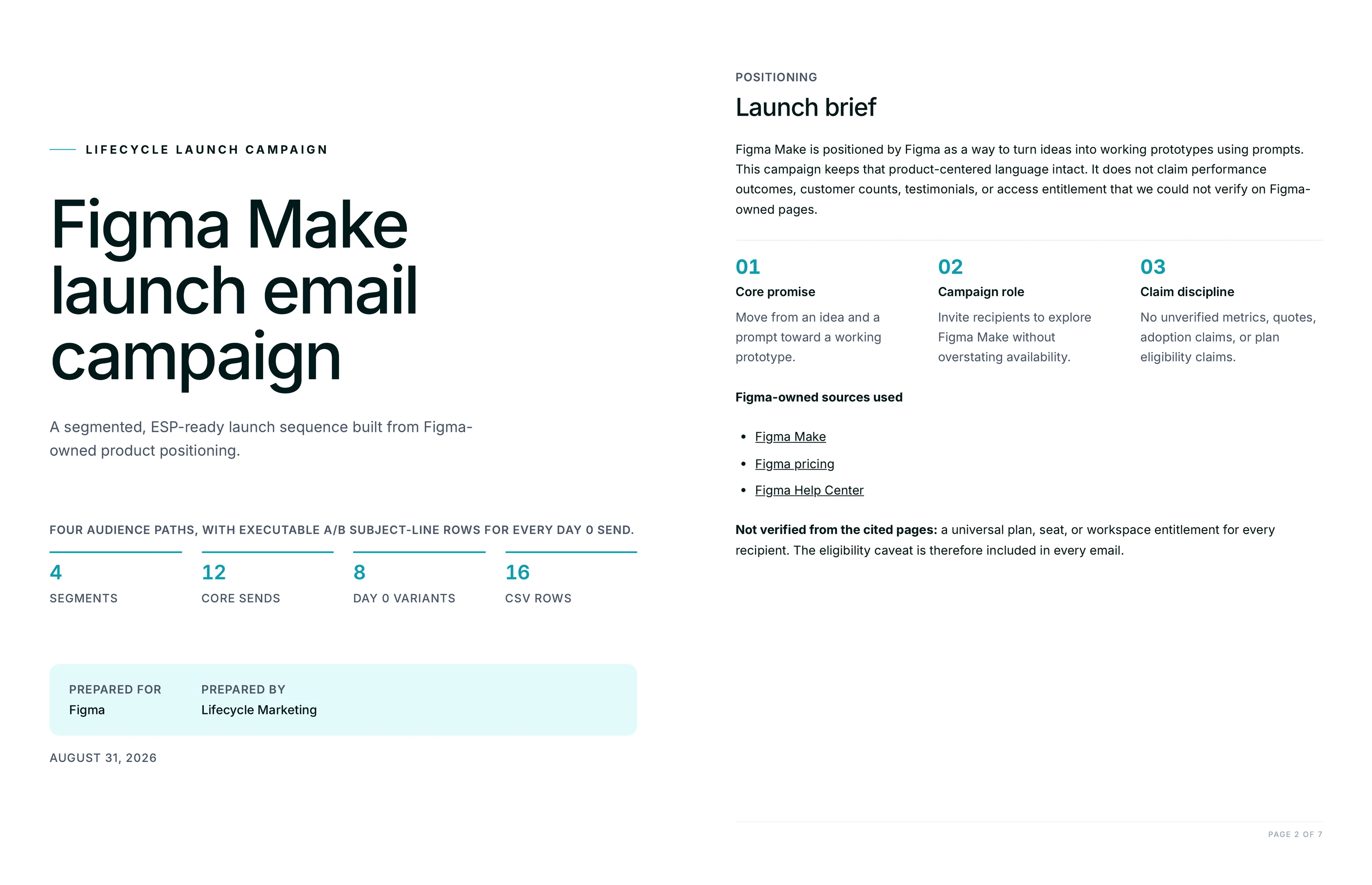
Name the client and the product, and Juma reads their live product pages first, then writes a segmented launch sequence in which every subject line variant is its own row the ESP can actually load.

Name the client, their website, and what they are launching. Juma reads the product's own live pages first and pulls the positioning language from there, so the campaign describes the product the way the company describes it. What comes back is not one email: it is a tailored sequence for each audience segment, a subject line and preheader test matrix, and a send schedule with the reason for each interval.

Two files land in the chat. A branded PDF campaign pack for the client conversation, and a CSV with one row per scheduled email, ready to paste into the ESP. Every product claim is grounded in a page the company owns, and anything that could not be verified is marked rather than guessed. 400+ marketing teams use Juma. Strategy, taste, and judgment stay human.

1

Turn one launch into a campaign the ESP can run

Thank you! Your submission has been received!
Oops! Something went wrong while submitting the form.
Try This Flow

Example Flow result

Hide details
  • Name the segments you actually have. The default split is paying customers, free or starter users, waitlist and inbound leads, and lapsed users. Real lists rarely match that. Naming the segments in the CRM gets a sequence the team can send instead of one it has to remap.
  • Check the variant rows before anything else. Each segment's first send should appear twice in the CSV, once per subject line variant, each with its own split percentage. A test matrix that lives only in the PDF is a slide, not a test.
  • Give the merge tokens a fallback. An empty first-name field renders as "Hi ," on send day. Every token comes back with a stated default, and it is worth reading one email with the token blank before the campaign goes near a schedule.
  • Say which claims are approved. Claims are taken from the client's own live pages, so anything unannounced is left out. Paste the launch brief or the approved messaging when the product page is not public yet.
  • Ask for the suppression rule when segments overlap. A lapsed user can also sit on the waitlist. The sequence comes with a priority order so one person receives one route, which is the difference between a campaign and four campaigns hitting the same inbox.
  • Bring the UTM structure if there is one. No tracking parameters get invented. Supplying the client's UTM pattern means the CTA URLs arrive ready to send rather than ready to edit.
2

How do you write subject lines you can actually A/B test?

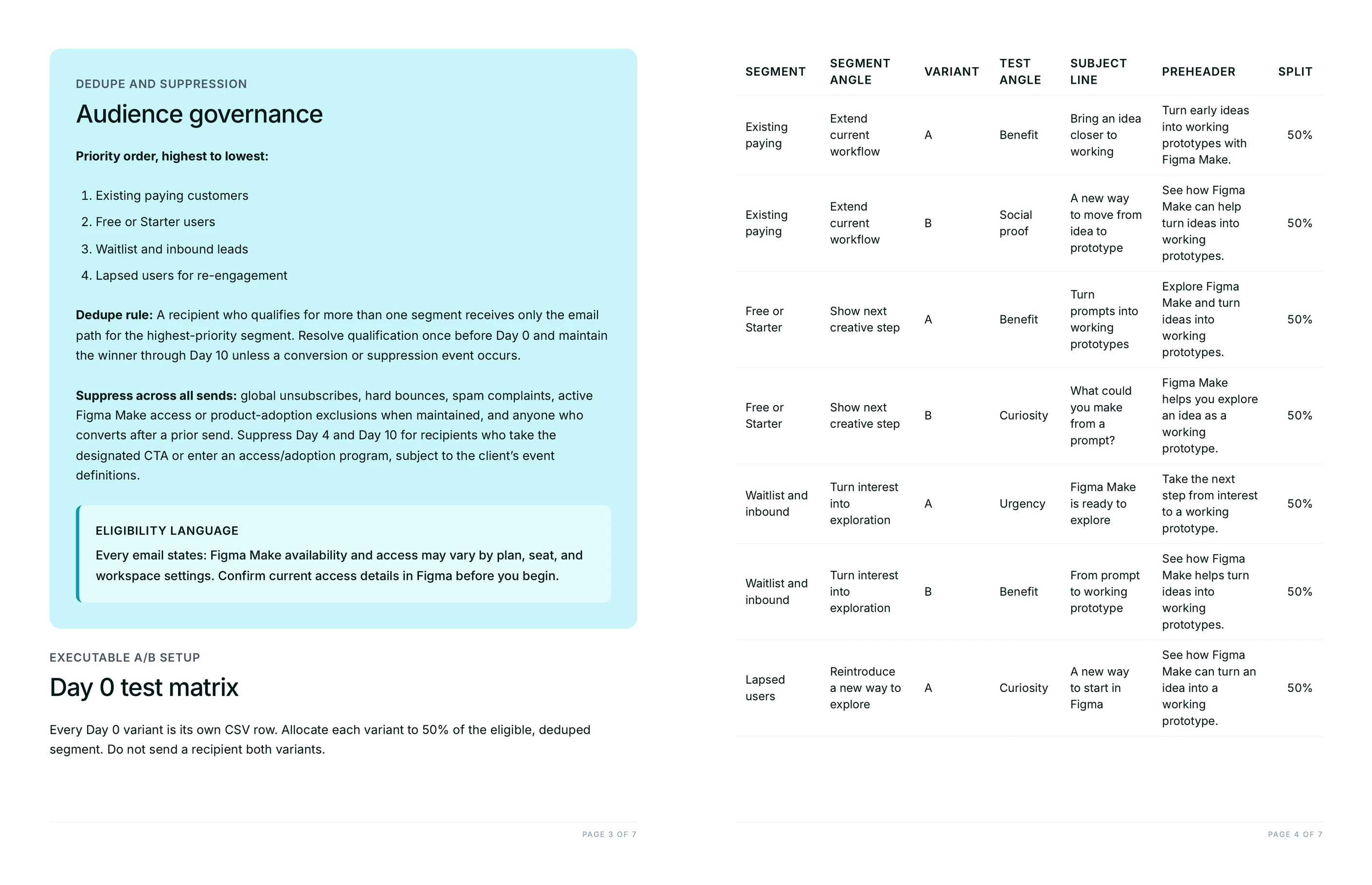
A subject line test needs more than two options on a page. It needs each variant as its own row, with the split percentage, the angle it plays, the metric the test is decided on, and the rule for calling a winner. This prompt produces that structure: two variants per segment on the first send, labelled curiosity, benefit, urgency, or social proof, each one loadable as a separate ESP entry. The winner rule carries into the later sends, so the second and third emails inherit the framing that won rather than starting the argument again.

Prompt
Copy

Rebuild the subject line test so it is shippable: two variants for each segment's first send, each as its own CSV row with a split percentage and the angle it plays, plus the primary metric and the winner selection rule.

Try This Flow
3

How do you decide the timing between launch emails?

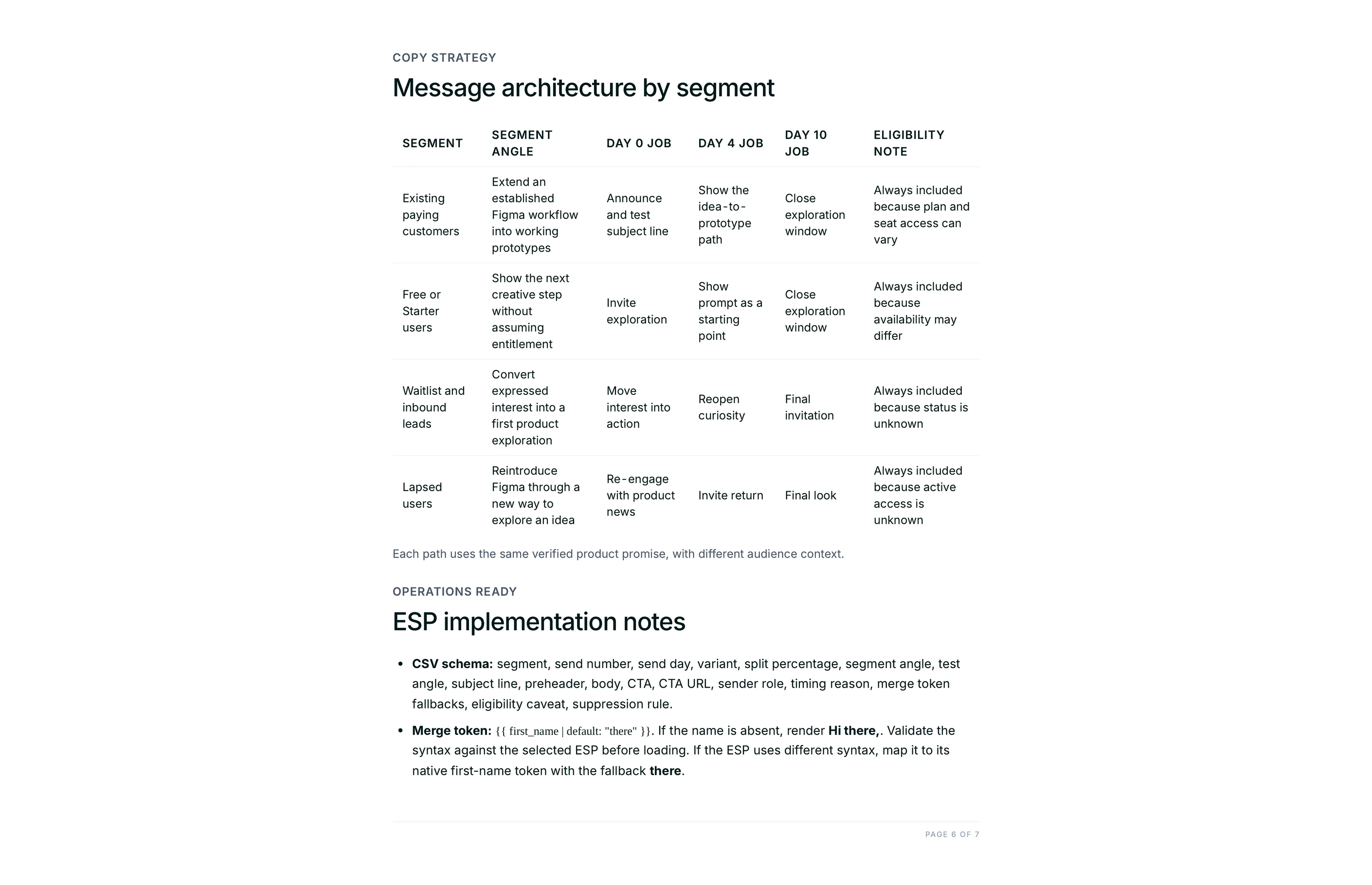
Most launch calendars assert their intervals. Day 0, Day 4, Day 10 appear with no explanation, and the client asks why not Day 2. This prompt makes the sequence defend itself: each send carries the reason for its gap, tied to what the previous email asked the reader to do and how long that action realistically takes. It also names what closes the sequence, so the last email is a genuine invitation rather than a deadline the team invented. The reasoning arrives as its own column, which means it survives the trip into the ESP and the client deck.

Prompt
Copy

For every send in the sequence, give the reason for the interval, not just the message job: why that many days after the previous email, and what closes the sequence without inventing a deadline. Add it as a timing reason column.

Try This Flow
4
Lightbulb Icon
Tips and tricks
Run this one before the campaign goes to the client's legal or product marketing reviewer. It is faster to fix a claim in the copy than in a scheduled send.

How do you keep launch claims accurate?

Launch copy is where invented specifics do the most damage. A performance number nobody approved, a customer quote that was never given, an availability promise the plan does not cover: each one reaches the whole list at once. This prompt audits the campaign against the client's own pages and reports what it could verify, what it could not, and where access varies by plan or seat. Anything unverified gets marked rather than dropped quietly, so the reviewer sees the gap and decides. The eligibility caveat then gets applied consistently, not just to the segments where someone remembered it.

Prompt
Copy

Audit every claim in the campaign against the client's own live pages. List what is verified with its source, what could not be verified, and every place access varies by plan or seat, then apply that caveat consistently across all segments.

Try This Flow
5

How do you stop one person getting four launch emails?

Segments look clean on a slide and overlap badly in a CRM. A lapsed user can sit on the waitlist, and a free user can have an open sales conversation, so a four-segment campaign can land four times in one inbox on the same morning. This prompt turns the segments into send logic: a priority order, an explicit dedupe rule so a recipient who qualifies twice receives only the higher-priority route, entry criteria in the ESP's own terms, and the suppression list to apply before the first send. That is usually the difference between a campaign the team can schedule and one it has to rebuild.

Prompt
Copy

Turn the segments into send logic: the priority order, the dedupe rule when someone qualifies for two segments, the entry criteria for each route, and the suppression list to apply before the first send.

Try This Flow

Set up your client project: positioning, voice, and the ESP's own fields

Launch campaigns repeat. The same client launches again next quarter, and the same three questions get re-answered every time: how do they talk about themselves, which claims are approved, and what shape does their ESP need. Keeping one project per client means those answers stay put, and every later flow in that project starts from them instead of from a blank chat.

What to add

Brand voice guide

How the client sounds in email specifically: sentence length, how direct the CTA is, what they never say. Email voice is usually tighter than website voice, and naming the difference keeps the sequence from reading like landing page copy.

Product positioning and launch brief

The approved messaging, the launch date, and the claims legal has cleared. With this in the project, the campaign works from what the team agreed rather than only from what is already public on the site.

ESP field spec and segment definitions

The column names the ESP imports, the merge token syntax, and how the segments are defined in the CRM. The CSV then arrives in the client's own field shape, which removes the remapping step before every send.

Guide Juma with project info

Each knowledge item takes a one-line description telling Juma what it is for. Short and specific works better than thorough.

  • Brand voice guide: "How this client writes email: tone, sentence length, CTA style, and the words they avoid."
  • Product positioning and launch brief: "Approved launch messaging and the claims cleared for use. Do not go beyond these."
  • ESP field spec and segment definitions: "The exact CSV columns, merge token syntax, and segment rules this client's ESP expects."
Juma Logo
Ship the launch campaign, not just the launch email

Frequently Asked Questions

What does this flow deliver?

It delivers a segmented launch email campaign as two files: a branded PDF campaign pack and a CSV with one row per scheduled email. The CSV carries segment, send number, timing, subject line, preheader, body, CTA, and the reasoning columns, so it loads into an ESP without retyping.

The PDF is the version for the client conversation. It holds the positioning the campaign was built from, the segment strategy, the subject line test matrix, the send schedule, and the implementation notes. The CSV is the working file the team sends from.

How many emails does it write?

Four segments across three sends is twelve emails, plus the subject line variants for the first send in each segment. The count follows the segments, so naming two segments produces a shorter campaign and naming six produces a longer one.

Each segment gets its own angle rather than the same email with a swapped opening line. The paying customer route and the lapsed user route are asking for different things, and the copy reflects that.

Can the subject line tests go straight into our ESP?

Yes. Each variant is its own row in the CSV with its own split percentage, so both versions import as separate entries rather than living as two options in a document. The primary metric and the winner selection rule come with them.

This is the part most launch templates get wrong. A test matrix that only exists in a slide is a recommendation, and it usually gets skipped on send day because nobody wants to rebuild it by hand.

Will it invent product claims or metrics?

No. Claims are taken from the client's own live pages and each one is traced back to its source. Anything that cannot be verified is marked as unverified rather than filled in, and no customer counts, performance figures, or quotes get added.

Where access varies by plan or seat, the copy says so and points the reader at their own settings. Human review on every output: the reviewer still signs off before anything is scheduled.

Does this replace our lifecycle team?

No. It removes the assembly work: the segment matrix, the twelve drafts, the test grid, and the CSV formatting that usually takes a day. What it hands back is a complete first version to react to.

Juma augments the team, it doesn't replace it. Teams using Juma report around 60% faster workflows and 50+ hours saved monthly, and the judgment about which angle suits this client and this launch stays with the marketers who know them.

Don't take our word for it

Ask AI about us

400+ marketing teams trust Juma. ChatGPT, Claude, and Perplexity know why. Ask them.

Ready when you are

What's on your plate today?

Start typing a task and Juma will figure out the rest.

Thank you! Your submission has been received!
Oops! Something went wrong while submitting the form.