Set up your client project: logo files, the approved palette, and sign-off history
A Juma Project is a shared space where the team keeps everything Juma needs to know about a client. Create one project per client, add context as the relationship grows, and Juma draws on whatever is relevant each time the team runs a Flow. For brand guidelines the gain is specific: the open web supplies what a brand has published, and the project supplies what was decided internally and never written down anywhere public.
What to add
Logo and Asset Files
The actual artwork: wordmark, logomark, icon, any lockups, in the formats the team ships. With the real files in the project, clear space and minimum sizes get measured against the mark the client uses, rather than against a version recovered from a web page at whatever size that page happened to render it.
Approved Palette and Type Licences
The hex values design has already signed off and the typefaces the client is licensed to set. This is what turns PROPOSED rows into OFFICIAL ones, and it stops a guideline recommending a face the client has no right to use, which is the kind of error that gets caught late and expensively.
Brand Sign-off History
What was rejected before and why: the gray that got argued over, the accessibility exception that was granted for one component, the lockup the founder vetoed. The confirmation list comes back shorter because questions already settled are not asked a second time.
Guide Juma with project info
Each knowledge item has a short description field. One line telling Juma what the file is and when to reach for it is enough to change which document it opens first.
- Logo and Asset Files: "Master artwork for every mark. Measure clear space and minimum sizes against these files, not against anything scraped from the site."
- Approved Palette and Type Licences: "Signed-off colors and licensed typefaces. Treat anything listed here as OFFICIAL and never propose a face that is not on this list."
- Brand Sign-off History: "Past brand decisions and their reasons. Check this before adding a question to the confirmation list."
Get brand guidelines a developer can paste
Frequently Asked Questions
What does the brand guidelines document include?
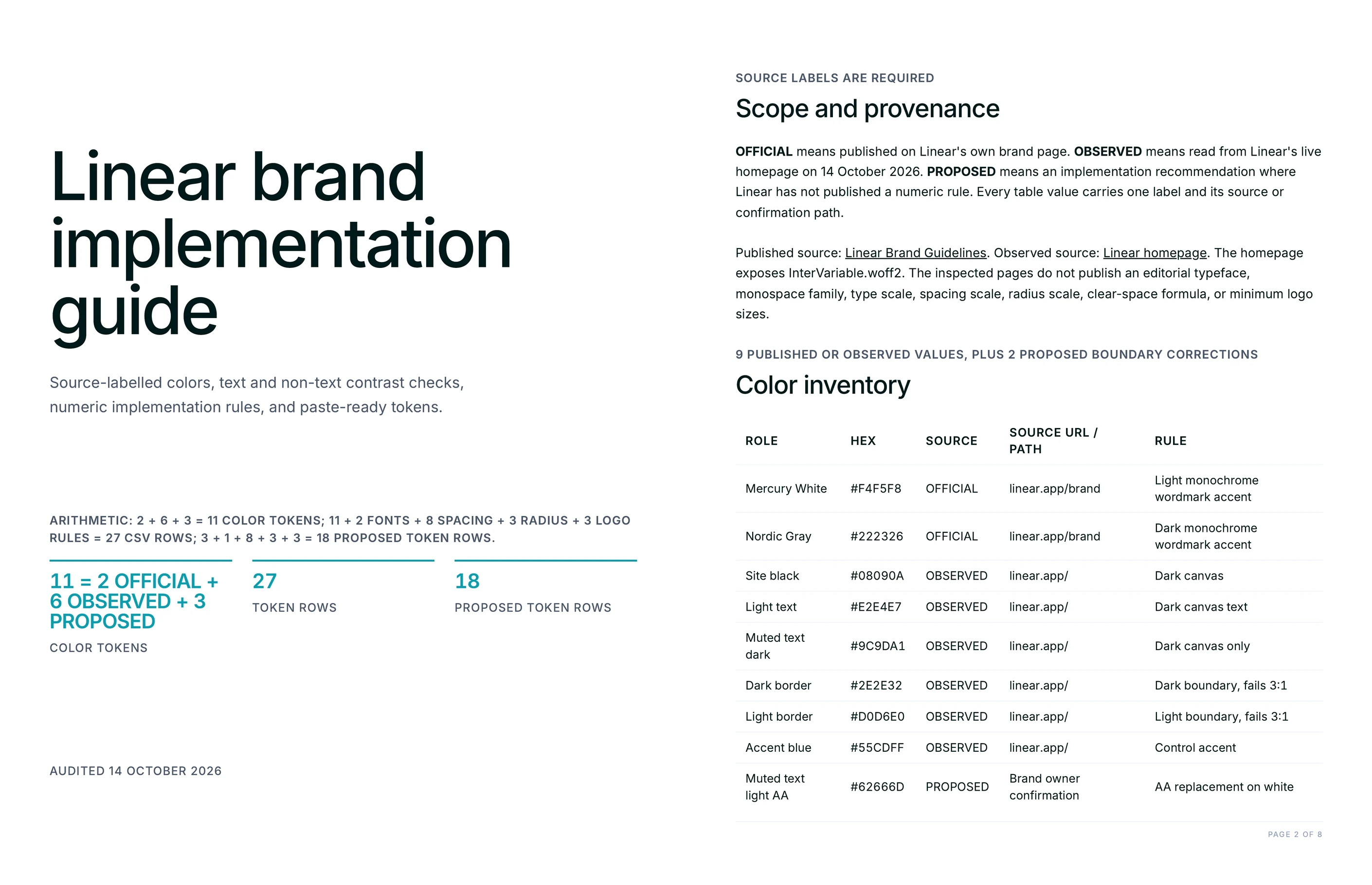
A brand book PDF covering color, typography, logo usage, spacing and radius, plus an editable CSV of the same values as design tokens. Every value carries a source label, every recommended color pairing carries its computed WCAG contrast ratio, and the document closes with a list of what the brand owner still has to confirm.
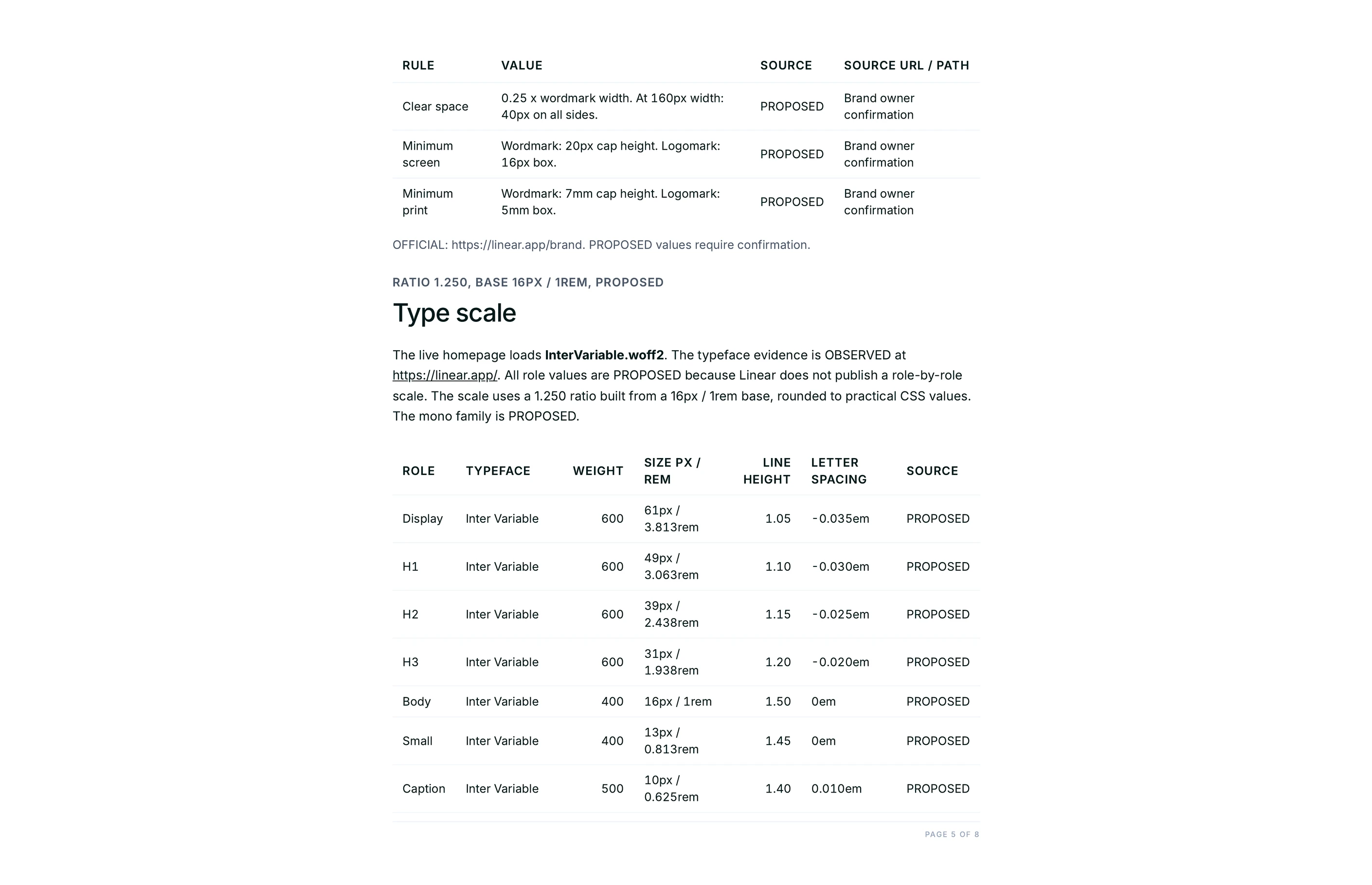
The typography section prints a real scale: one row per named role from display down to caption and mono, with typeface, weight, size in both px and rem, line height, letter spacing, and the ratio the scale is built on. The logo section states clear space as a multiple of a named measurement on the mark with the resulting pixel value, and gives minimum sizes in px for screen and mm for print.
Where do the colors and typefaces come from?
From the brand's own material. Juma fetches whatever brand or press page the company publishes, then reads the live site, and keeps the two apart. Values the brand publishes are labelled OFFICIAL with the URL they came from. Values read off the site are labelled OBSERVED with the page. Nothing is invented.
Where a brand publishes no rule at all, and most do not publish a spacing scale or a type scale, the gap is filled with a PROPOSED value and that value goes straight onto the confirmation list. The distinction matters more than it sounds: a team that treats an observed marketing-site gray as a brand color will defend it in a redesign that was always free to change it.
How does this compare to a brand designer building guidelines by hand?
It covers the mechanical work: gathering every value in use, computing contrast ratios, building the scales, writing the token exports, and listing what nobody has confirmed. That is the part that takes days and the part where a hand-built document quietly carries an untested color pairing.
It does not decide what the brand should feel like, which of two grays is the right gray, or whether an exception is worth granting. Strategy, taste, and judgment stay human. The useful version of this Flow is a designer opening the document with the measurements already done and the open questions already gathered, then spending their time on the decisions that actually need a person.
Does this work for a brand with no published brand page?
Yes, and the output shifts accordingly. With no brand page to read, nothing can be labelled OFFICIAL, so the document comes back as OBSERVED values plus PROPOSED rules, and the confirmation list is longer. The document says this explicitly rather than presenting the result as settled.
For a client in that position the confirmation list is usually the most valuable part of the delivery, because it is the first time anyone has written down which brand decisions the company has never actually made.
What is a design-token sheet, and who uses it?
A design token is a named value, such as a color, a spacing step or a font size, stored in a form code can read. The token sheet is that set as one row per token with its value, type and source label, which an engineer imports instead of reading hex codes out of a PDF.
Developers use it to build components, designers use it to keep a design tool in step with what ships, and the shared naming is what keeps the two in agreement. It is also what makes the next revision cheap: change the token, and every component referencing it follows.