Set up your client project: approved claims, brand guidelines & the campaign history
One Project per client. Add the context once and every brief after the first starts from what the team already knows about this brand rather than from the live website alone. Juma remembers the approved claims, the visual system and the routes that have already run, so the second brief argues about the idea instead of re-establishing the basics.
What to add
Approved claims library
The claims legal has actually cleared, with the substantiation behind each one. Live site copy and the cleared list are not always the same thing, and this is what keeps the do-not-say section specific to this client.
Brand guidelines
Logo, colour, typography and the tone rules. With these in the project the PDF comes back looking like the client's own document rather than a generic template.
Past campaign briefs and what got made
The routes that have already run and how they performed. This is what stops a new brief proposing the territory the team shot last quarter.
Guide Juma with project info
Each knowledge item takes a one-line description telling Juma what it is for. A short, plain sentence is enough.
- Approved claims library: "The claims we are cleared to make, with the evidence behind each. Never write a claim that is not on this list."
- Brand guidelines: "Colour, type and logo rules. Apply these to every PDF deliverable."
- Past campaign briefs: "Territories we have already run. Do not propose a route we shot in the last year without saying how it differs."
Brief the work before the work starts
Frequently Asked Questions
What is a creative brief for an ad campaign?
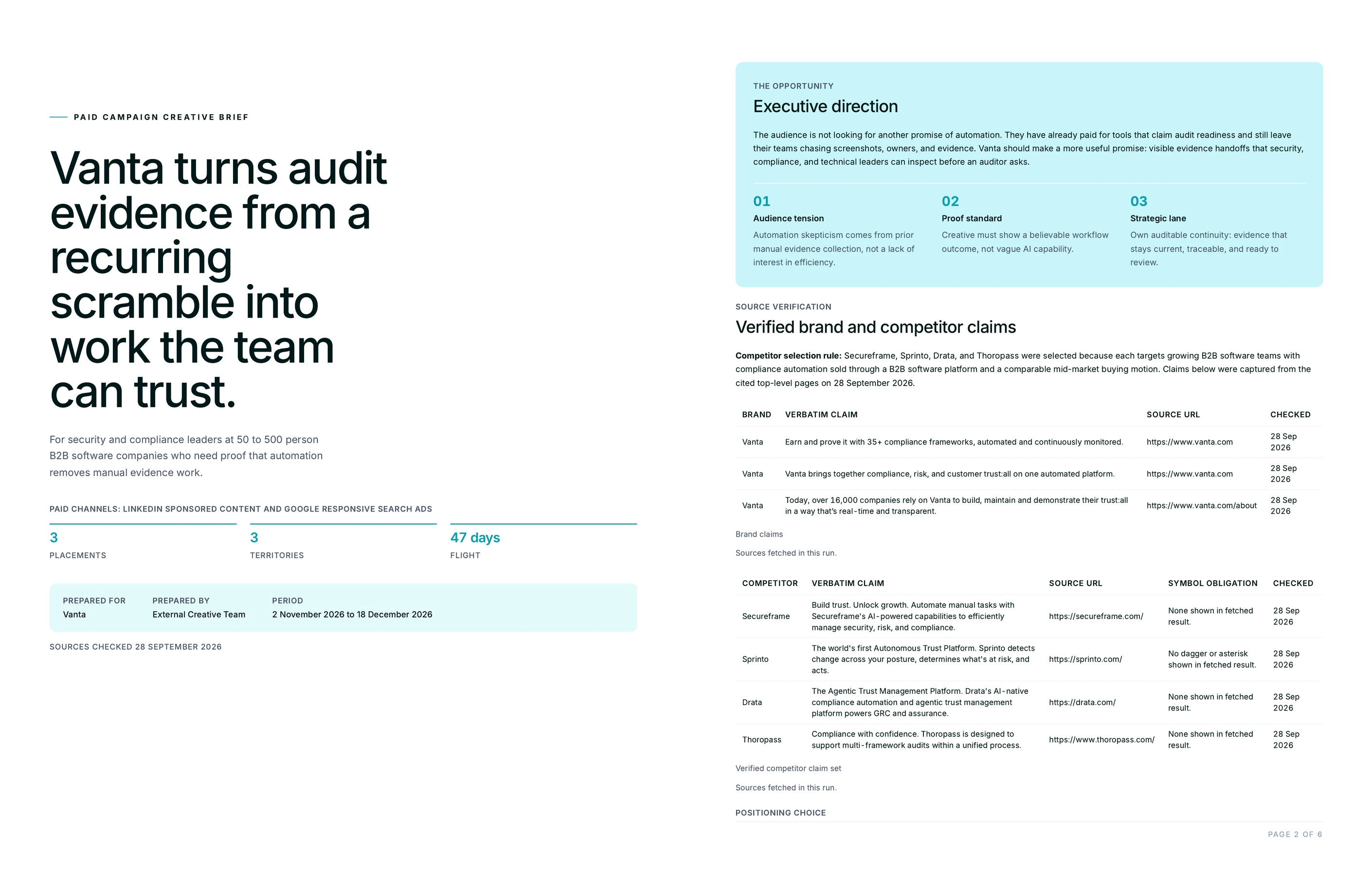
A creative brief is the document a marketer gives a designer, editor or agency before any asset gets made. It fixes the audience, the single proposition the work has to land, the routes worth exploring, the language that cannot be used, and the technical shape of every asset the campaign needs.
It is not the ad and it is not the media plan. It is the decision record that keeps three people making three different things from arriving at three unrelated answers, and it is the thing a reviewer scores returned work against.
How is this different from writing the ad copy itself?
This Flow stops before the ad. It produces the brief that tells someone else what to make and how it will be judged, which is a different job from writing the finished headline.
If the team wants the ads themselves, the copy Flows cover that ground: Google Ads copy, Facebook ads and LinkedIn ad copy each produce finished variants. The brief is the upstream document those executions get measured against, and it is the artifact the external agency actually needs.
Does the brief include real platform specifications?
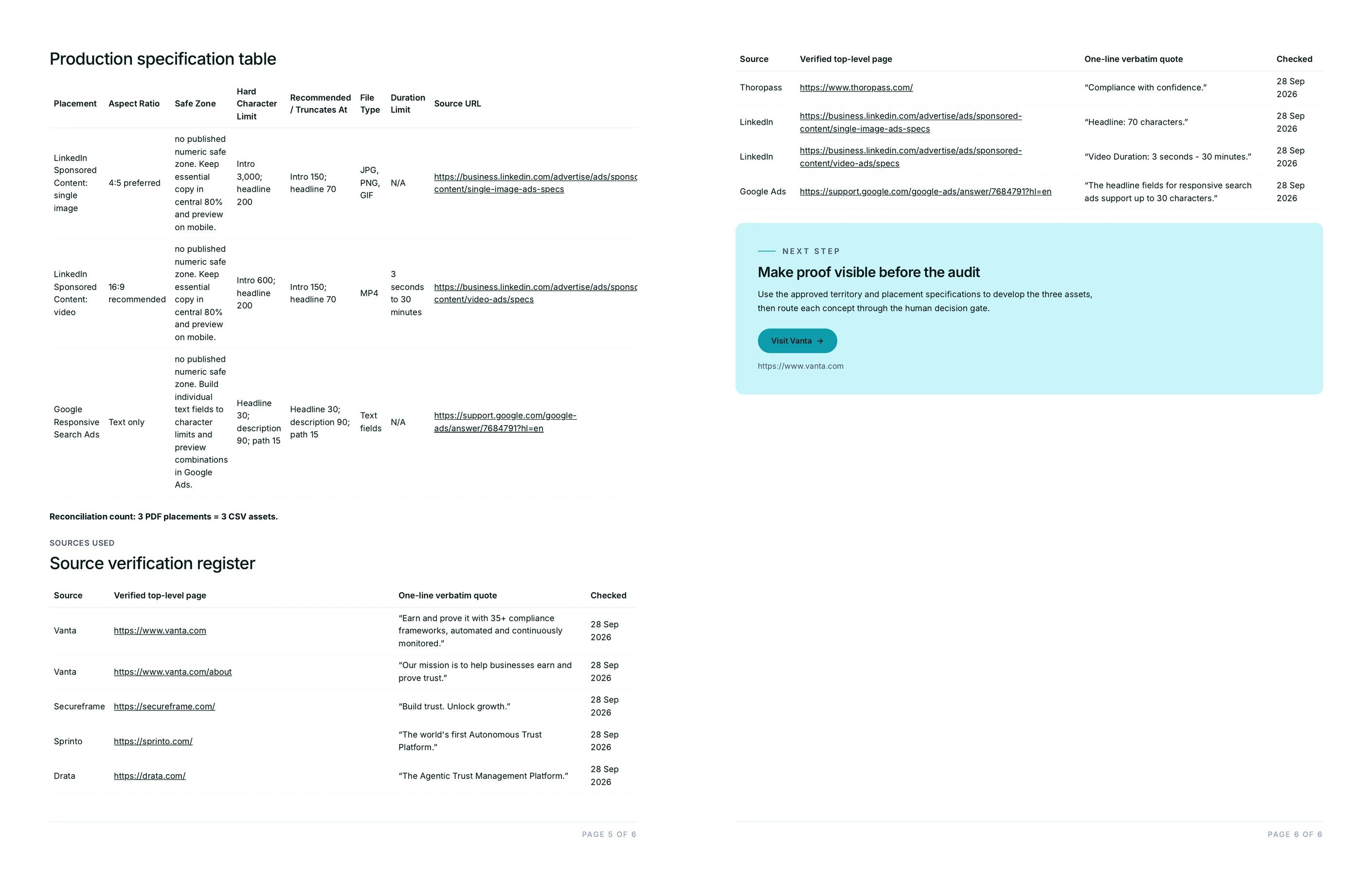
Yes. Each placement row carries the aspect ratio, a numeric safe zone, file type, duration limit and the character counts, quoting the platform's own specification page with the date it was checked.
The character count is deliberately split into the hard limit and the recommendation, because those two numbers get confused constantly and the confusion is expensive: copy built to a recommendation printed as a maximum gets truncated, and copy built past a real limit gets rejected. Specifications also change, so the checked date is printed on every row and the brief tells the team to confirm in the platform before trafficking.
Does it work for B2B campaigns, or only consumer brands?
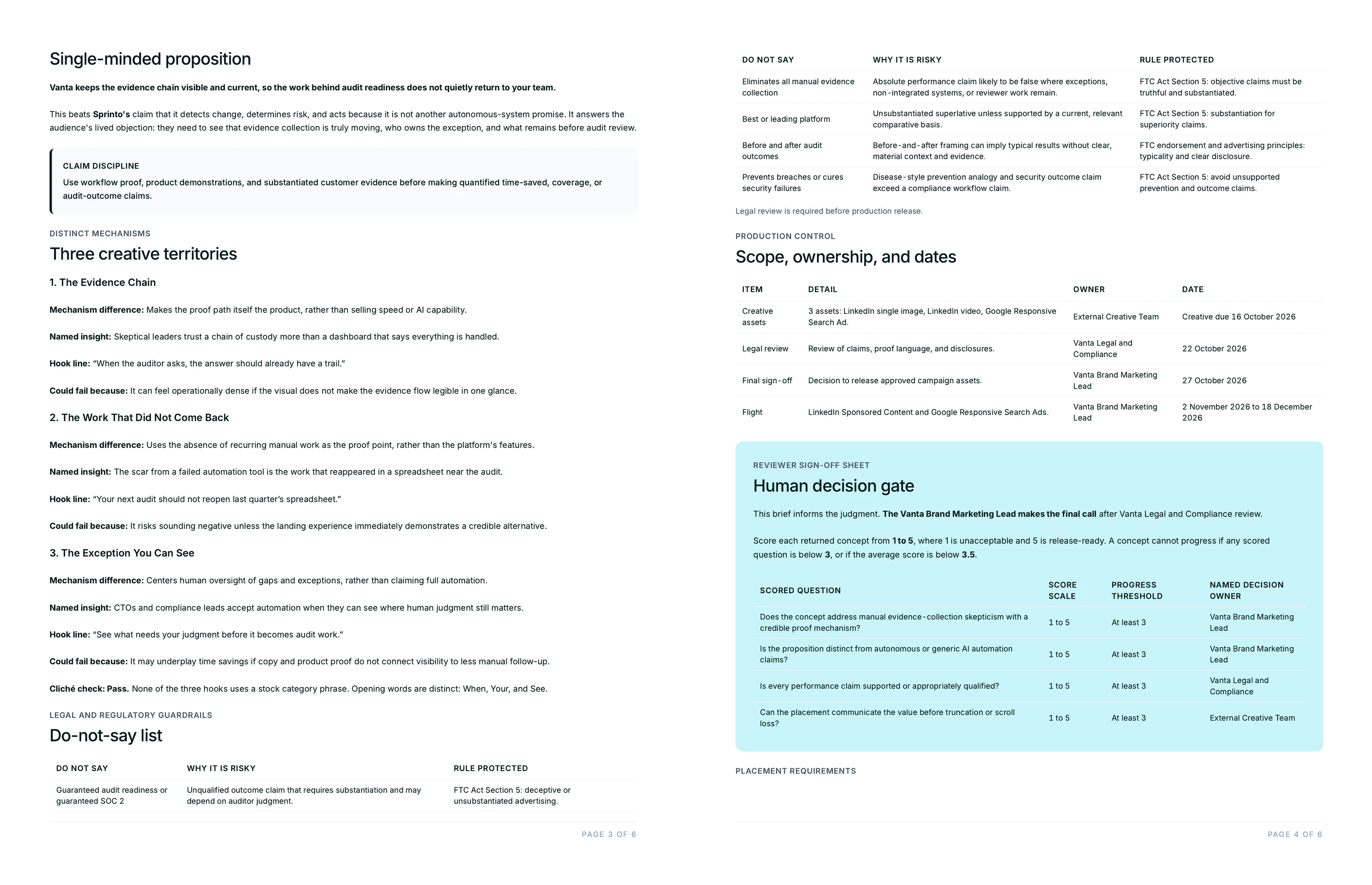
Both. The structure is the same either way: the claims your competitors make, one proposition that beats a named claim, three routes, the specs and the guardrails.
What changes is the evidence and the placements. A consumer supplement campaign pulls product-page claims and Meta placements. A B2B software campaign pulls security and compliance claims and LinkedIn placements, with the regulated-language section shifting from health claims to whatever the category actually constrains.
Who approves the creative in the end?
A person, always. The brief carries a reviewer sign-off sheet with scored questions and a threshold, and it names the human decision gate explicitly.
Juma augments the team, it does not replace it. The Flow does the research, the sourcing and the specification work that eats an afternoon, so the argument that matters, which route to make, happens with better evidence and with a named person still making the call.






.webp)