Set up your client project: levelling, pay bands and approval rules
Juma projects work per client, and hiring is one of the areas where the same four documents get asked for on every single role. The team builds one project for the client, adds the context the open web cannot supply, and every posting after the first starts from the company's own rules rather than from research. For job descriptions the context that changes the output most is the internal frame: how this company levels roles, what it actually pays, how it sounds, and who has to approve a posting before it goes live. If the project already exists, these are additions rather than a fresh setup.
What to add
Role Levelling Framework
How the company defines each level, the scope that separates a mid-level role from a senior one, and the internal title conventions. With this in the project the internal title and the seniority framing come from the company's own ladder instead of being inferred from the job title alone.
Compensation Bands and Policy
The approved ranges by level and location, the currency, and what the company is willing to disclose in an advertisement. This is what turns a labelled market estimate into the real range, and it is the single piece of context that removes the biggest publication gate.
Employer Brand and Voice
The careers-page tone, the benefits the company genuinely offers, and the equal-opportunity and accommodation wording legal has already cleared. Keeping the approved wording in the project stops each posting from rewriting the paragraphs that are supposed to stay identical.
Hiring Approval Rules
Who signs off the copy, who signs off the range, and which jurisdictions the company posts into. Without it the posting can name an approval gate but cannot say whose name belongs in it, which is the step that most often stalls between a finished draft and a live advertisement.
Guide Juma with project info
Each file in a project can carry a short description in the project info field. Those descriptions tell Juma what a file holds and when it matters, so the right context gets picked up for the task at hand rather than everything at once.
- Role Levelling Framework: "Our levels, the scope that separates them, and internal title conventions. Use for the internal title and the seniority framing."
- Compensation Bands and Policy: "Approved ranges by level and location and what we disclose in adverts. Use as the real range instead of a market estimate."
- Employer Brand and Voice: "Careers-page tone, the benefits we actually offer, and cleared equal-opportunity and accommodation wording. Use verbatim where it applies."
- Hiring Approval Rules: "Who approves copy, who approves pay, and the jurisdictions we post into. Use to fill the approval gate and the disclosure check."
Write the posting and the paperwork in one pass
Frequently Asked Questions
How is this different from a job description generator?
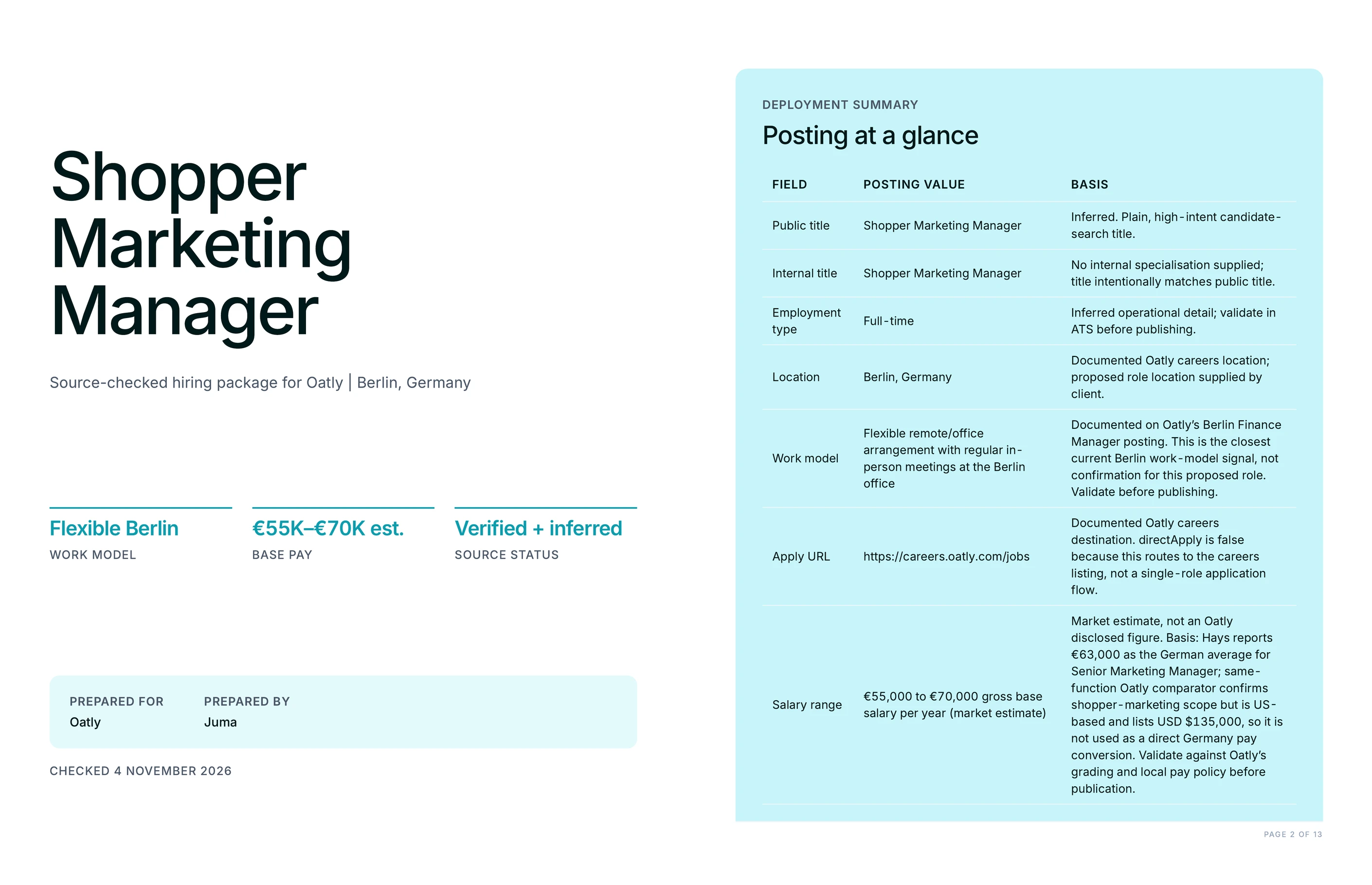
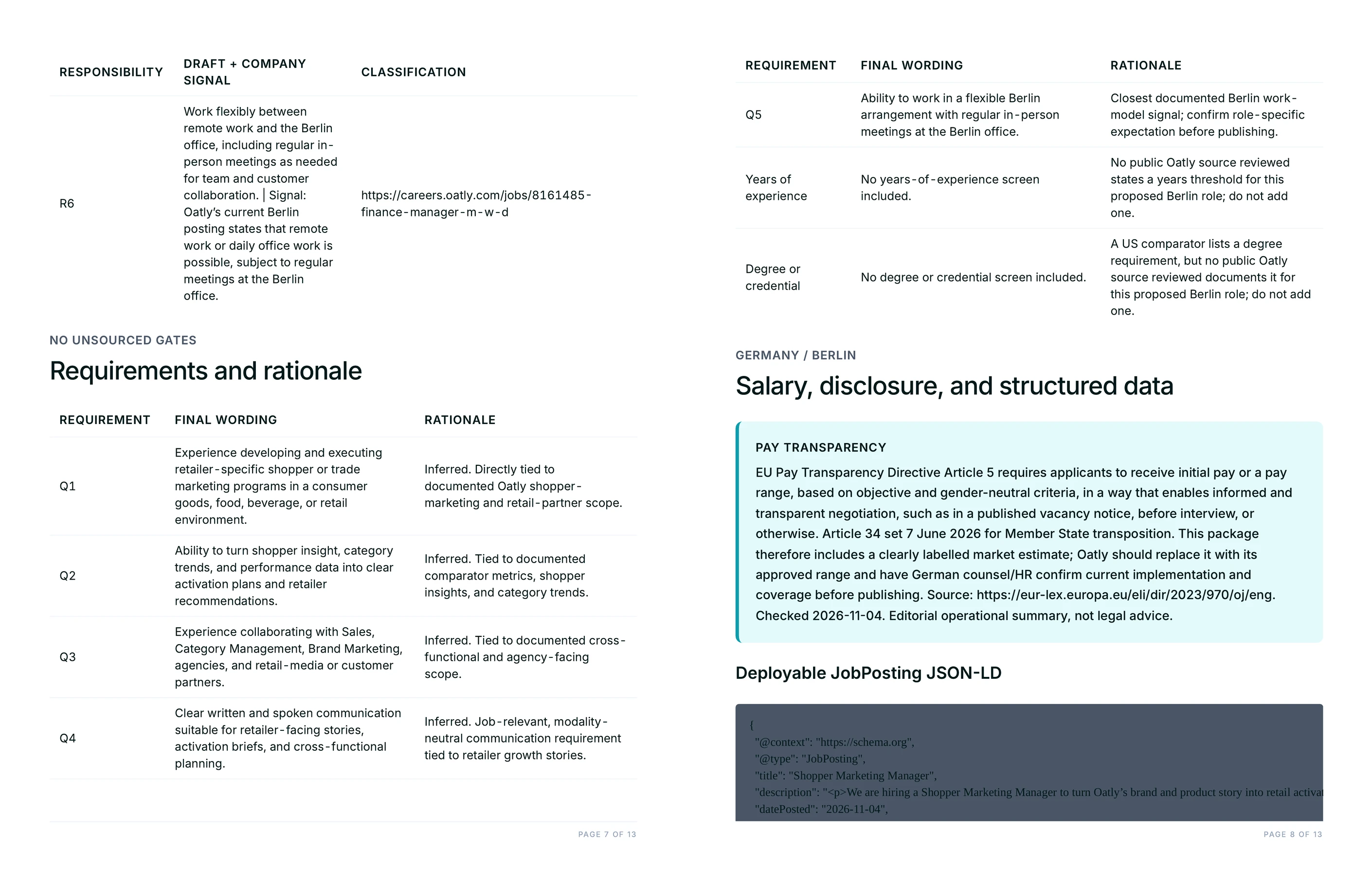
A generator produces prose. This produces a posting plus the paperwork that has to travel with it: an evidence map tying each line to the company's own pages, the structured data that makes the role eligible for Google Jobs, the disclosure the city requires, and an audit of the actual draft. The prose is the smallest part.
The difference shows up at review. A generated description gets read for tone, and whatever requirements it invented tend to survive because nobody can see which ones were invented. Here the inferred lines are listed separately, so the review is a short conversation about a handful of proposals rather than a careful reread of everything.
It also shows up at publication. A generator hands over text that still needs schema, a disclosure check and a legal read. Those arrive together here, which is usually the difference between posting the same day and posting next week.
Can we trust the salary range it produces?
Not as a figure to publish, and the posting says so. Any range without a company source arrives labelled a market estimate, with the same-function comparator role named and the reasoning shown, and it stays gated until a compensation owner replaces it with the approved number.
That labelling is the useful part. A range presented as verified when it came from a guess is the version that causes problems, because nobody downstream knows to question it. Naming the comparator also lets a compensation partner disagree with the specific choice rather than with the number, which is a much faster conversation.
Once the approved bands are in the project, this stops being an estimate at all. The posting pulls the real range for the level and location, and the publication gate disappears.
Does the JobPosting schema actually get the role into Google Jobs?
The schema makes the role eligible. Indexing still depends on the page being crawlable and the posting living at a real URL, so the block arrives with a short list of values to replace at launch: the live requisition link, the posting date, the expiry and the approved salary.
What the flow does handle is the internal consistency that most postings get wrong. The expiry date is present, the salary carries a time unit, the direct-apply flag matches the link actually supplied, and the work-model value reflects the real arrangement rather than defaulting to remote. A hybrid role tagged as fully remote is a common error and it quietly routes the posting to the wrong candidates.
What stops it from adding requirements that screen people out?
A standing rule against unsourced screens. Years-of-experience bars, degree requirements and credential screens are only included when the company's own site states them, and anything kept arrives with its rationale written beside it in the requirements table rather than appearing as an unexplained condition.
Those lines are worth the attention because they are the ones that shrink a candidate pool without anyone deciding to. A years threshold copied from a previous posting is a decision nobody made, and it usually outlives the role it was written for. Leaving it out by default means adding it back has to be deliberate.
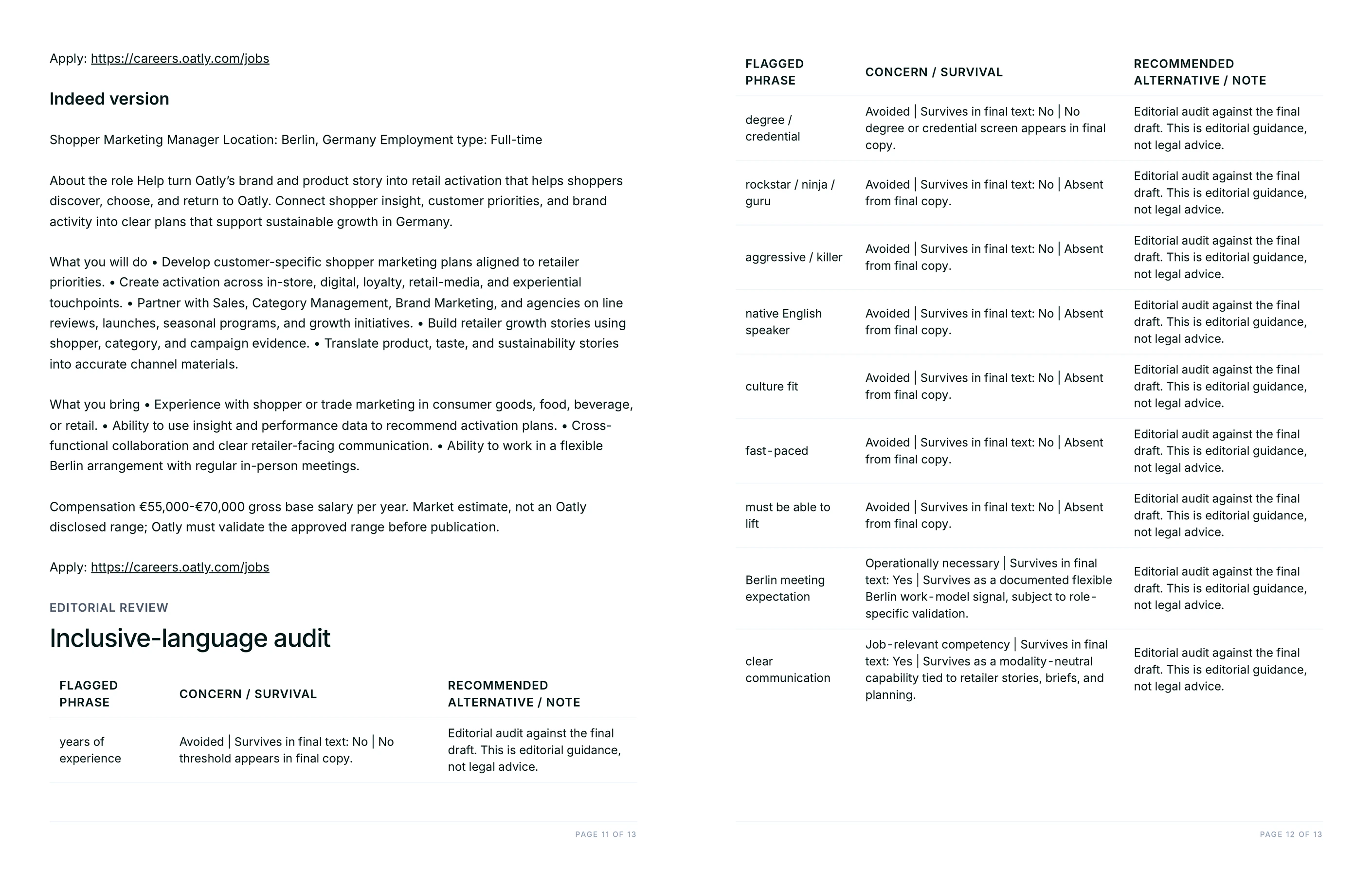
The audit then records the omission as a finding rather than a silence, so a reviewer can see that the screens were considered and left out on purpose. This is editorial guidance and not legal advice, and a named human still approves the posting before it goes live.
How long does this take compared with writing it by hand?
Researching a company's public positioning, drafting the posting, checking the local disclosure rule, hand-writing the structured data and reviewing the language for exclusionary phrasing is most of a day for a recruiter and a hiring manager between them, and the schema and the audit are usually the parts that get dropped when the role is urgent.
Running this returns the posting, the evidence map, the disclosure check, the schema, the screening questions and the board cuts in one working session. What it does not decide is the level, the range, which requirements the business genuinely needs, or whether the role should exist in this shape at all. Those are judgment calls with budget and headcount behind them. Juma augments the hiring team, it does not replace it, and no posting reaches a job board without a named person approving it.
The second role is cheaper again. The levelling framework, the bands and the cleared legal wording stay in the project, so the next posting starts from the company's own rules rather than from research.