Content Writing
Website
No items found.

Write your About Us page with AI: Section-by-section copy, press boilerplates & company schema

Name the client and their URL. Juma audits what every competitor's About page already claims, then writes the page to the angle nobody has taken, with three press boilerplates and a source-checked claims ledger.

Name the client and their URL, and Juma reads their site, newsroom, and founder or investor material to reconstruct the company's real story, then scrapes three to five competitor About pages to find the claims everyone in the category already makes. The page gets written to whatever angle is left open.

What comes back: section-by-section copy with a purpose and a target word count for every block, three press boilerplates at 25, 50 and 100 words, a meta title and description, Organization and AboutPage schema, and a claims ledger that tags every factual statement with its source and flags what the client still has to confirm. 400+ marketing teams use Juma to run work like this.

1

Write an About Us page for a software company

Thank you! Your submission has been received!
Oops! Something went wrong while submitting the form.
Try This Flow

Example Flow result

Hide details
  • Name the competitors you want audited. Juma picks the obvious three if nothing is specified. Naming the five companies the client actually loses pitches to makes the sameness table sharper and the open angle easier to defend in the review.
  • Say what changed at the company. A funding round, a new category, a merger, a pivot: the reason the old page stopped working is the reason the new story has a spine. Without it the copy defaults to a founding-year narrative.
  • Ask for the boilerplate lengths the comms team distributes. 25, 50 and 100 words cover directory listings, partner pages and press releases. If the client's comms team works to different counts, name them in the prompt.
  • Read the claims ledger before anything ships. Every factual statement comes back tagged with its source and a verified yes or no, plus a separate list of what the client has to confirm. That list is the fastest part of the review and the part that protects the page.
  • Add the founder interview notes to the project. The origin story, the almost-failed moment, the first customer: anything not on the open web is what stops the page reading like every other About page in the category.
  • Run it alongside the homepage copy Flow. The About page carries the company story and the entity facts. The homepage carries the product promise. Keeping both in one client project keeps the two consistent.
2

How do you find out what every competitor's About page already says?

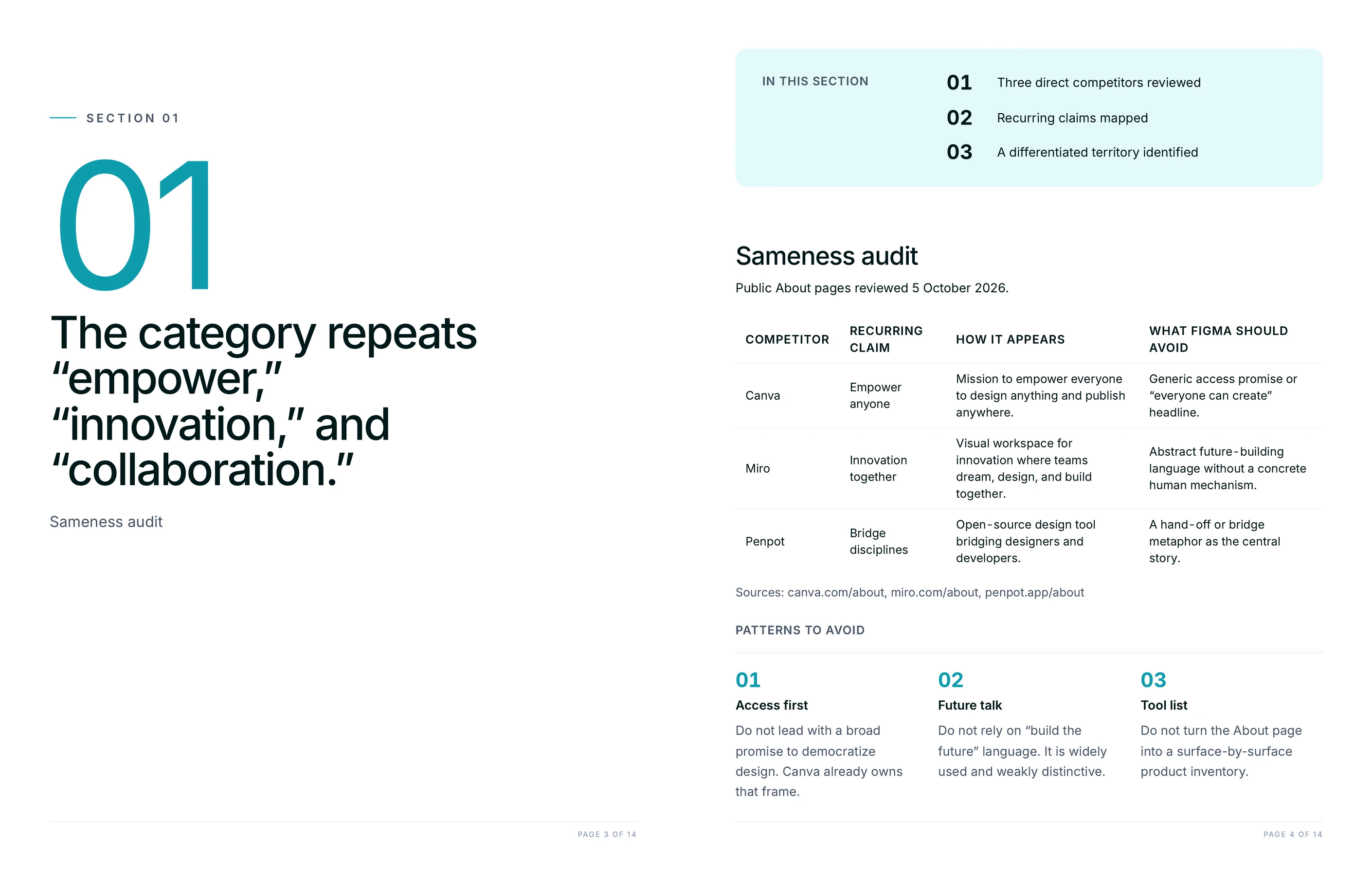
Before writing a word of the page, find out which claims the category has already used up. Juma scrapes the About pages of the client's closest competitors and returns a table of the claims that recur across them, with a note on what to avoid for each one. Most categories converge on the same four or five promises, so the table usually shows that the obvious angle is taken three times over. The last column is the useful one: the positioning territory nobody has occupied, which becomes the spine of the page.

Prompt
Copy

Scrape the About pages of our client's five closest competitors and give me a table of the claims that recur across all of them, with what to avoid for each. Then tell me which positioning angle is left open.

Try This Flow
3

How do you write a press boilerplate the comms team will reuse?

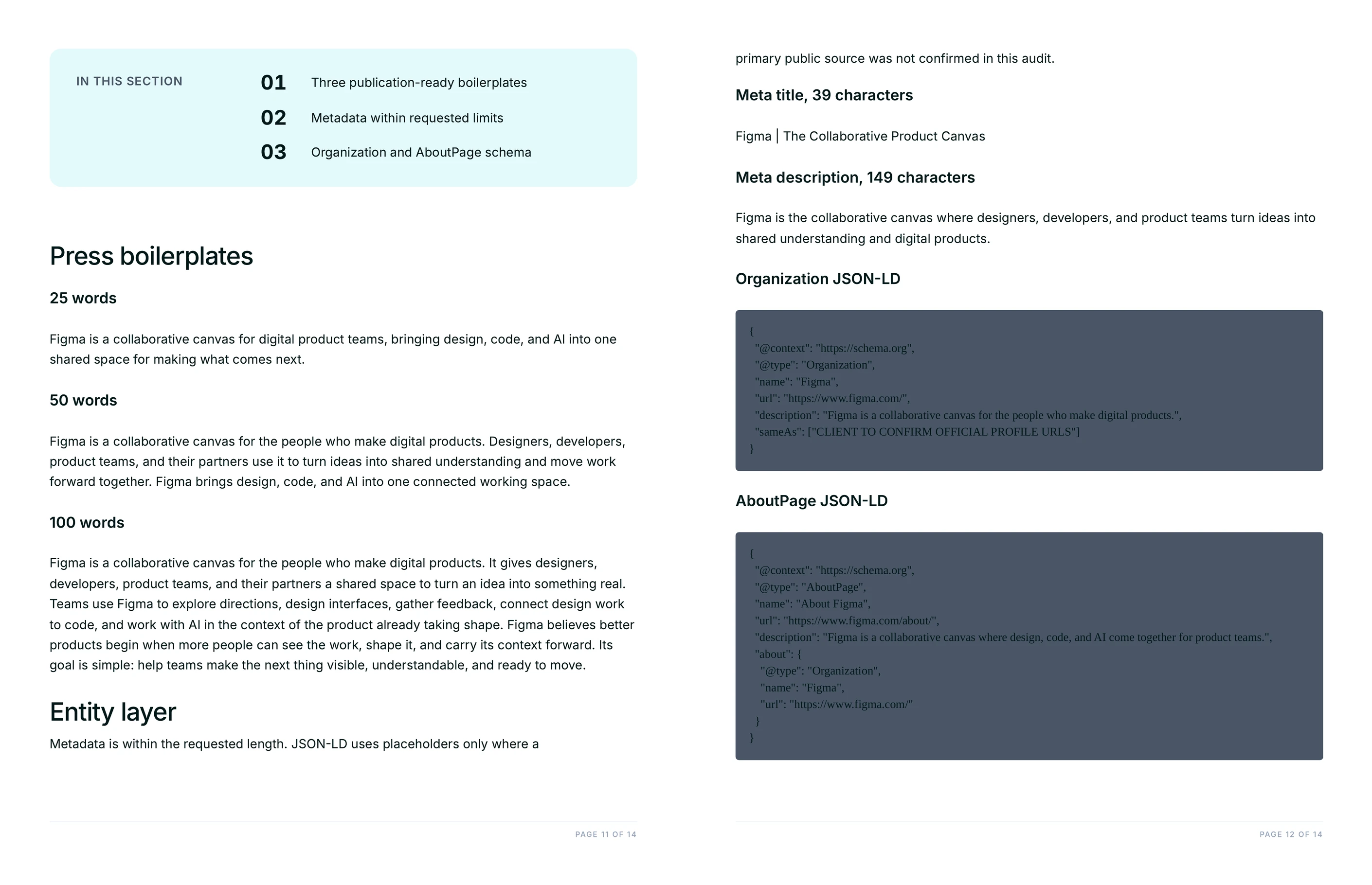
The boilerplate is the part of an About page that gets reused twenty times a year, in directory listings, partner pages, award submissions and the bottom of every press release. One length does not cover those uses, so the Flow writes three: 25 words for a listing, 50 for a partner page, 100 for a release. Each one stands on its own without edits, and each is built only from claims that appear in the ledger. Where a claim could not be verified, the boilerplate section says so and offers the version that drops it.

Prompt
Copy

Write three press boilerplates for the client at 25, 50 and 100 words. Each one has to work without edits in a directory listing, a partner page and a press release, using only claims from the ledger.

Try This Flow
4

What makes an About page quotable by AI search engines?

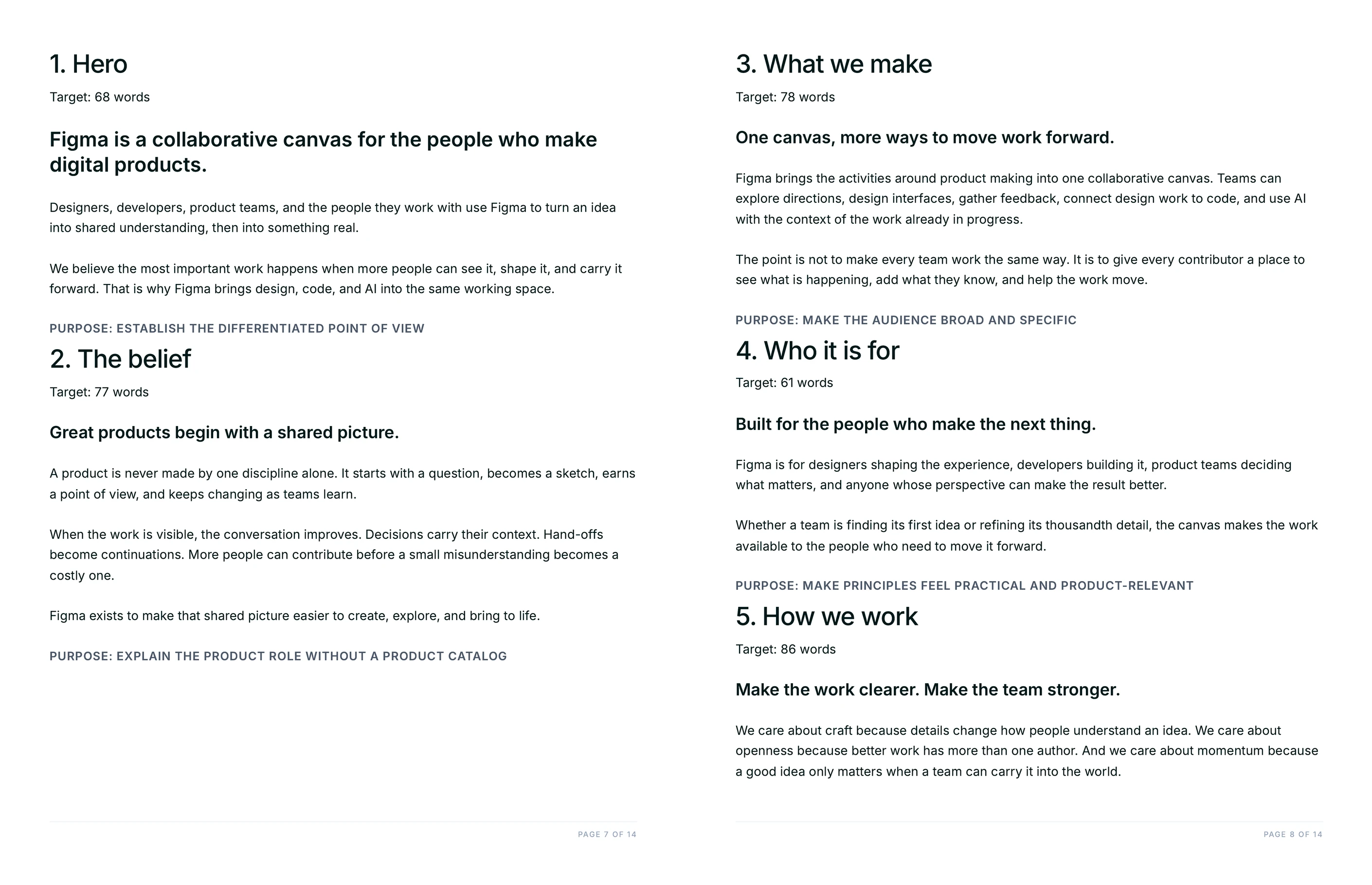
The About page is the page answer engines read when someone asks what a company does, and most of them open with a mission statement instead of a definition. That forces the engine to infer the category, and a guess is what gets quoted. The fix is a hard first sentence in the form "[Company] is a [category] for [audience]", short enough to lift whole. Alongside it the Flow produces the meta title and description, plus Organization and AboutPage JSON-LD with founding date, founders and profile links, so the structured data agrees with the prose.

Prompt
Copy

Rewrite the opening of the About page as a hard definition an answer engine can quote standalone, then give me the meta title, meta description, and the Organization and AboutPage JSON-LD to match.

Try This Flow
5

How do you check an About page's claims before it goes live?

About pages carry more factual risk than any other marketing page: headcount, founding year, headquarters, customer counts, funding, certifications. Each one dates, and a wrong number on the page that press and procurement both read is the expensive kind of mistake. The Flow returns a claims ledger listing every factual statement in the copy, the source it came from, and whether it checked out. Anything it could not verify goes on a separate confirmation list for the client, written as questions the account team can send in one email.

Prompt
Copy

Build a claims ledger for the About page copy: every factual claim, its source URL, and whether it is verified. List separately everything the client has to confirm before we publish.

Try This Flow

Set up your client project: brand voice, founder notes, and the company fact sheet

A Juma Project is a shared space where the team keeps everything Juma needs to know about a client. Create one project per client, add context as the relationship grows, and Juma uses whatever is relevant each time the team runs a Flow. For an About page the gain is direct: the open web gives Juma the company's public facts, and the project gives it the parts that were never published.

What to add

Brand Voice Guide

How the client sounds: tone, vocabulary, sentence rhythm, and the words they never use. An About page is the most voice-sensitive page on a site, so with this in the project the first draft comes back in the client's register instead of a house style that has to be rewritten.

Founder and Origin Notes

Interview notes, the real origin story, the decision that nearly went the other way, the first customer, why the company was named what it was named. This is the file that changes the output most. None of it is on the open web, and it is the difference between a founder story and a founding date.

Company Fact Sheet

Current headcount, headquarters, office locations, founding year, funding, certifications, and the customer numbers the client has approved for external use. With this in the project the claims ledger comes back mostly verified, and the confirmation list shrinks to the few things that genuinely need a client answer.

Guide Juma with project info

Each knowledge item takes a one-line description in project info. That line tells Juma what the file is for, so it reaches for the right one when the task calls for it.

  • Brand Voice Guide: "How the client writes and speaks. Follow it for all page copy, including the boilerplates."
  • Founder and Origin Notes: "Unpublished origin material. Use it for the founder story section and nowhere else without checking."
  • Company Fact Sheet: "Approved company facts and numbers. Treat anything here as verified, and flag anything missing."
Juma Logo
Write the About page nobody else could have written

Frequently Asked Questions

What does the About Us page Flow deliver?

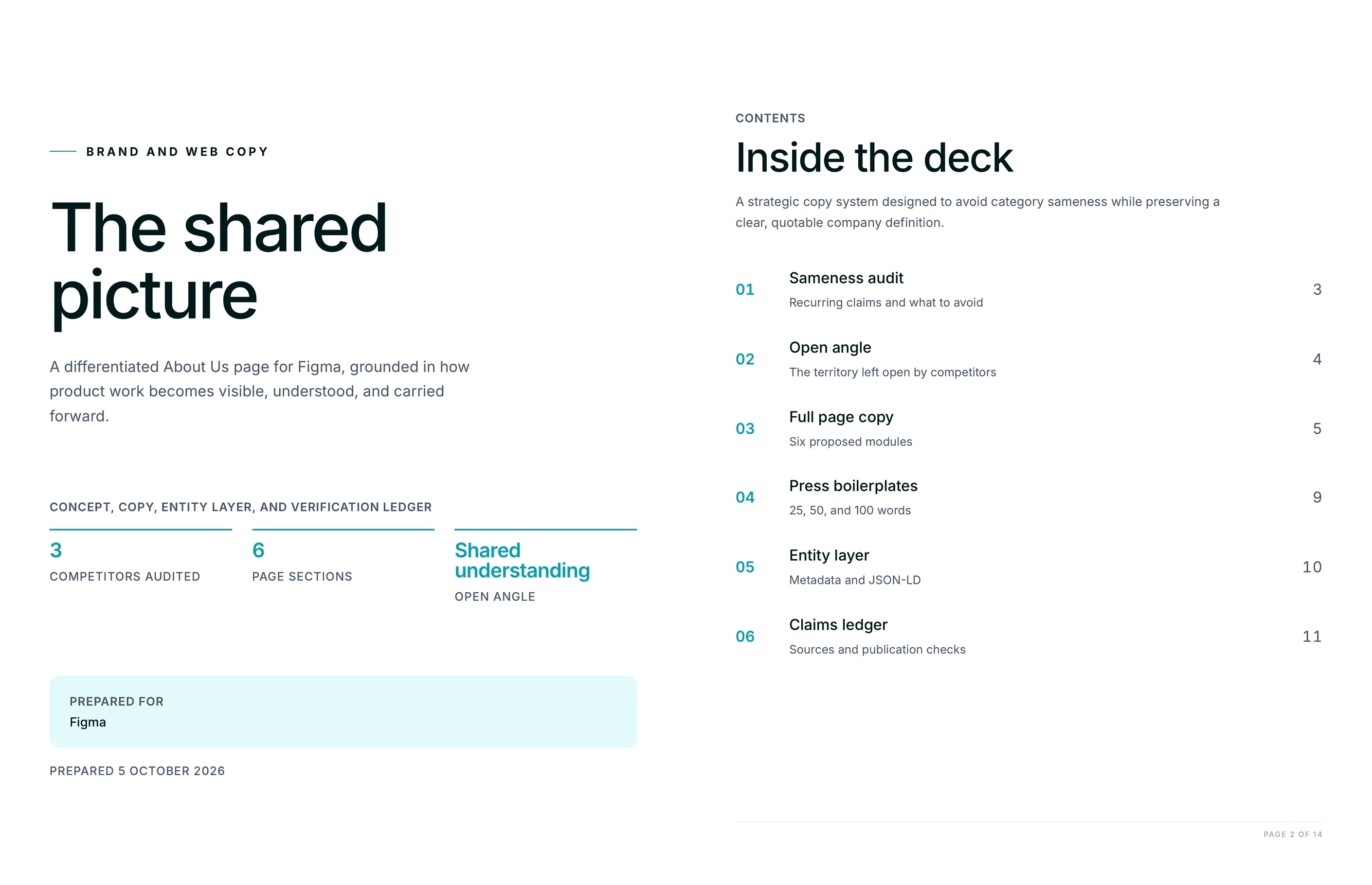
Two files. A branded PDF copy deck holding the competitor sameness audit, the chosen angle, section-by-section page copy, three press boilerplates, the entity layer and the claims ledger. Alongside it an editable CSV with one row per page section: section name, its purpose, the copy, and a target word count.

The split is deliberate. The deck is the document a stakeholder reviews and signs off. The CSV is what the person building the page actually pastes from, which saves the usual round of copying blocks out of a PDF and guessing how long each one was meant to be.

How does Juma know what competitors' About pages already say?

Juma scrapes them. Name the competitors, or let Juma identify the closest three to five from the client's own positioning, and it reads their live About pages and tables the claims that recur across them.

The output is a table of shared claims with the companies each one appeared on, and a short note on what to avoid for each. Categories converge harder than most teams expect: collaboration, accessibility and better outcomes tend to show up on nearly every page in a software category, which is exactly why a page that opens with one of them disappears.

How does the Flow avoid inventing facts about the company?

Every factual claim in the copy lands in a claims ledger with the source it came from and a verified yes or no. Anything Juma could not confirm is marked unverified and moved to a separate list of questions for the client, rather than being smoothed into the prose.

That matters most in the boilerplate, which travels furthest and gets the least scrutiny. Where a boilerplate leans on an unverified claim, the Flow says so and gives the version that drops it, so there is always a copy that can go out while the client checks the rest.

How is this different from writing the About page in-house?

The research is the difference. A writer briefed on an About page rarely has time to read five competitor pages, reconstruct the founder story from primary sources, and fact-check every number against a URL. The Flow does that part first, so the writing starts from evidence instead of a blank page.

What it does not do is decide what the company stands for. The Flow proposes an angle and shows the audit that led to it, and the team argues with it, reshapes it, or throws it out. Strategy, taste, and judgment stay human, and there is human review on every output before a page goes live.

Does this Flow work for consumer brands as well as B2B?

Yes. The structure holds across categories because the underlying job does not change: find out what the category already claims, build the story on verified facts, and give the comms team boilerplates and schema they can reuse. Only the sources shift.

For a consumer brand Juma leans more on the newsroom, product pages, sustainability or sourcing claims and press coverage, and less on investor material. The sameness audit tends to be more useful there, because consumer categories repeat their founding-purpose language even more tightly than software ones do.
Don't take our word for it

Ask AI about us

400+ marketing teams trust Juma. ChatGPT, Claude, and Perplexity know why. Ask them.

Ready when you are

What's on your plate today?

Start typing a task and Juma will figure out the rest.

Thank you! Your submission has been received!
Oops! Something went wrong while submitting the form.