Content Writing
Strategy & Planning
SEO
Web analysis
Web Icon
Web analysis
PDF
PDF Icon
PDF
Excel
Excel Icon
Excel
Web analysis
Web Icon
PDF
PDF Icon
Excel
Excel Icon

Write your website homepage copy with AI: Live-page audit, section-by-section rewrite & a build sheet

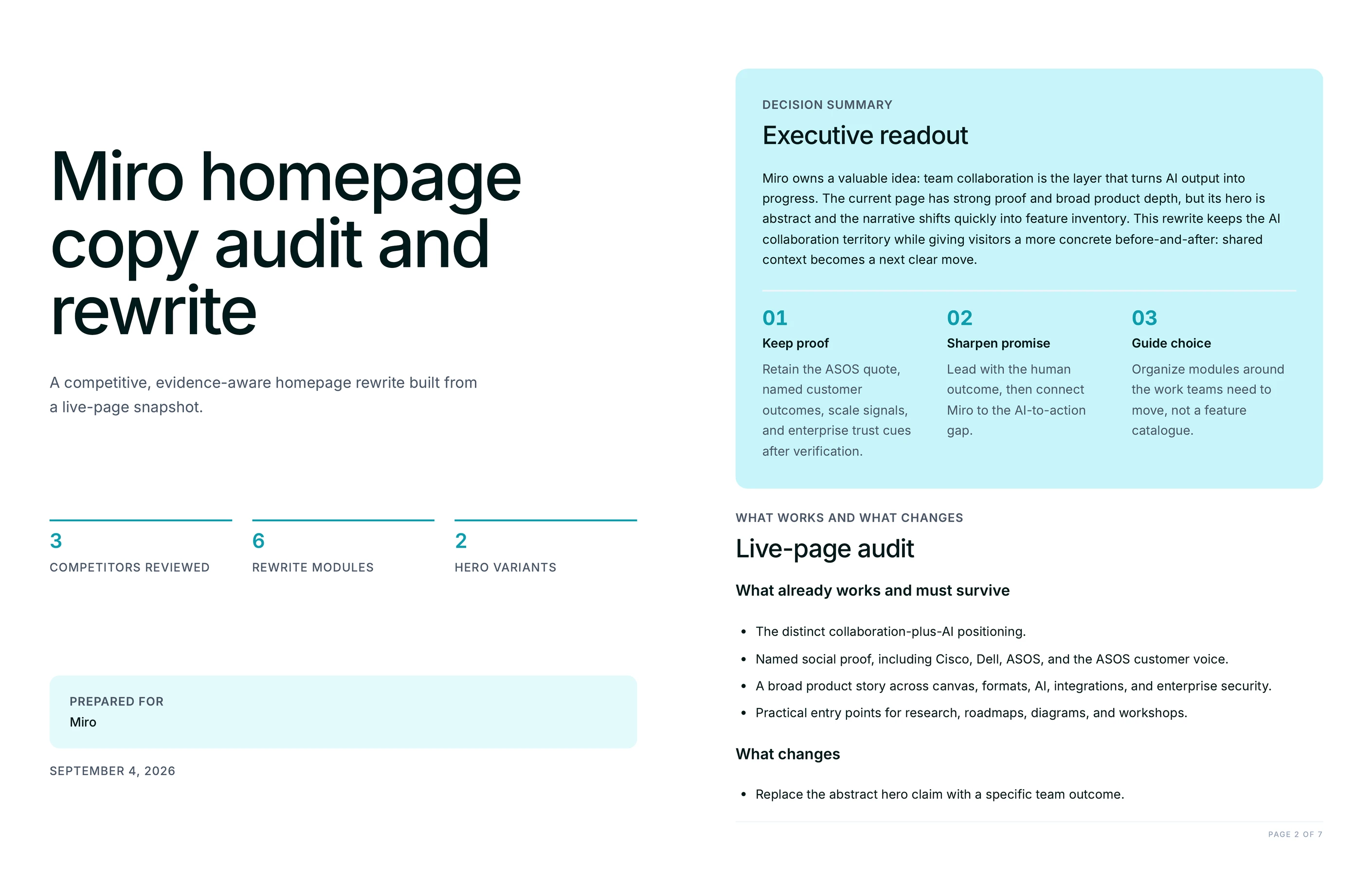
Name the client and their URL, and Juma audits the live homepage against three competitors, then returns every section rewritten with character counts, two hero variants to test, and the evidence each claim still needs.

Give Juma the client name and their homepage URL. The Flow reads the live page first, section by section, then reviews three competitor homepages to see which claims are already crowded and which ground is still open. Nothing is written from a blank page.

What comes back is a branded PDF with the audit and the full rewrite, plus an editable CSV build sheet: one row per page module, with the new copy, its character count against the slot budget, the live section it replaces, and the proof each claim still needs before it goes live. 400+ marketing teams use Juma, and the homepage is usually the page nobody wants to touch without evidence.

1

Rewrite a client homepage from the live page up

Thank you! Your submission has been received!
Oops! Something went wrong while submitting the form.
Try This Flow

Example Flow result

Hide details
  • Name who the page has to convert. "The buyer is a VP of Engineering evaluating three tools" produces a different hero than "developers." Without an audience the rewrite defaults to whoever the current page already speaks to.
  • Point at the competitors you actually lose to. The audit picks three comparable homepages on its own, but naming the two brands that come up in real deals is what keeps the new hero off ground someone else already owns.
  • Say what must not change. A tagline the founder is attached to, a CTA that legal signed off, a metric the board quotes. Anything named as fixed is preserved and the rewrite works around it.
  • Give the character budgets your design system uses. If the hero headline breaks past 55 characters in the current build, say so. Every copy field comes back with its count measured against the budget you set.
  • Add the brand voice guide to the project. With the voice guide and the messaging framework in Project Knowledge, the rewrite arrives already sounding like the client instead of needing a voice pass afterwards.
  • Run the hero test before rewriting the rest. The two hero variants ship with one success metric and a winner rule. Settling the headline first stops the rest of the page from being rebuilt around a hypothesis nobody checked.
2

How do you test two homepage headlines without guessing?

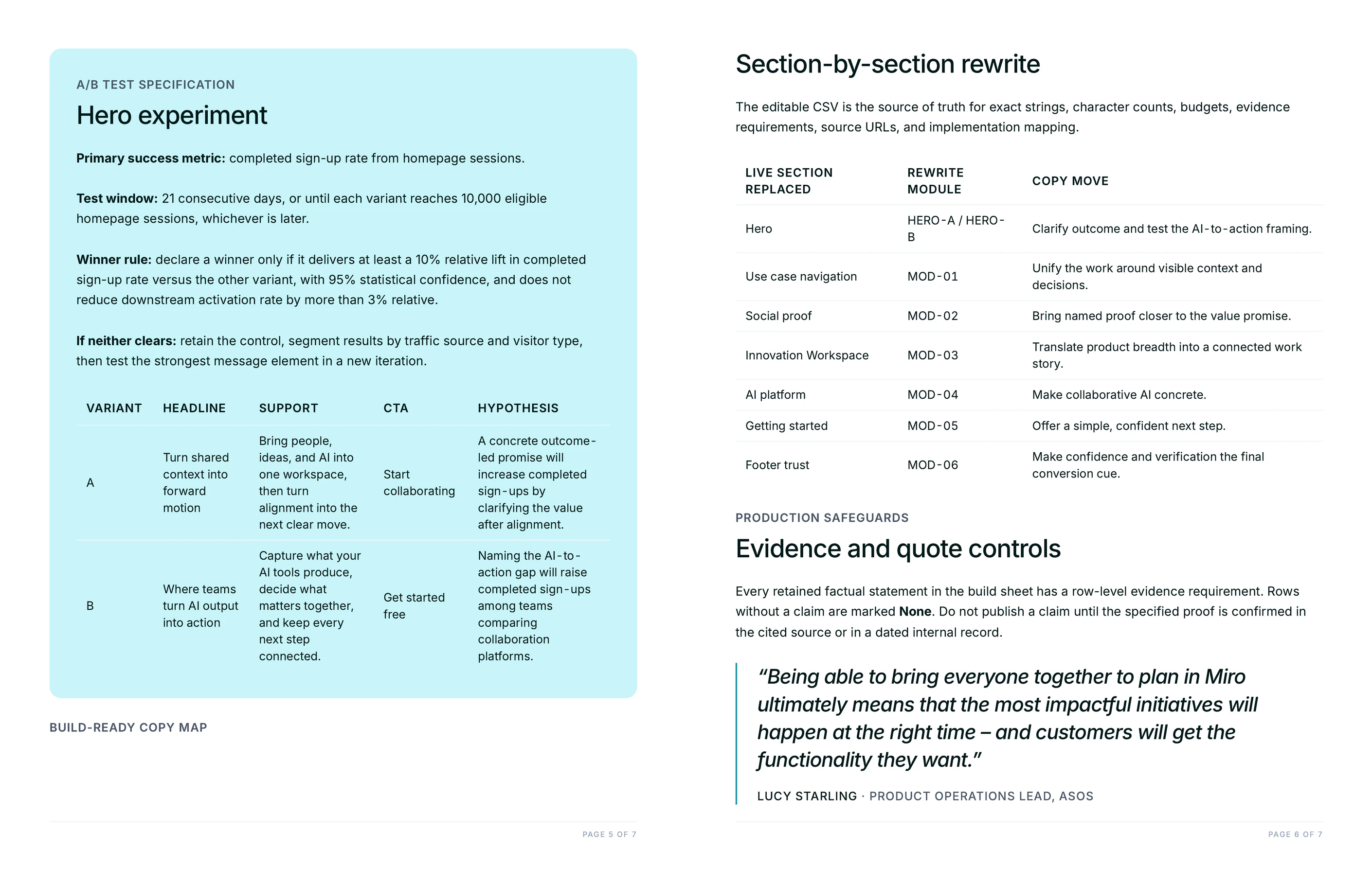
A homepage rewrite usually ships as one opinion. This step turns the hero into an experiment instead. The Flow writes two hero variants that make genuinely different arguments, not two phrasings of the same claim, and gives each one a written hypothesis about why it should win. Alongside them comes a single primary success metric, a test window, the threshold each variant has to clear, and an explicit rule for what to do when neither clears it. That last part matters: a test that returns a small unclear difference is a result, and calling it a winner anyway is how homepages get rebuilt on noise.

Prompt
Copy

Write the hero test properly: two variants that argue different things, a one-line hypothesis each, one primary metric, the test window, the threshold each has to clear, and what we do if neither clears it.

Try This Flow
3

Which homepage claims need proof before they go live?

Homepage copy is where unverified claims quietly become public. A customer count copied from a two-year-old deck, a percentage nobody can source, a testimonial that was tidied up until it stopped being a quote. This step walks every claim in the rewrite and names the specific proof each one needs and where to verify it, so the list arrives sorted into what is already evidenced, what needs a source, and what should be cut. Quotes are held to a harder line: verbatim, customer named, source URL, or the row says no public quote was found rather than filling the space.

Prompt
Copy

Go claim by claim through the rewrite. For each one, name the exact proof it needs and where to verify it, and sort them into evidenced, needs a source, and cut. Flag any quote that is not verbatim with a named customer and a source URL.

Try This Flow
4

How do you write a homepage that AI answer engines can quote?

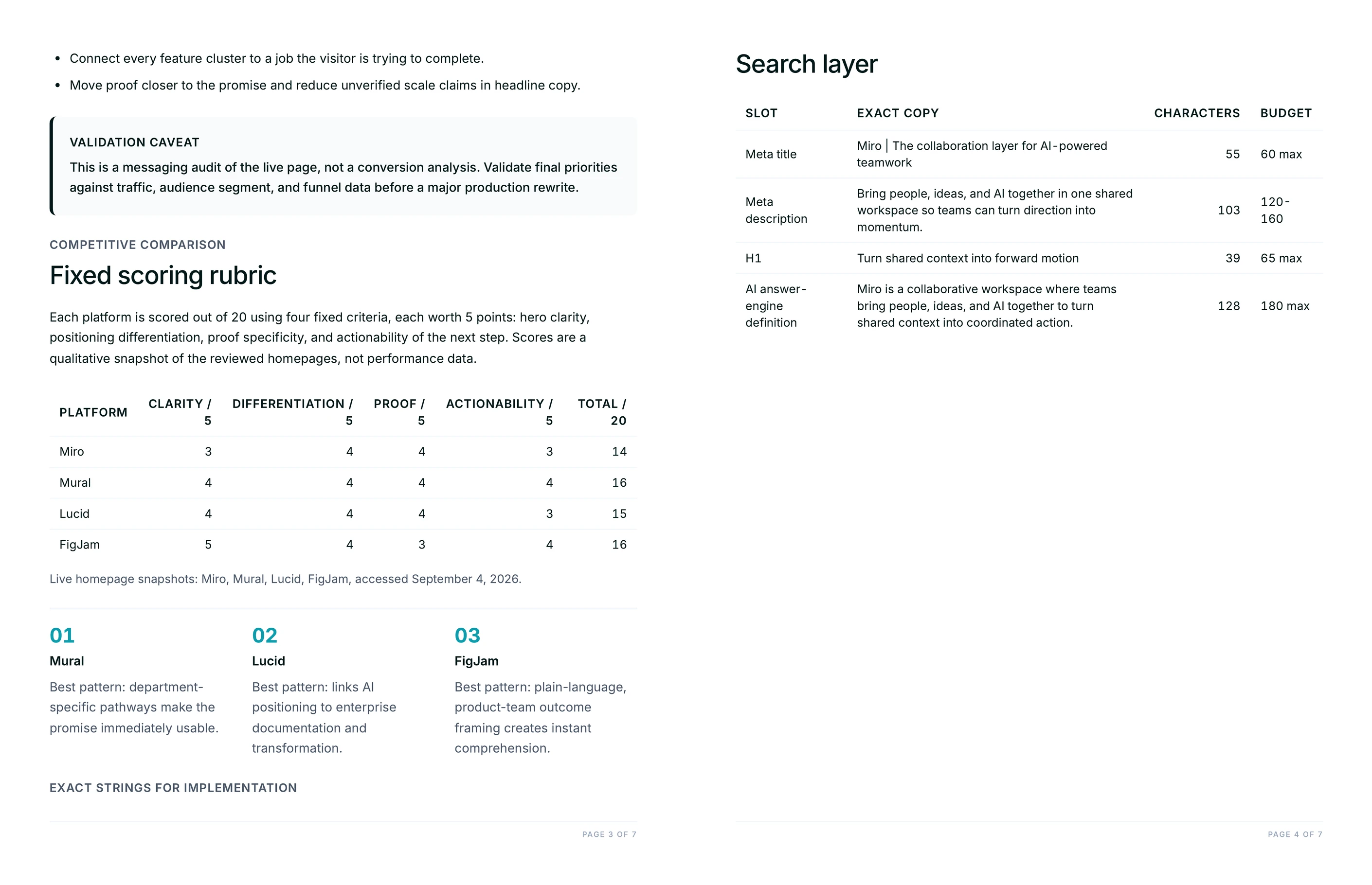
People increasingly meet a company through an AI answer before they ever reach the homepage, and an answer engine can only quote a page that states plainly what the company does and who it is for. This step adds the search layer to the rewrite: the meta title, the meta description, the H1 exactly as it will render, and a one-sentence definition of the company written to survive being lifted out of context. It also flags the sections where the current page describes a category rather than the company, which is the wording that makes a homepage unquotable.

Prompt
Copy

Add the search layer: meta title, meta description, the H1 as it will render, and a one-sentence definition of the company an AI answer engine could quote. Flag any section that describes the category instead of the company.

Try This Flow
5

How do you carry the new message through the rest of the site?

A rewritten homepage that leads somewhere unchanged creates a mismatch a visitor feels immediately: a promise in the hero, then a product page still making last year's argument. This step extends the approved homepage message to the pages the homepage sends people to, usually the product page, the pricing page, and the top-level navigation labels. Each page comes back with the same build sheet structure, plus a note on which existing copy already agrees with the new message and can stay. The result is one argument told consistently, rather than a strong homepage bolted onto a site that contradicts it.

Prompt
Copy

Now carry the approved homepage message into the product page, the pricing page, and the top-level nav labels. Same build sheet per page, and mark the existing copy that already agrees with the new message and should stay.

Try This Flow

Set up your client project: brand voice, messaging framework, proof library

Keep one Project per client. The homepage rewrite reads the live site every time, so it works with an empty project, but the parts a website cannot tell you are the parts worth storing: how the client sounds, which claims they are allowed to make, and which quotes have been cleared. Add those once and every rewrite after the first starts closer to finished.

What to add

Brand voice guide

How the client sounds: tone, the words they use, the words they refuse. With this in the project, the rewrite comes back in the client's voice instead of a neutral one that then needs a voice pass.

Messaging framework or positioning doc

The value propositions, the audience segments, and the competitive claims the client has already agreed. The rewrite builds on these rather than proposing a new position the client never signed off.

Approved proof library

Cleared customer quotes with their sources, current metrics, case study numbers, and logo permissions. This is what turns the evidence column from a list of open questions into a list of things you can publish today.

Guide Juma with project info

Each knowledge item takes a one-line description telling Juma what it is for. These are the descriptions that keep a rewrite from reaching for the wrong file.

  • Brand voice guide: "How this client sounds. Match this tone in every line of copy."
  • Messaging framework: "The agreed positioning and value propositions. Build on these, do not replace them."
  • Approved proof library: "Cleared claims, metrics, and verbatim customer quotes with sources. Only use proof from this file."
Juma Logo
Rewrite the homepage, with the evidence attached

Frequently Asked Questions

What does the homepage copy rewrite include?

Two files. A branded PDF holding the live-page audit, the competitor comparison, and the full section-by-section rewrite, and an editable CSV build sheet with one row per page module: the new copy, its character count against the slot budget, the live section it replaces, the CTA, and the proof each claim still needs.

The rewrite covers the whole page, not just the hero: the opening promise, the proof strip, the workflow or product sections, the use cases, the enterprise or objection-handling block, the closing call to action, and the footer paths. Two hero variants come with it, each with a hypothesis, one success metric, and a winner rule.

What does Juma need before it can rewrite a homepage?

The client name and their homepage URL, and nothing else. That is enough for a complete first pass, because the Flow reads the live page section by section and reviews three competitor homepages before writing a single line. No files to upload, no exports, no access to the CMS or the analytics.

Naming the audience the page has to convert, the competitors you actually lose deals to, and anything that must not change will sharpen the result. So will a brand voice guide and an approved proof library in Project Knowledge, which is what lets the rewrite use cleared quotes instead of flagging them as open questions.

How is this different from asking a chatbot to write homepage copy?

A chatbot writes from a blank page and a general idea of what homepages sound like. This Flow reads the client's live homepage section by section first, compares it against three competitor homepages, and names what already works and must survive the rewrite before proposing a single new line.

The difference shows in the parts nobody enjoys: character counts measured against real slot budgets, a mapping from every new module to the live section it replaces, and an evidence column that names the proof each claim needs and where to verify it. Generic copy is easy to generate. Copy someone can actually build and publish is the harder half.

Can we keep our own brand voice and messaging framework?

Yes. Add the brand voice guide and the messaging framework to the client's Project, and the rewrite builds on the positioning the client has already agreed rather than proposing a new one. Anything named as fixed, a tagline, a CTA, a metric, is preserved and the rest is written around it.

Teams working across several clients keep one Project per client, so each rewrite draws on that client's voice, proof, and competitive set without re-briefing. Unlimited seats on every plan means the whole team can work in the same Projects.

How does this compare to hiring a copywriter?

It covers the mechanical half of the job: reading the live page, comparing the competitive set, drafting every section against a character budget, and listing the claims that need proof. That is usually the part that takes a week of calendar time before anyone gets to the interesting decisions.

What it does not do is decide what the company should stand for. Strategy, taste, and judgment stay human, and every claim in the build sheet is written to be checked by someone before it ships. Juma augments the team, it does not replace it.

Don't take our word for it

Ask AI about us

400+ marketing teams trust Juma. ChatGPT, Claude, and Perplexity know why. Ask them.

Ready when you are

What's on your plate today?

Start typing a task and Juma will figure out the rest.

Thank you! Your submission has been received!
Oops! Something went wrong while submitting the form.