Set up your client project: positioning, the competitor set, and the proof library
A Juma Project is a shared space where the team keeps everything Juma needs to know about a client. Create one project per client, add context as it arrives, and every flow the team runs draws on what is relevant. Pitch work benefits more than most: the audit gets sharper every time the competitor set or the proof library grows.
What to add
Current Positioning or Messaging Framework
Whatever the client says about themselves today: the messaging framework, the pitch deck narrative, the homepage copy. This is the input the audit works on. Without it Juma builds the candidate claims from the public site alone, which is usually thinner than what the team has already agreed internally.
Competitor Set
The names the client actually loses deals to, which are often not the obvious market leaders. Add the list with a line on each about where they compete. This changes the audit more than any other file, because a claim is only undifferentiated relative to the set it is checked against.
Proof Library
Case studies, research, analyst mentions, customer quotes, and any numbers the client is cleared to say out loud. Juma labels each proof point by type, so the more the library holds, the fewer claims come back flagged as having nothing behind them.
Objection Log
What buyers push back on, in their words, from call notes or the sales team's own list. Real objections produce better turns than inferred ones, and they tell the audit which claims are already being challenged in the market.
Guide Juma with project info
Add a short description to each knowledge item in the project's info field so Juma knows what the file holds and when to reach for it. For example:
- Current Positioning: "Messaging framework agreed Q2 2026. Use as the source of candidate claims for the audit."
- Competitor Set: "The five accounts we lose deals to. Check every claim against these, not against the category leaders."
- Proof Library: "Cleared numbers and case studies. Only cite from here; label each one by evidence type."
- Objection Log: "Pushback from discovery calls, verbatim. Use for the objection turns."
Find out which lines in your pitch everyone else is already saying
Frequently Asked Questions
What makes an elevator pitch defensible?
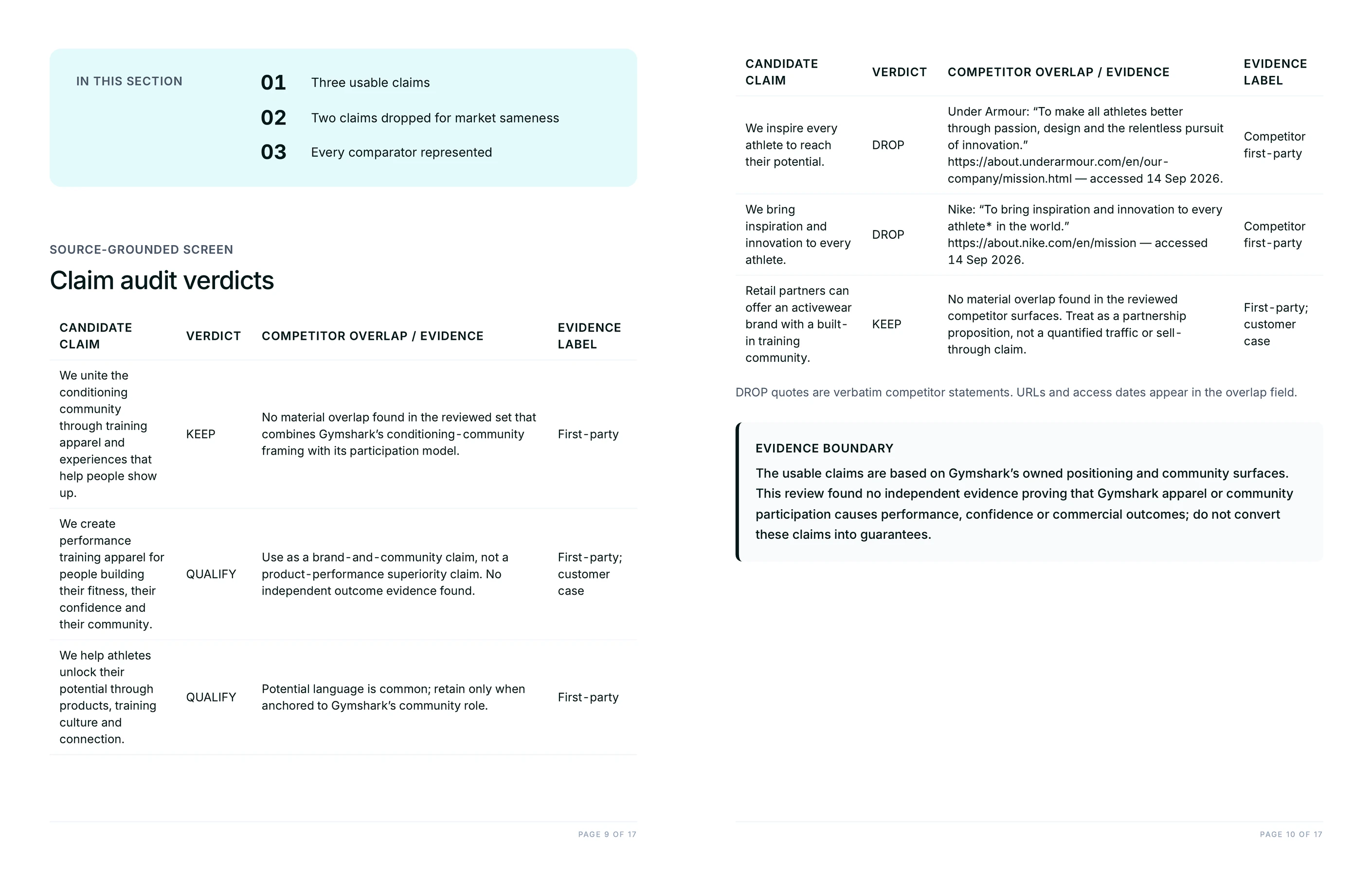
A defensible pitch is one where every line either says something the competition does not already say, or is supported by evidence the client can show. This flow tests both: each candidate claim is checked against competitor language, and each proof point is labelled by evidence type, so the weak lines are visible before anyone says them in a room.
The failure mode is not a bad sentence, it is a true sentence that carries no information. "The collaborative design platform" is accurate about several products at once, which makes it useless as a pitch even though nobody could call it a lie. The audit separates those two problems. A claim marked drop is not wrong, it is unowned, and the report says so in that language so the client understands they are losing a line to the category rather than to a factual error.
What the flow will not do is decide which of the surviving claims should lead. That is a judgment about the client's ambition and the room they are walking into. Juma augments the team here, it does not replace it.
How long should an elevator pitch be?
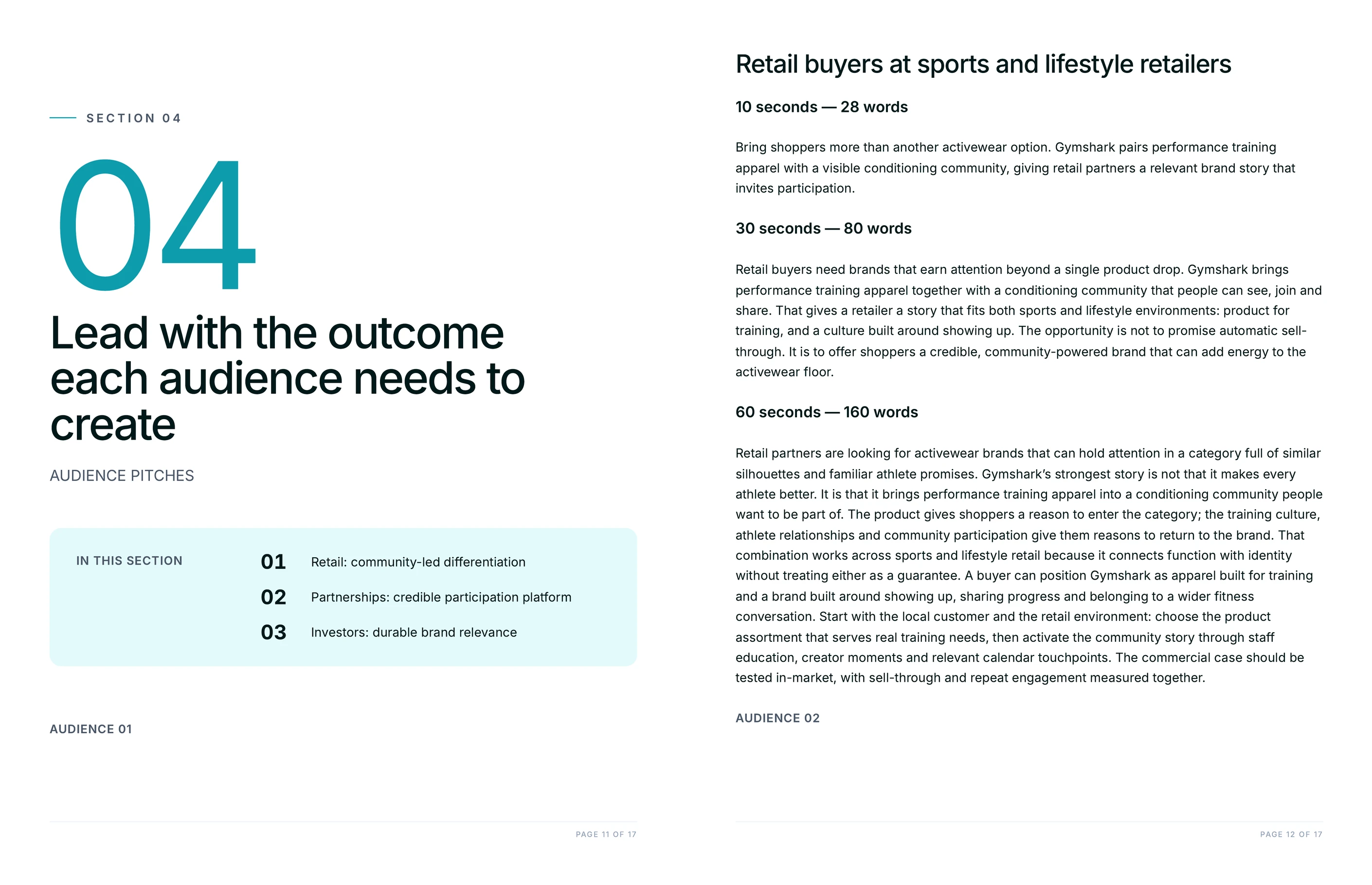
Write three lengths, not one: roughly 25 to 30 words for a 10 second opener, 75 to 90 for 30 seconds, and 150 to 180 for a full minute. Speaking pace sits near 150 words per minute, so a word budget is a far more reliable constraint than a stopwatch when the pitch is being drafted.
The three lengths do different jobs. The 10 second version earns the right to keep talking and should carry exactly one idea. The 30 second version makes the case and is the one most people actually use. The 60 second version is for when the room invites detail, and it is the only place where a second proof point belongs. Asking for all three in one run keeps them consistent, which matters more than it sounds: when the short and long versions are written separately they tend to drift onto different claims, and a buyer who hears both notices.
Which competitors should the pitch be checked against?
Check against the companies the client loses deals to, which are frequently not the category leaders. Four to six is the working range. Fewer than four and the audit calls too many claims distinctive; more than six and almost every line looks undifferentiated, because at some point somebody in a wide set says everything.
Juma picks a reasonable set from public research when the team does not supply one, and states why each name is in it, so the assumption is visible and easy to correct. Adding the real set to the project is the higher-value move. It also helps to name the surfaces worth reading: homepage language is the most generic copy a company owns, so a set checked on homepages alone will overstate how much sameness there is. Pointing the flow at product and pricing pages as well produces sharper verdicts.
Can the flow write a pitch when the client has no case studies or research?
Yes, and it will say so rather than paper over it. Claims with nothing behind them are flagged, then rewritten to stand on something observable about the product instead of an unsupported outcome number. The report ends with the evidence worth gathering next, in priority order.
This matters most in front of technical and finance buyers, who tend to check. A pitch that says "teams ship faster" with no source invites the question the client cannot answer; a pitch that describes what the product does differently, plainly, survives it. Where third-party evidence does exist, the flow labels it by type rather than treating all proof as equal, because a vendor-commissioned study and an independent one land very differently in a CFO conversation. The labels travel into the claim log, so the team can see at a glance which parts of the story rest on the client's own word.
How is this different from a brand messaging framework?
A messaging framework is the written architecture: pillars, proof, boilerplate, the document the team writes from. This flow produces the spoken layer that sits on top of it, tested for sameness and timed for delivery. Teams that have a framework already should feed it in as the source of candidate claims.
The two work in sequence. Build the framework first if the client has never agreed one, then run this flow to find out which parts of it can survive being said out loud to someone who has already heard three competitors that week. Teams that skip the framework can still run this flow standalone, since Juma builds the candidate claims from the client's public positioning, but the audit is sharper when it has the internal version to work from rather than the website alone.