Set up your client project: founder notes, live copy, voice and claim constraints
Juma projects work per client rather than per task. The team builds one project for each client, adds context to it over time, and every Flow run inside it starts from that shared ground. For a brand story the context that changes the output most is the material the open web does not carry: what the founders actually said, what the client is allowed to claim, and what their pages say today. If the project already exists, these are additions to it rather than a fresh setup.
What to add
Founder and Origin Notes
Interview transcripts, the real origin, the decision that nearly went the other way, the first customer. With this in the project the narrative spine comes from the room rather than from the press release, and the gap list shrinks to what is genuinely still open.
Claims and Legal Constraints
The claims already approved, the markets the client publishes in, and who signs off on what. This is what turns the ledger from a general risk template into the specific review their counsel asked for.
Live Copy Inventory
The current About page, boilerplate, careers copy and sales deck narrative. The contradiction check compares the new story against these, so collisions read as a concrete update list rather than a guess about what is out there.
Brand Voice Guide
How the client sounds, the words they use and the ones they avoid. Every channel cut comes out in the right register from the first draft, which matters most on the founder post, where a wrong register reads as ghostwritten.
Guide Juma with project info
Each file in a project can carry a short description in the project info field. Those descriptions tell Juma what a file holds and when it matters, so the right context gets picked up for the task at hand rather than everything at once.
- Founder and Origin Notes: "Interview notes and the real origin. Use for the narrative spine and to close gaps in the timeline."
- Claims and Legal Constraints: "Approved claims, our markets, and who signs off. Use for every row of the claims ledger."
- Live Copy Inventory: "What our pages say today. Compare the new story against this for the contradiction check."
- Brand Voice Guide: "How we sound and what we avoid. Apply to every channel cut."
Write a brand story you can source line by line
Frequently Asked Questions
What can this build without a founder interview?
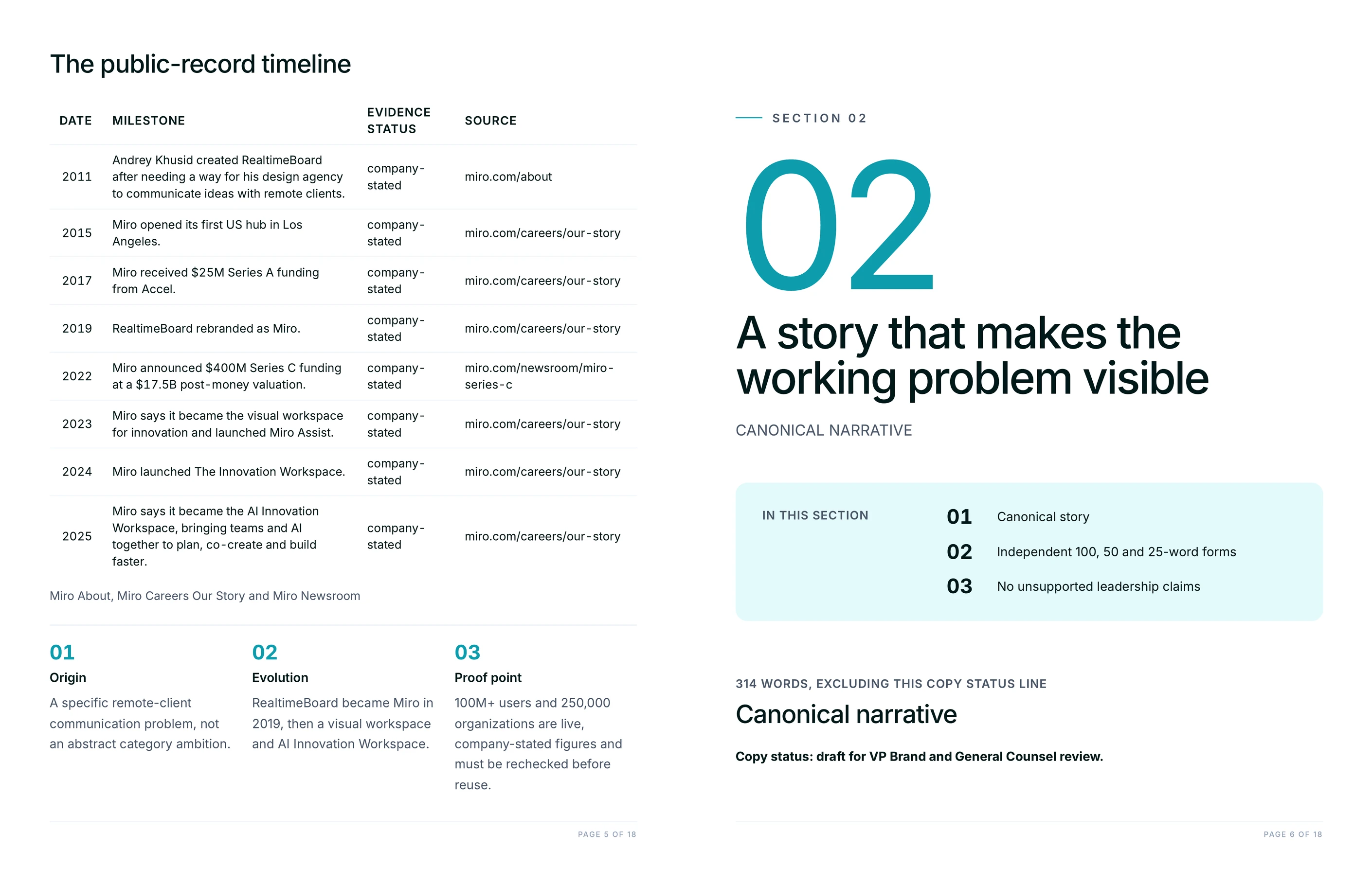
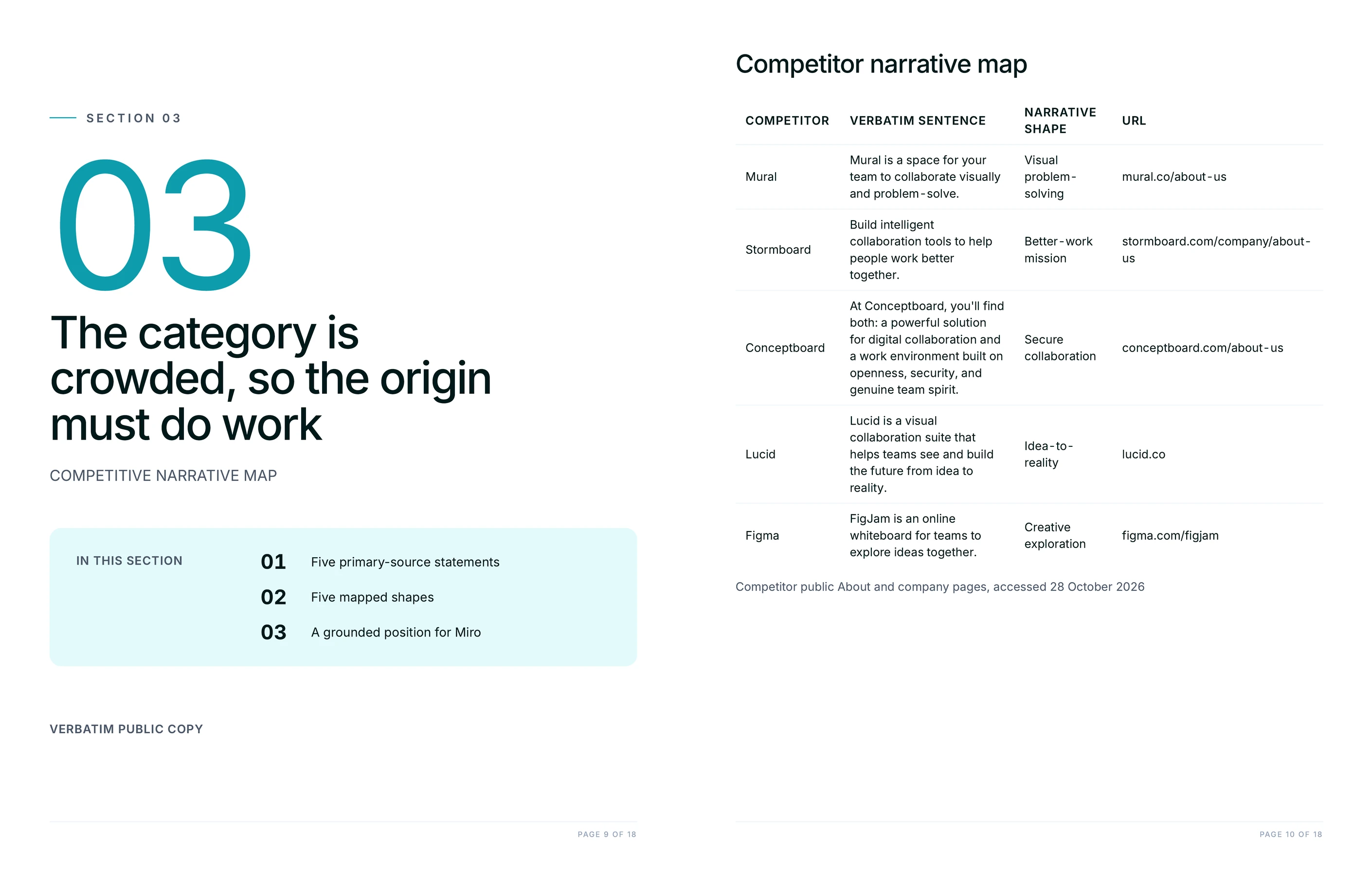
It builds the whole defensible layer: a sourced timeline from the client's own pages, newsroom and filings, the category narrative map with competitors quoted verbatim, the canonical narrative and every channel cut, and the full claims ledger. What it will not do is invent the human parts the record does not carry.
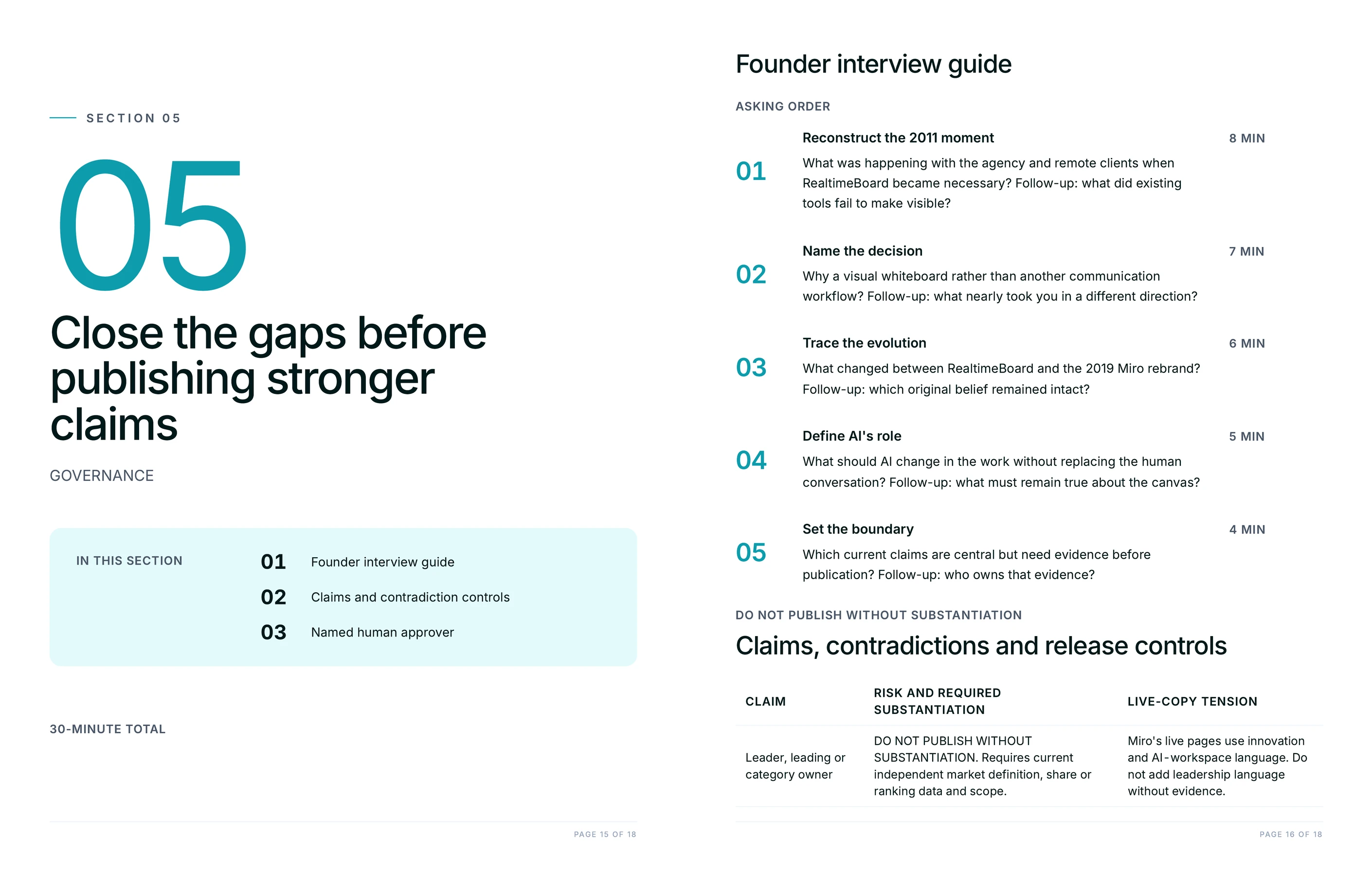
Those parts come back as an ordered interview guide instead, each question tied to the specific blank it fills. That is a deliberate boundary. The quickest way to get a brand story rejected by the people who lived it is to hand them a paragraph about a motivation they never had, and a plausible invention is harder to spot than an obvious one.
Teams usually run it twice for this reason: once to find out what is missing and book the conversation, then again with the notes in the project.
What does the claims ledger include?
One row per claim in an editable CSV: the exact wording, the source behind it, a status of company-stated, filing-stated or third-party corroborated, the risk type, the jurisdiction, a named approver role and a review-by date. It opens in any spreadsheet and goes straight to whoever signs the copy off.
The risk types stay separate rather than collapsing into one column, because a weak citation, an unproven category first and an environmental claim need three different fixes. Superlatives come back marked as unpublishable until somebody produces the substantiation, with a note on what that substantiation would have to be.
The review-by date matters more than it sounds. A claim that was true at the last funding round can quietly stop being true, and the ledger is what makes that visible on the next run.
How is this different from writing an About Us page?
An About page is one destination. This Flow produces the narrative itself and then cuts it for everywhere the story gets told out loud: the About page, a founder post, the pitch-deck arc, a 60-second sales intro, the careers page and the press boilerplate, each written to its own constraint.
The other difference is what sits underneath. A page gets written once and published. A story bible carries the spine, the evidence, the gaps and the ledger, so the next person who needs to tell the story in a new format starts from the same source of truth instead of paraphrasing the website again.
Does this work for a B2B brand with no consumer story?
Yes. The method starts from whatever public record exists rather than from a consumer-brand template, so it works the same on a B2B software company, a services firm or an industrial supplier. The sources shift toward filings, funding announcements, conference talks and customer case studies, and the channel cuts shift with them.
For a B2B brand the pitch-deck arc and the sales intro usually carry more weight than the About page, because the story gets told in a room far more often than it gets read on a site. The category narrative map tends to be sharper too, since B2B about pages cluster around a very small number of shapes.
How long does this take compared with a brand narrative workshop?
A narrative workshop plus the write-up is usually two to three weeks of elapsed time, most of it spent gathering material and chasing sources. Running this Flow gets the evidence base, the category map, the narrative, the cuts and the ledger back in one working session, with the time that remains going into the interview and the judgment calls.
Those calls are the part that stays with the team. Which tension the brand is willing to tell in public, how much of the founder's version survives contact with the facts, and whether a claim is worth defending are decisions a person makes. Strategy, taste and judgment stay human, and nothing in the bible reaches a release without a named person signing it.
The workshop does not disappear either. It gets shorter and much better, because everyone walks in with the record already assembled instead of spending the first half of the day arguing about what happened in which year.