Content Planning
Strategy & Planning
SEO
Web analysis
Web Icon
Web analysis
PDF
PDF Icon
PDF
Excel
Excel Icon
Excel
Web analysis
Web Icon
PDF
PDF Icon
Excel
Excel Icon

Build an e-commerce content strategy with AI: Collection gap audit, 90-day calendar & internal link plan

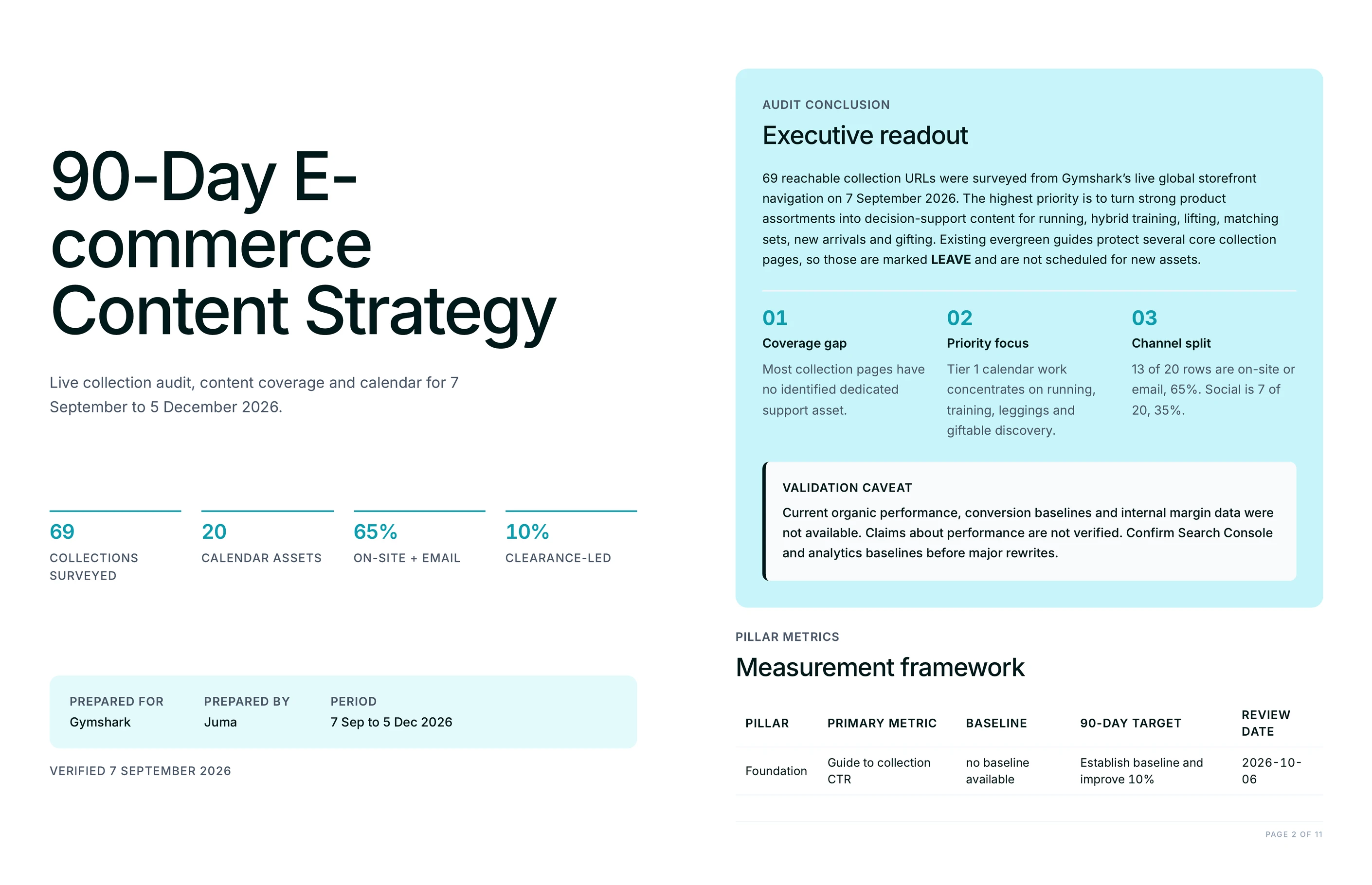
Name the client and their store URL, and Juma audits which collections already have supporting content and which have none, then returns a 90-day e-commerce content strategy with an editable calendar mapped to real collection URLs.

Give Juma the client name and their store URL. The Flow reads the live catalog first, collection by collection, then checks what supporting content already exists against each one and marks it create, refresh or leave alone. A guide that is already published gets improved rather than commissioned twice.

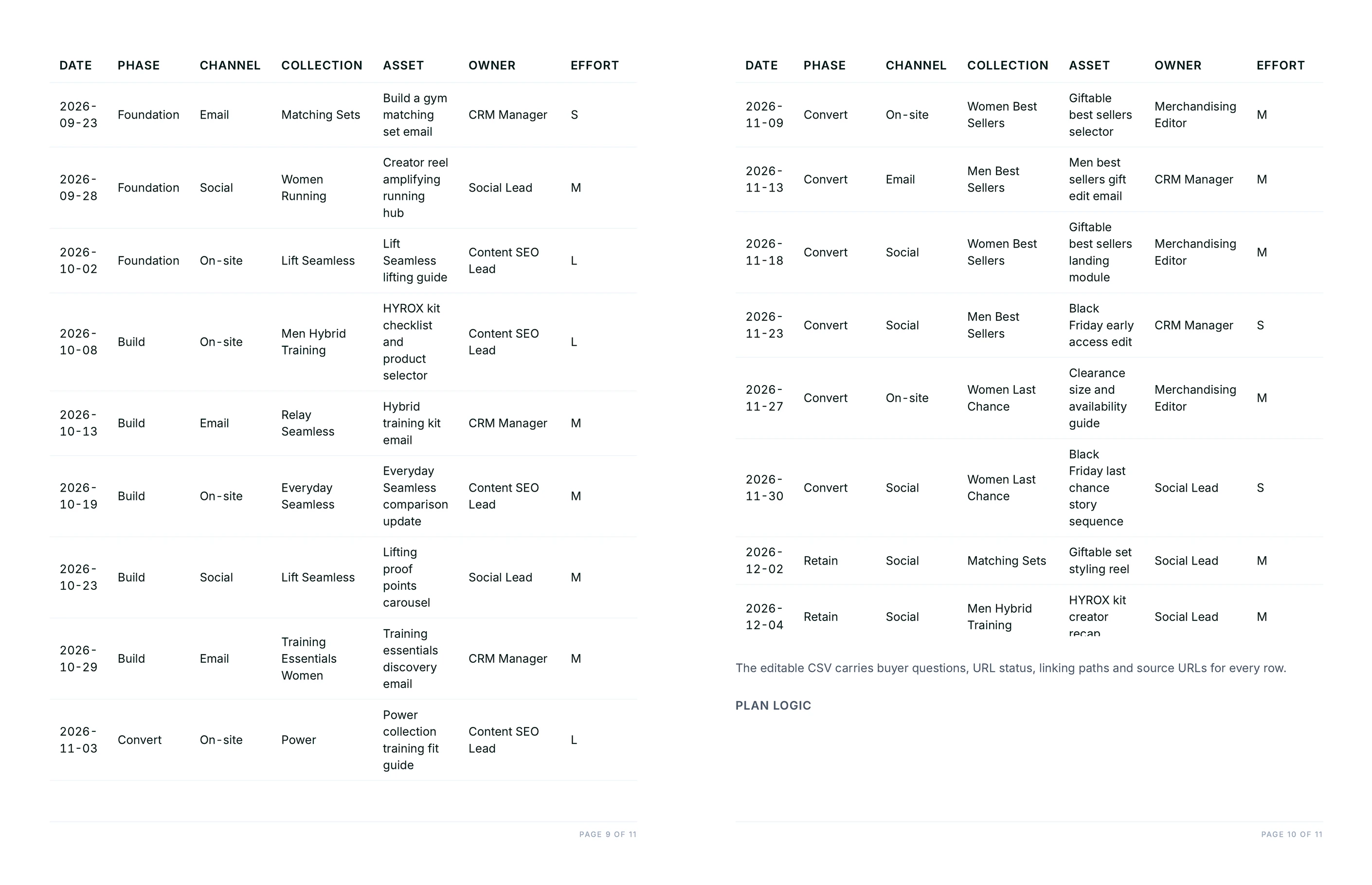
What comes back is a branded PDF strategy plus an editable CSV calendar: one row per planned asset, carrying the buyer question it answers, the collection URL it sends people to, the pages it should link to and be linked from, the owner, the effort, and the metric it moves. 400+ marketing teams use Juma, and the pattern this Flow keeps surfacing is the same one: the collections carrying the most revenue are often the ones nobody has written anything about.

1

Build a 90-day content strategy for an online store

Thank you! Your submission has been received!
Oops! Something went wrong while submitting the form.
Try This Flow

Example Flow result

Hide details
  • Name the collections that carry the revenue. The audit covers the catalog it can reach, but naming the five collections the client actually trades on decides where the calendar spends its weight. Without that steer, effort spreads evenly across collections that do not earn it.
  • Say which surfaces the client owns. Buying guides, collection page copy and email behave differently from social. Give the split you want and the calendar is built to it, instead of drifting into a social plan that rents its audience.
  • Give the trading dates that matter. Peak weeks, promotional windows and shipping cutoffs move the whole plan. Named dates get the phases aligned to them, and the clearance-led pieces capped so the calendar does not turn into a discount channel.
  • Point at the existing blog or guide hub. With the current content in view, each collection comes back marked create, refresh or leave alone. That is what stops the team paying to rewrite a guide that already ranks.
  • Add the brand voice guide to the project. With the voice guide and the messaging framework in Project Knowledge, working titles and hooks arrive already sounding like the client rather than needing a voice pass afterwards.
  • Say who writes it. Naming the roles on the team, an SEO writer, a merchandiser, an email lead, gets an owner and an effort estimate on every row, which is the difference between a strategy and a plan the team can resource.
2

How do you find which product collections have no supporting content?

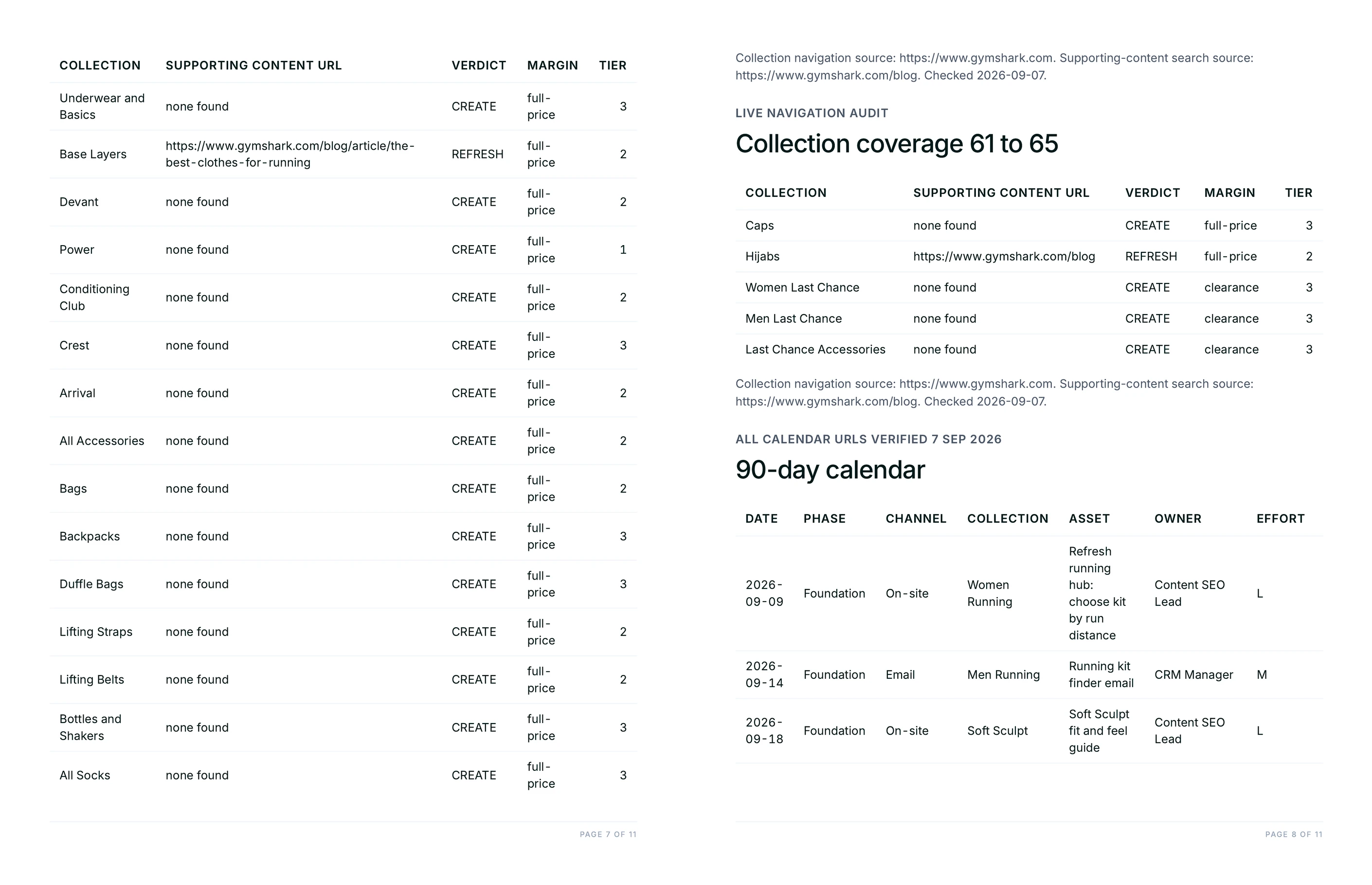
Most stores have a blog that grew around whatever was topical, not around what the catalog sells. This step walks the live collection structure and checks each one for supporting content: buying guides, fit and sizing help, comparison pages, care instructions, anything that answers a question before the shopper reaches the product grid. What comes back is a coverage table with one row per collection, the existing content and its URL where there is any, the words "none found" where there is not, and a verdict of create, refresh or leave alone. The gaps sitting against high-revenue collections are the ones worth funding first.

Prompt
Copy

Show me the coverage table on its own: every collection, the supporting content that already exists with its URL, and a create, refresh or leave verdict for each.

Try This Flow
3

How do you decide what to refresh instead of writing from scratch?

A refresh is cheaper than a new piece and usually ranks faster, but only when the existing page is close enough to save. This step takes the collections already marked refresh and says what specifically is wrong with each page: the questions it never answers, the products it links to that no longer exist, the sections that predate the current range. Each one comes back with the edit list and an effort estimate, so the team can compare a two-hour refresh against a full commission and spend accordingly. Work that already earns traffic gets improved rather than quietly replaced.

Prompt
Copy

Take everything marked refresh and give me the specific edit list for each page, with an effort estimate, so we can compare refreshing against commissioning new.

Try This Flow
4

How do you plan e-commerce content around peak trading dates?

Content that lands the week after a promotion has missed the trade it was written for. This step maps the plan onto the retail calendar in the client's markets: the promotional moments, the peak weeks, the shipping cutoffs, and the quieter stretches that suit evergreen guides. Every asset gets a publish date chosen against those dates rather than an even weekly drip, with lead time built in so a gift guide is live before people start buying gifts. Each collection also gets a margin posture, full price or clearance, and the clearance-led pieces stay capped so the calendar does not slide into a discount channel.

Prompt
Copy

Re-time the calendar against the UK and US retail dates in this window, with lead time before each peak, and cap clearance-led pieces at one in ten.

Try This Flow
5

How do you turn a content calendar into briefs the team can write from?

A calendar row names the piece; a brief is what a writer can start from on Monday morning. This step takes any set of rows and expands them into full briefs: the buyer question in the shopper's own words, the angle, the sections to cover, the collection and product pages to link out to, the pages that should link back, the word count, and the one metric the piece is accountable for. Briefs come back as a document the team can hand straight to a freelancer or an in-house writer, with the collection URLs already checked rather than assumed.

Prompt
Copy

Expand the first six weeks of the calendar into full writer briefs, each with the buyer question, the sections, the internal links in and out, the word count and the metric.

Try This Flow

Set up your client project: catalog map, existing content inventory, trading calendar, performance baselines

Keep one Project per client. The Flow reads the live store every time, so it works with an empty project, but the things a storefront cannot tell you are the ones worth storing: which collections carry the margin, what has already been published, when the client trades, and what the numbers looked like before this plan started. Add those once and every quarter after the first starts from a real baseline instead of a fresh guess.

What to add

Catalog and collection map

The collections that matter commercially, with margin posture and any that are being retired. A storefront shows every collection as equal. This file is what tells the calendar where the revenue actually sits.

Existing content inventory

The current guides, blog posts and landing pages with their URLs. With this in the project the audit marks refresh accurately instead of recommending a piece the client published last year.

Trading and promotional calendar

Peak weeks, promotional windows, launch dates and shipping cutoffs by market. This is what moves publish dates off an even weekly drip and onto the days the trade actually happens.

Performance baselines

Current sessions, conversion rate and revenue by collection, however rough. Targets set against a real baseline can be reviewed. Targets set against nothing cannot.

Brand voice guide

How the client sounds: tone, the words they use, the words they refuse. With this in the project, working titles and hooks arrive in the client's voice rather than a neutral one.

Guide Juma with project info

Each knowledge item takes a one-line description telling Juma what it is for. These are the descriptions that keep an audit from reaching for the wrong file.

  • Catalog and collection map: "Which collections carry the revenue and the margin. Weight the calendar by this, not by catalog size."
  • Existing content inventory: "Everything already published, with URLs. Check against this before recommending anything new."
  • Trading and promotional calendar: "When this client trades. Set publish dates against these moments with lead time."
  • Performance baselines: "Current numbers by collection. Set every target against these."
  • Brand voice guide: "How this client sounds. Match this tone in titles, hooks and body copy."
Juma Logo
Find the collections nobody has written about

Frequently Asked Questions

What does the e-commerce content strategy actually include?

Two files. A branded PDF holding the collection coverage audit, the content pillars, the phased 90-day roadmap and the measurement plan, and an editable CSV calendar with one row per planned asset carrying its publish date, buyer question, collection URL, internal links, owner, effort and metric.

The audit is the part teams tend to skip. Every collection is checked for supporting content that already exists, listed with its URL, and marked create, refresh or leave alone. That single column is what stops a quarter of budget going on a guide the client already published, and it is why the calendar reads as a set of decisions rather than a list of ideas.

The CSV is built to be worked in. It carries a status column, so the same file tracks the quarter rather than being replaced by a spreadsheet someone rebuilds by hand in week two.

How is this different from a content calendar template?

A template gives the team empty rows and the same pillar names every store gets. This Flow reads the client's live catalog first, so the calendar is built from their actual collections, their existing content and the questions their buyers ask, with every row pointing at a collection URL that was checked during the run.

The other difference is the demand layer. Each row names the buyer question it answers in the shopper's own words, which is what connects a piece of content to a commercial destination. A template cannot do that, because it does not know the catalog.

Strategy, taste, and judgment stay human. The Flow does the reading, the mapping and the arithmetic; which collections deserve the quarter's budget is a call the team makes with the audit in front of them.

What does Juma need to run the audit?

The client name and their store URL, and nothing else. The Flow reads the live collection structure and the supporting content around it during the run, so a first audit works with nothing prepared, no files uploaded and no analytics account connected. Everything beyond those two inputs is optional context.

Adding context sharpens it considerably. Naming the collections that carry the revenue changes where the calendar spends its weight. Giving the trading dates moves publish dates onto the days the client actually trades. Supplying current performance numbers turns targets from round guesses into figures that can be reviewed at the end of the quarter.

How does this compare to a strategist running the audit manually?

A strategist auditing a mid-sized catalog by hand spends most of a week clicking through collections, searching the blog for near-duplicates and building the coverage table before any strategy work starts. This Flow does that reading and mapping in one run, and hands the strategist the table to argue with.

Juma augments the team, it doesn't replace it. The judgment calls that decide whether the quarter works, which collections to back, which gaps are worth the money, what the brand is willing to say, stay with the people who know the client. Human review on every output, and the audit is easier to review than a blank page.

The practical gain is that the arguing starts on day one instead of day five, with sourced evidence rather than recollection.

Does this work for any store platform?

Yes. The Flow reads the public storefront, so the platform underneath it does not matter: Shopify, WooCommerce, Magento, BigCommerce or a custom build all present collections and content the same way to a reader. Nothing needs connecting and no export is required for the first run.

Marketplace-only sellers are the one case that needs care. If the range lives entirely on Amazon or Etsy with no owned storefront, there are no collection URLs to map content to, and the calendar should be pointed at the listings and the brand store instead. Say so in the prompt and the plan is built around those destinations.

Don't take our word for it

Ask AI about us

400+ marketing teams trust Juma. ChatGPT, Claude, and Perplexity know why. Ask them.

Ready when you are

What's on your plate today?

Start typing a task and Juma will figure out the rest.

Thank you! Your submission has been received!
Oops! Something went wrong while submitting the form.