Set up your client project: the new URL structure, the retirement list, and who signs off
Run one project per client and the migration stops being a cold start. A replatform is decided over months, and most of what the map needs is already written down somewhere on the account. Add it once and every pass of the ledger inherits it, which is the difference between a map that proposes destinations and a map that knows them.
What to add
The target URL structure
Whatever the new platform's path rules will be, even in draft: the collection and detail patterns, the locale prefix, the trailing-slash and casing conventions. Without it the destinations are informed guesses. With it they are real paths the team can test on staging.
The retirement and consolidation list
The pages the client already decided to kill or merge, with the reason. These are the rows that become 410s rather than redirects, and knowing them up front stops the map inventing a destination for a page nobody intends to keep.
Analytics and Search Console access notes
Which property covers which market, what the conversion events are called, and any known tracking gaps. The rollback triggers are only as good as the report behind them, and this is what lets the plan name a real source instead of a generic one.
Who signs what
The named owners for SEO, platform, content and each priority market. Every row carries an owner and a QA status, and an owner column filled with a job title nobody holds is how a launch gate quietly stops being a gate.
Guide Juma with project info
Each knowledge item takes a short description. One line is enough, and it tells Juma when to reach for that item instead of reasoning from the open web.
- Target URL structure: "The new platform's path rules, locale prefix and slug conventions. Use to build real destinations instead of proposed ones."
- Retirement list: "Pages already agreed for removal or merge, with reasons. Use to set 410 rows rather than inventing destinations."
- Analytics notes: "Which property covers which market and what the conversion events are called. Use to name the data source behind each rollback trigger."
- Sign-off owners: "The named people who approve SEO, platform, content and market decisions. Use to fill the owner column on every row."
Build the redirect map before the platform changes under you
Frequently Asked Questions
How is this different from an SEO migration checklist?
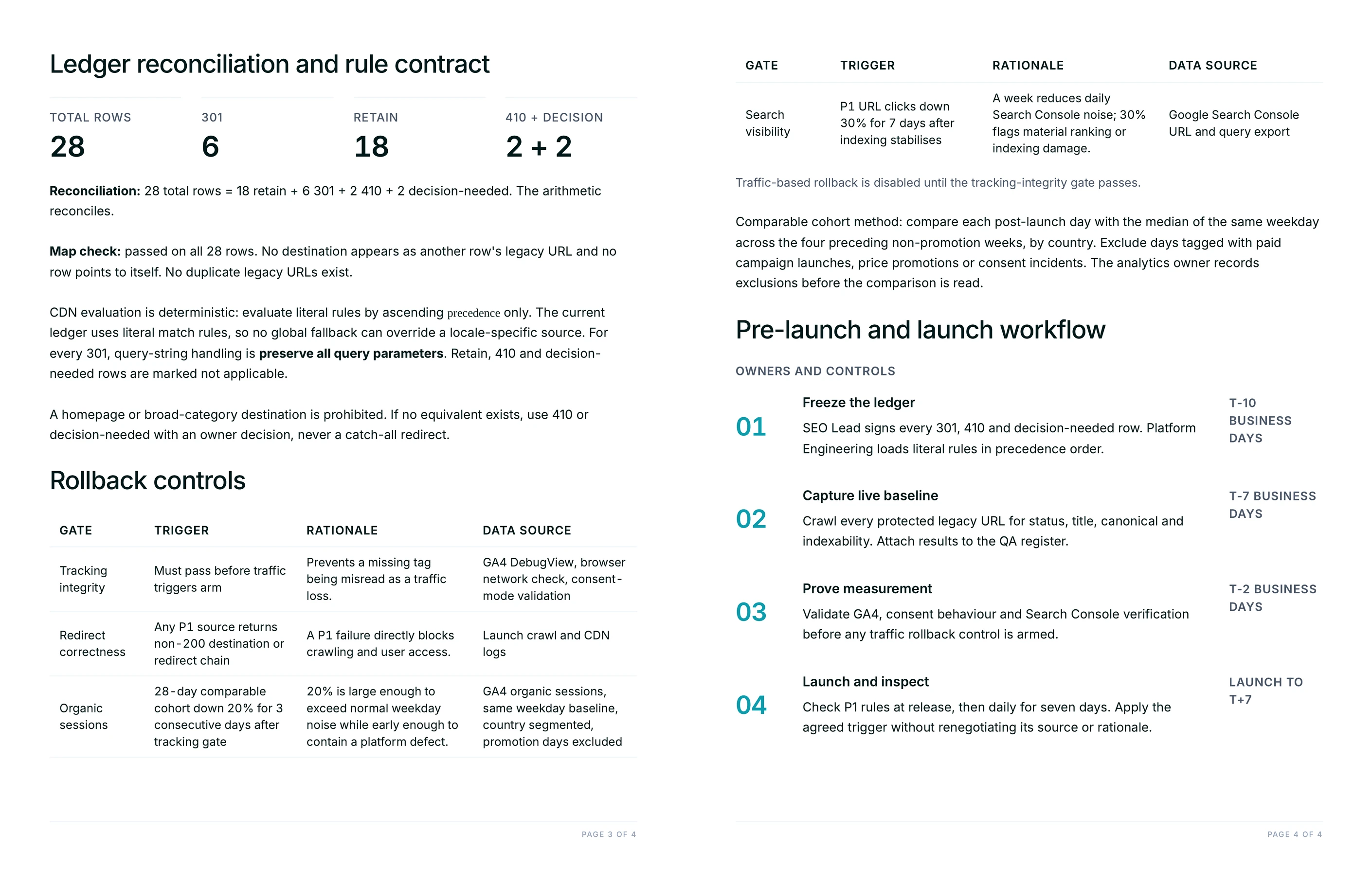
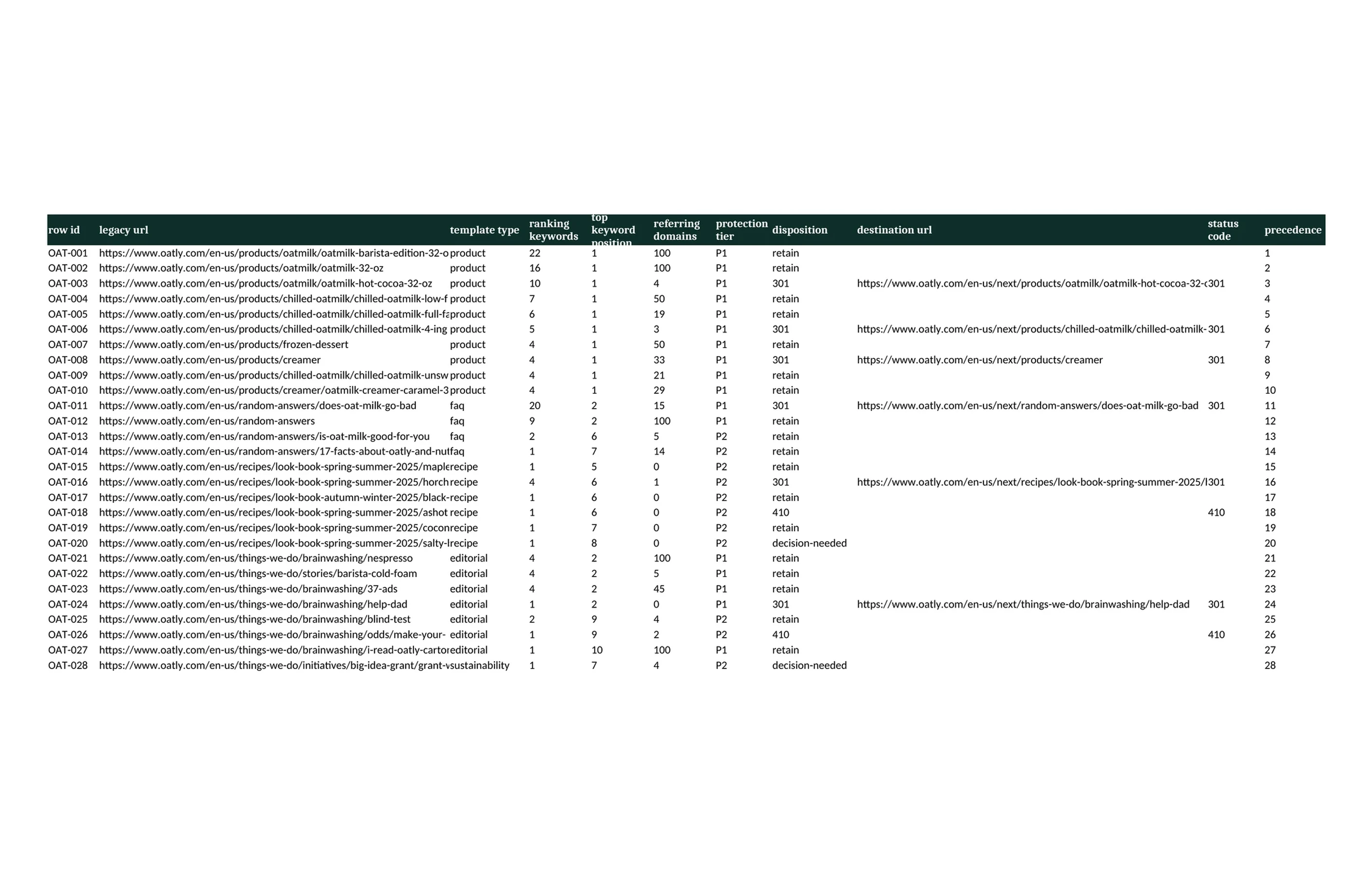
A checklist tells the team what to do. This produces the artifact itself: a CSV where every row is one URL that currently ranks, carrying the evidence for why it is protected, its disposition, its destination, and the fields the platform team needs to load it. The checklist is still in the PDF, as launch gates and a workflow with owners and dates, but it sits around the map rather than standing in for it.
The practical difference shows up in what can be checked. A checklist cannot be wrong in any way you can test. A map can: the four dispositions have to sum to the row count, no destination may be another row's source, no row may point at itself, and no source may appear twice. Those checks run against the file and come back as a pass or a list of row IDs, which is a different kind of confidence from a document everyone nodded at.
Strategy, taste, and the decision about which pages deserve to survive stay human. The flow handles the inventory, the evidence and the validation.
Does the map cover every URL on the site?
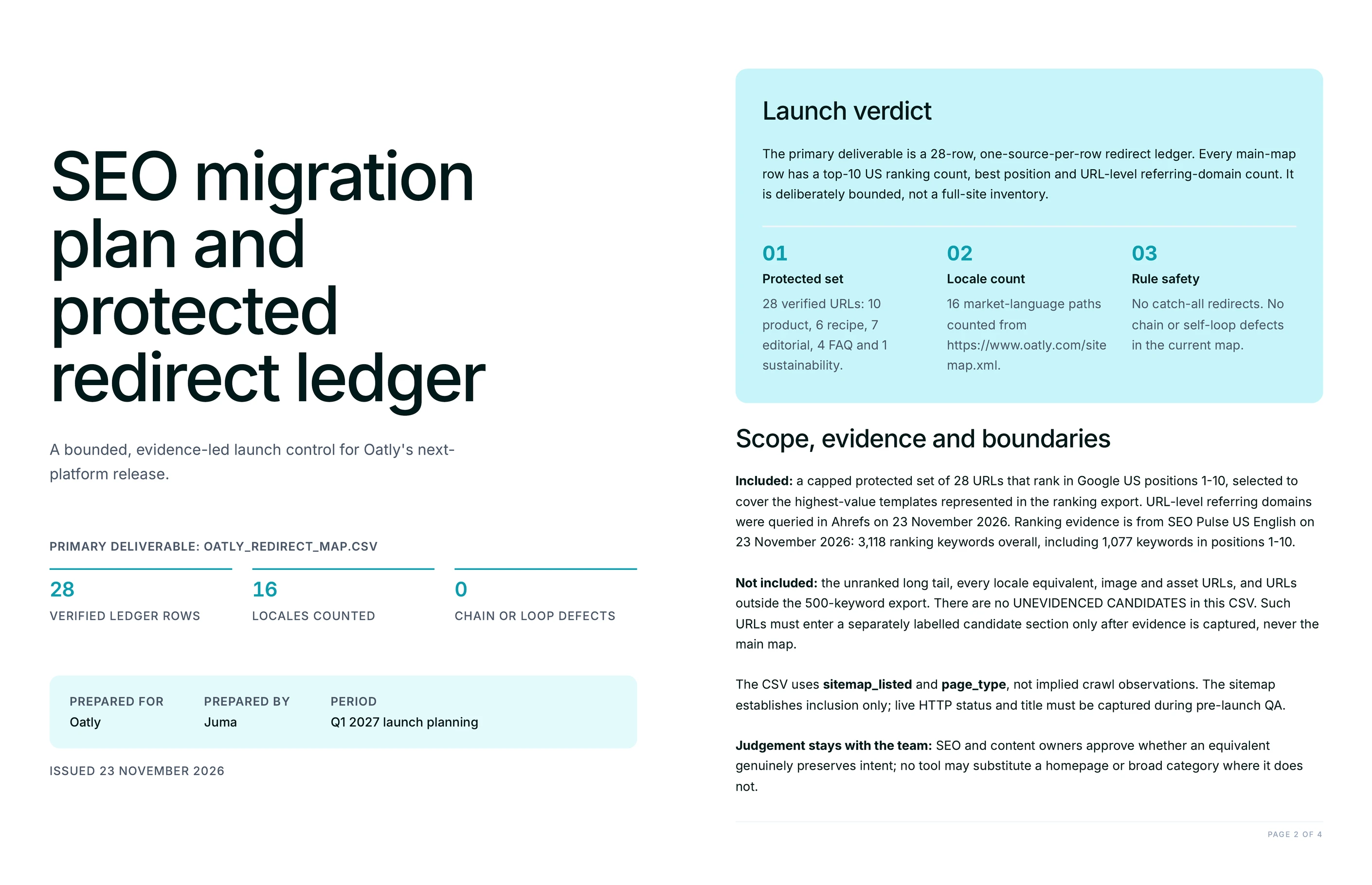
No, and it says so in the plan. It covers the protected set, meaning the URLs that hold a top-10 position and earn links today, spread across the templates that carry the value rather than concentrated in one. The scope section names what was included, what was left out, and the date and source of the ranking evidence behind it.
That boundary is deliberate. A full-site ledger for a large international site is a multi-week data exercise that needs CMS exports and server logs, and a map that claims to be complete while quietly guessing at most of its rows is more dangerous than one that states its limits. The flow produces the evidenced core, names the gap, and leaves the long tail as a scoped next step rather than a silent omission.
Where a URL belongs in the conversation but cannot be evidenced, it goes into a separate unevidenced candidates section with the reason, so it is visible without pretending to be verified.
What happens to pages with no equivalent on the new site?
They become a 410 or a decision, never a redirect to the homepage. A 410 is a deliberate statement that the content is gone, which search engines handle cleanly and quickly. Pointing a retired page at the homepage or a broad category to avoid showing a 404 produces a soft 404 instead, which is slower to resolve and tells search engines nothing true.
The rows the client still has to decide on are marked decision-needed with an empty destination and an owner against them, and they block launch for that URL until somebody answers. That is the honest state of those rows during a migration, and surfacing them as open decisions is more useful than filling the cell with a plausible guess that nobody reviews.
Can this run before the new URL structure is finalized?
Yes, and it often should. Run it early and the output is the protected set with evidence, the dispositions, and the destinations proposed from the current structure. That becomes the input to the information architecture conversation, because it shows which URLs the new structure has to account for before anyone starts drawing it.
Once the target structure exists, add it to the client project and run the flow again. The destinations firm up from proposals into real paths, and the rows that were decision-needed get resolved or confirmed. Teams that run it twice, once to scope and once to implement, get the better outcome, because the second pass inherits both the evidence and the decisions from the first.
Which parts still need a person?
Three, and the plan names them. Whether a proposed destination genuinely preserves what the visitor came for is a judgment the content owner makes, because two pages about the same product can serve different intents. Whether a page is retired at all is a commercial decision, not an SEO one. And the live status and title of each legacy URL should be captured in the pre-launch crawl, which is why the ledger marks what came from the sitemap rather than implying an observation it did not make.
Everything around those three is the part worth automating: pulling the ranking evidence, grouping it by URL, spreading the set across templates, running the arithmetic and the chain checks, and formatting the result so the platform team can load it. Juma augments the team, it does not replace it.