Set up your client project: the current price list, the real competitive set, and the objections
Run one project per client and the pricing work stops starting from scratch. Most of what a pricing decision needs is already somewhere on the account, in a deck, a sales call, or a renewal thread. Add it once and every pass inherits it, which is the difference between a recommendation drawn from public pages and one that also knows what this business can actually charge.
What to add
The current price list and plan structure
What the client charges today, including legacy plans still on the books, standard discounts, and annual terms. Without it the recommendation is a greenfield exercise. With it the output can say what moves, what stays, and who gets grandfathered.
The competitive set they actually lose to
The three or four names that come up in deals, not the ones that rank for the category. This is the single biggest lever on the quality of the teardown, because it decides the altitude of the market being compared and therefore where the anchor lands.
Win and loss notes where price came up
The deals lost on price and what the objection actually was: the headline number, the billable unit, the step between tiers, or the annual commitment. These become the questions the page has to answer rather than a generic set.
Floors, commitments and discount policy
The price the client will not go below, any contractual commitments, and what sales is allowed to give away. A market-defensible number that breaks a floor or a contract is not a usable recommendation, and these constraints are the part no public page can supply.
Guide Juma with project info
Each knowledge item takes a short description. One line is enough, and it tells Juma when to reach for that item instead of reasoning from the open web.
- Current price list: "Today's plans, prices, legacy tiers and standard discounts. Use to say what changes and who gets grandfathered."
- Competitive set: "The competitors this client actually loses deals to. Use to pick the teardown set and the market altitude."
- Win and loss notes: "Deals where price was the objection, and what the objection specifically was. Use to write the questions the page answers."
- Floors and commitments: "The price floor, contractual commitments and discount policy. Use to keep the recommendation inside what the business can charge."
Decide the pricing before you write the pricing page
Frequently Asked Questions
How is this different from writing pricing page copy?
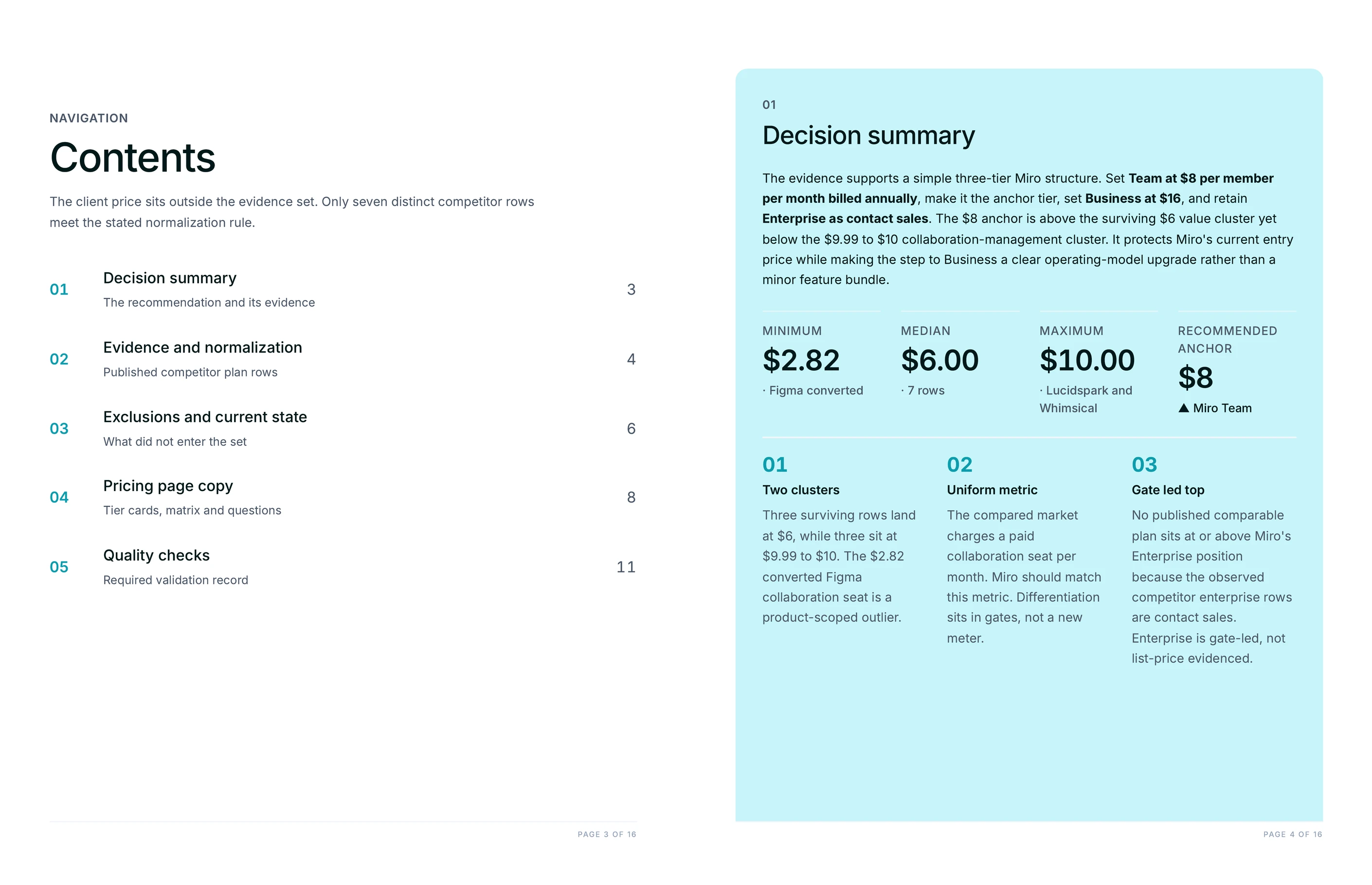
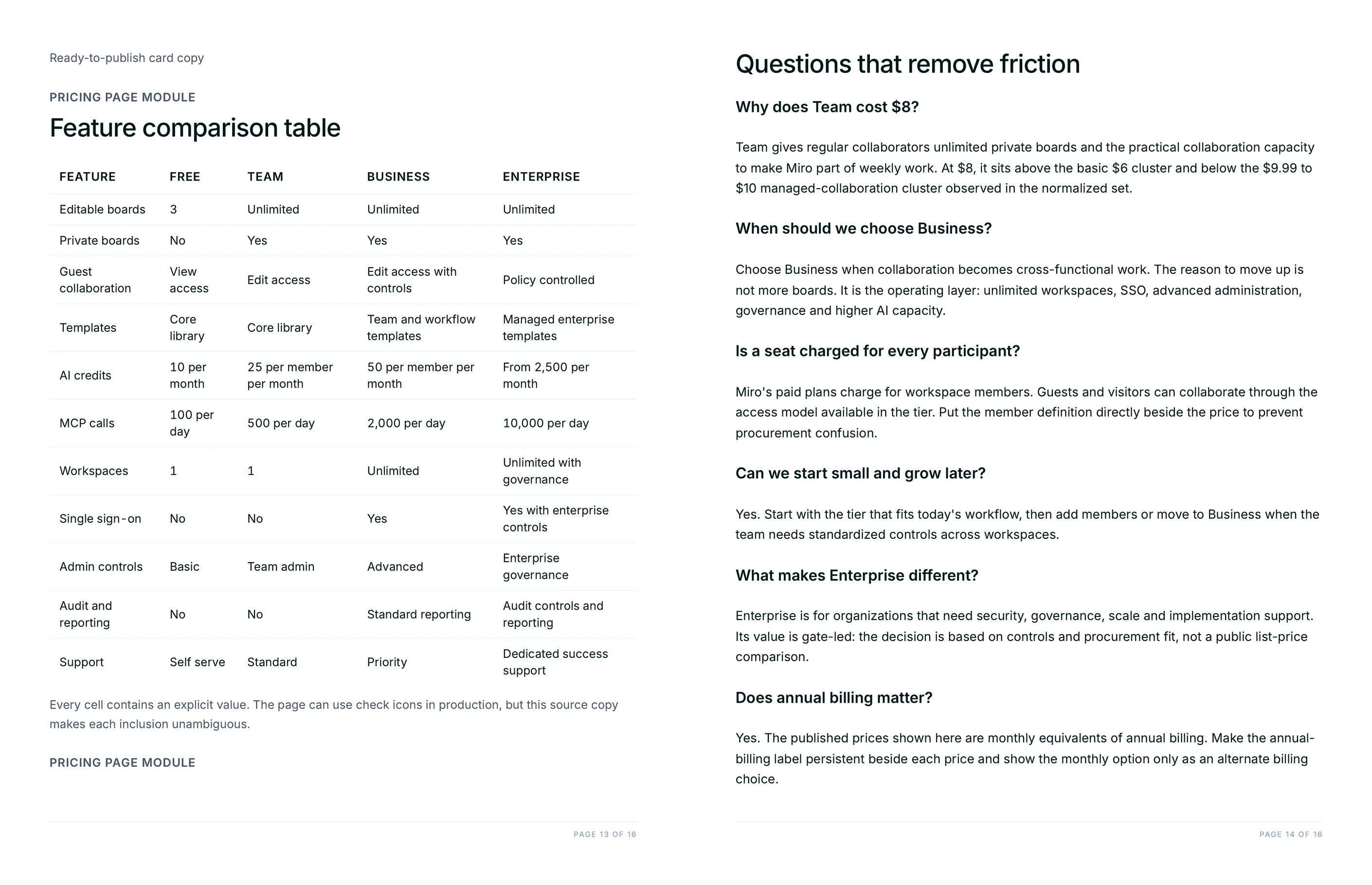
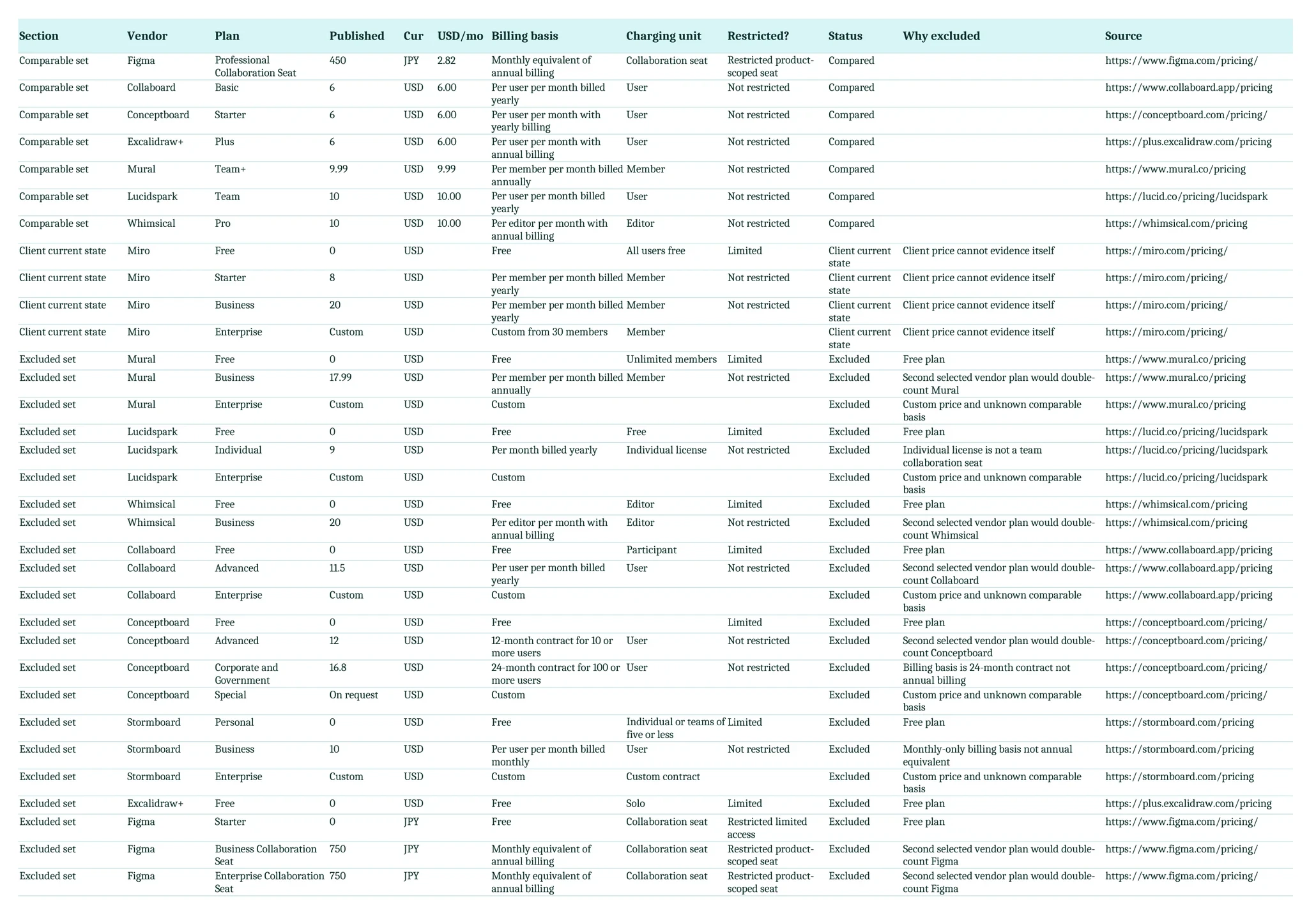
Copy work takes the tiers as given and makes them read better. This produces the decision first: a teardown where every competitor price has been converted to one currency and one billing basis so the numbers can honestly share a column, a three-tier architecture with the anchor named and the reason it is the anchor, and only then the page written against it. The copy is still there, in full, as tier cards, a comparison table and the questions. It just stops being the first thing decided.
The practical difference is that the recommendation can be checked. The entry prices get a printed minimum, median and maximum, so a claim about where the market clusters has arithmetic behind it. Tier prices have to strictly increase. Every feature row in the comparison table needs an explicit value for every tier. A price that cannot share a unit, a currency and a billing basis with the others is moved out of the comparison with the reason stated and counted, so an awkward competitor cannot be dropped quietly.
Strategy, taste, and the judgment about what this business is worth stay human. The flow handles the evidence, the arithmetic and the validation.
Does this decide what we should charge?
It produces a defensible recommendation, not a verdict. What the flow can do well is establish what the market actually charges, convert those prices into something comparable, compute where the cluster sits, and propose an architecture with the anchor justified against those numbers and against what each tier gates.
What it cannot see from public pages is margin, cost to serve, the sales motion, and the price the business has already committed to in contracts. Add the price floor and the current plan structure to the client project and the recommendation lands inside the range the business can actually charge. Without them, treat the output as the market case for a number rather than the number itself.
The useful discipline is that the file says which of the two it is. Where the top tier has no published comparable near it, it states that the tier rests on its gates rather than on list prices, which is an honest position and a very different claim from pointing at a competitor.
What if the client already has a pricing page?
Then run it as a challenge rather than a rewrite, and the first thing to watch for is the output simply describing what is already there. Asked plainly to write a pricing page, Juma will tend to restate the client's current plans back in better prose, which is accurate and changes nothing.
The prompt in Step 1 avoids that by asking for the architecture to be decided from evidence before any copy is written, and by requiring the value metric to be compared against the evidenced competitors. If the recommendation comes back identical to the current structure, that is a real answer worth having, and it arrives with the market evidence that supports keeping it.
How current is the competitor pricing, and what happens when it changes?
Every row carries the source URL it came from and the date it was captured, because published prices move and a teardown with no date is a liability in a client conversation. The prices are read from the vendors' own pricing pages at the time the flow runs, not from a cached list.
Two habits keep it useful. Re-run the flow before any pricing conversation that matters, since a competitor changing a plan gate is the kind of thing that invalidates an anchor. And check the rows where a vendor publishes in a local currency, because those carry a conversion with a stated rate and date, and the rate is the part that ages fastest.
Which parts still need a person?
Three, and the output names them. Whether two plans are genuinely comparable is a judgment call, because a per-host price covering twenty participants and a per-editor price are different products wearing similar numbers, and the flow flags the mismatch rather than resolving it. Whether to match the market or deliberately sit above it is a positioning decision, not an analytical one. And the floor, the margin and the discount policy come from the business.
Everything around those three is worth handing over: reading the pricing pages, converting the prices onto one basis, computing the cluster, building the tier matrix with no gaps, running the comparability checks and writing the page against the result. Juma augments the team, it does not replace it.